

[Exclusive] Samsung Electronics formalizes historic largest shareholder return in the 100th trillion won era... "More next year"
Samsung Electronics is set to convene its board of directors by the end of this month to finalize and announce a shareholder return policy, which will be the largest in history for a domestic company, reaching the 100th trillion won range. This move comes amid an unprecedented boom in the semiconductor industry, where the company has been setting quarterly earnings records, with the clear intent of adhering to the principle of sharing its success with its owners, the shareholders.
According to relevant industry sources on the 20th, Samsung Electronics plans to convene its board of directors by August to approve major shareholder return measures, including a special cash dividend. The scale of the return is reported to exceed 100 trillion won. This marks another record-level shareholder return policy, following SK Hynix's announcement the previous day of a 40 trillion won share buyback and cancellation.
First, half of the free cash flow (FCF) is allocated to returns. While some segments of the securities industry have mentioned shareholder returns as high as 200 trillion won, the prevailing view is that this is unrealistic when considering the increasingly expanding amount of facility investment. Samsung Electronics spent more than 55 trillion won on research and development (R&D) and facility investments alone in the first half of the year; unlike operating profit, which reflects only costs and depreciation, FCF deducts equipment purchase costs in full.
An industry insider stated, "Regardless of Wall Street speculation, formalizing a shareholder return in the range of 100 trillion won is a watershed moment for enhancing shareholder value," and added, "Given that performance is expected to improve further next year, the absolute amount of shareholder return corresponding to '50% of FCF' will be significantly larger."
The specific measures are expected to center on cash dividends. In the case of SK Hynix, SK Square prefers share cancellation, which can increase its stake ratio, as it is required under the Monopoly Regulation and Fair Trade Act to secure a certain percentage of shares. On the other hand, Samsung Electronics favors a dividend approach because it is more helpful for corporate governance management. Under the "Act on Structural Improvement of the Financial Industry" (Financial Separation Act), if share cancellation increases Samsung Electronics' stake in Samsung Life Insurance and Samsung Fire & Marine Insurance, the burden will increase accordingly.
Samsung Electronics plans to continue reviewing additional shareholder returns by monitoring performance fluctuations, including cash flow, even after this announcement. The company also appears to hold the view that, having become a national company with retail shareholders reaching 8 million (7,971,242 as of the end of June), its stock price remains undervalued for not properly reflecting its performance.
Earlier, Samsung Electronics stated in its earnings announcement at the end of last month that "the current board of directors and management are actively discussing concrete implementation plans for this year's shareholder return policy, including a special dividend," and added that they would "prepare measures to secure an optimal balance between maximizing the effect of enhancing shareholder value and reinvesting for future growth purposes, and will share these with shareholders soon."
“Releasing the Cash Vault”: Why Samsung’s “Dividends” and SK’s “Buybacks” Differ in Shareholder Return Methods
Samsung Electronics and SK Hynix are amassing massive cash reserves as they ride the AI (artificial intelligence) memory supercycle. While both companies are focusing on expanding shareholder returns based on record-breaking earnings, their approaches to distributing funds appear to differ. Samsung Electronics is placing relatively more emphasis on dividends, while SK Hynix is leaning toward share buybacks for cancellation. This divergence stems from each company being subject to the "10% rule" and "20% rule" under relevant laws, respectively.
According to the semiconductor industry on the 20th, Samsung Electronics is expected to soon announce a shareholder return policy utilizing 50 percent or more of its free cash flow (FCF). The scale of the return is reported to exceed 100 trillion won this year alone, marking the highest level in history.
Samsung Electronics recorded sales of 305.37 trillion won and an operating profit of 146.72 trillion won in the first half of this year. The Device Solutions (DS) division, which is responsible for semiconductor operations, alone generated an operating profit of 142.86 trillion won. As of the end of June, its net cash holdings reached 167.59 trillion won. This is why attention is focused on shareholder returns.
◇Samsung Electronics Financial Subsidiaries Subject to Financial Services Act's '10% Rule'.. Outlook Centered on Dividends
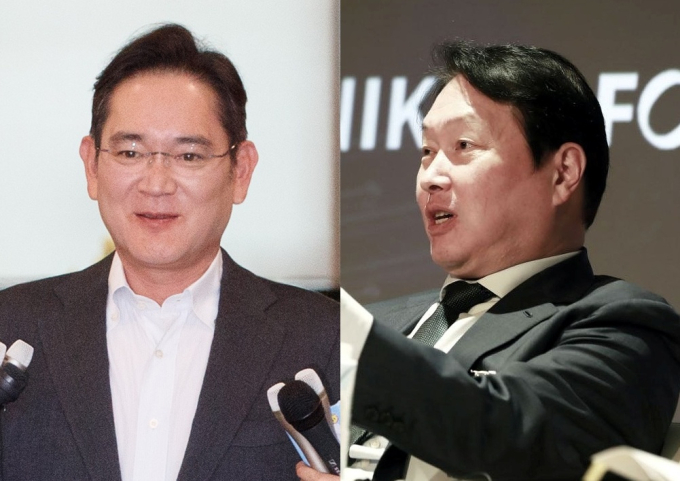
The enhancement of shareholder value through an aggressive shareholder return policy was driven by the will of the chaebol leaders. The Samsung Group, which has long emphasized "management principles," set aside 50% of free cash flow (FCF) as a source for shareholder returns early on, establishing clear benchmarks. Even in recent controversies over "N% performance bonuses," the insistence on full stock-based compensation rather than cash payments reflected Chairman Lee Jae-yong of Samsung Electronics' determination to uphold these principles and minimize concerns about the erosion of shareholder value.
The same applies to SK Group, which places the very purpose of a company on "the happiness of its members." Choi Tae-won (Chairman) has previously stated that "the prerequisite we believe in is that stakeholders (such as shareholders) must be happy together."
However, the specific method of shareholder return is expected to be differentiated. Industry and capital market observers anticipate that Samsung Electronics' shareholder return will focus on cash dividends, including regular and special dividends. In its 2024–2026 shareholder return policy announced in January 2024, Samsung Electronics committed to returning 50% of free cash flow (FCF) to shareholders over three years and implementing an annual regular dividend of 9.8 trillion won. The remaining funds after the regular dividend will be utilized for special dividends, share buybacks, or cancellations.
The reason for expecting greater emphasis on cash dividends is the "10% rule" under the Act on Structural Reform of the Financial Industry (Financial Sector Separation Act). Under this law, Samsung Life Insurance and Samsung Fire & Marine Insurance, as financial group affiliates, are permitted to hold up to 10% of Samsung Electronics shares in total. As of the end of June, Samsung Life Insurance held 8.51% and Samsung Fire & Marine Insurance held 1.49%, collectively reaching the limit.
If Samsung Electronics retires its treasury shares, the total number of issued shares will decrease, causing the ownership percentages of Samsung Life and Samsung Fire & Marine Insurance to rise. This means that for financial group companies to maintain their 10% limit, they must offer an equivalent amount of Samsung Electronics stock to the market. In fact, when Samsung Electronics announced a plan in March to retire 73.36 million ordinary shares, Samsung Life and Samsung Fire & Marine Insurance disposed of approximately 1.5 trillion won worth of Samsung Electronics stock via block deals (after-hours large-volume trading) to align their ownership percentages.
When treasury shares are retired, Samsung Life Insurance and Samsung Fire & Marine Insurance must continue to sell their holdings accordingly. While the combined stake will remain at around 10%, the actual number of shares held will decrease. This is a concern because it means the financial affiliates, which serve as the core link in the Samsung Group's corporate governance structure, will hold fewer shares of Samsung Electronics. This explains why analysts argue there is relatively little incentive to significantly increase the proportion of treasury share retirements.
The fact that Lee (Chairman) and other members of the founding family directly hold Samsung Electronics shares also has an impact. When minority shareholders receive dividends, the structure is such that Lee (Chairman) and others receive dividends as "the same shareholders." On a common stock basis, △Chairman Lee Jae-yong holds 1.67%, △Hong Ra-hee, Honorary Chairman of the Leeum Museum of Art, holds 1.25%, △Lee Seo-hyun, Samsung C&T's Strategic Gi Hoek-dam-dang (President), holds 0.78%, and △Lee Boo-jin, Chairman of Hotel Shilla, holds 0.71% of Samsung Electronics shares.
◇ SK Hynix to retire 40 trillion won worth of treasury shares, increasing stake in SK Square
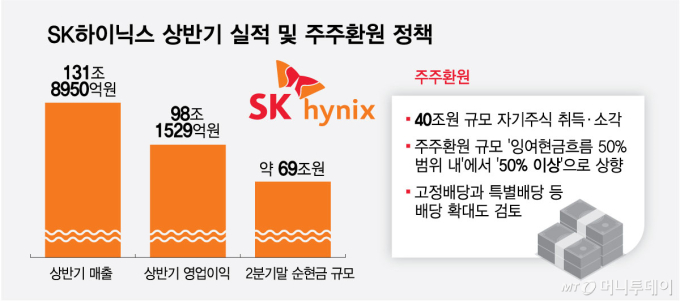
SK Hynix is in a different situation. SK Hynix announced on the previous day (the 19th) that it would acquire its own shares worth 40 trillion won (24.07 million shares) and cancel all of them. This amount corresponds to approximately 3.3% of total issued shares. At the same time, the company strengthened its shareholder return benchmark for cumulative free cash flow from 2025 to 2027 from "within 50%" to "50% or more."
The driving force behind the massive shareholder return is record-breaking performance. SK Hynix posted an operating profit of 98.15 trillion won in the first half of this year alone. Net cash, which stood at 35 trillion won at the end of the first quarter, nearly doubled to 69.4 trillion won by the end of the second quarter within just three months.
SK Hynix's share buyback and cancellation has another effect beyond shareholder returns. The largest shareholder, SK Square, is subject to the "20% rule," which requires it to hold at least 20% of SK Hynix shares to maintain its status as a holding company under the Monopoly Regulation and Fair Trade Act. When shares are cancelled, the number of shares held by SK Square remains unchanged, but the total number of issued shares decreases, thereby increasing its ownership stake.
SK Square's current stake in SK Hynix stands at 20.00%, touching the legal minimum threshold. If the 24.07 million shares announced for cancellation are fully retired, SK Square's stake would rise to approximately 20.68% under a simple calculation. This creates room to meet the 20th% requirement without any additional share acquisition.
This could also be utilized as a buffer to issue additional American Depositary Receipts (ADRs) in the future. If SK Hynix constructs ADRs through new share issuance, similar to last month, the total number of issued shares will increase, thereby reducing SK Square's stake. The scale of the ADR issuance conducted last month also took into account the constraint that SK Square must maintain a 20% stake.
With this share buyback and cancellation, SK Square's stake will rise to 20.68%, creating room for additional issuance of new shares in the form of ADRs in the future. This is because the company can issue new shares equivalent to the number of shares cancelled. By repurchasing and cancelling its own shares when the stock price is relatively undervalued, and then issuing new shares at a time when corporate valuation has increased, the company can improve capital raising efficiency from its perspective.
Unlike Samsung Electronics, the SK Group's founding family has virtually no direct shareholding in SK Hynix either. The only instance was when SK Group Chairman Choi Tae-won purchased 3,620 shares of SK Hynix for approximately 4.8 billion won at the end of last month.
An SK Hynix official said, "We will pursue additional shareholder returns by simultaneously repurchasing and retiring shares and paying dividends, taking into account cash flow, market conditions, and distributable profits during the policy period," adding that "specific scale and methods will be announced at the time of the third-quarter earnings release."
Samsung ties up while Hynix loosens... Different calculations for performance-based stock compensation
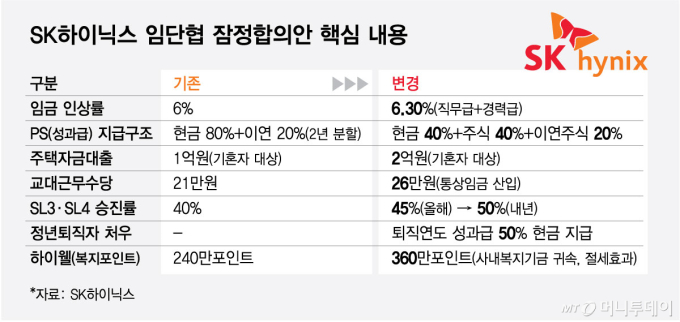
SK Hynix's labor and management agreed to pay 60 percent of the excess profit distribution (PS) in the form of treasury shares, a result of reconciling the interests of the company and the union. The company secured the principle of stock-based compensation while also establishing a mechanism to offset losses in case of price declines by not imposing sell restrictions on the 40th percent of treasury shares distributed in that year. This effectively lowered the shareholding conditions compared to Samsung Electronics, increasing the likelihood of acceptance by the labor union.
According to the electronics industry on the 20th, the tentative agreement on the 2026 wage and collective bargaining agreement (W&C) prepared by SK Hynix management and labor includes provisions to pay 40% of PS in cash and 60% in company stock. Of the company stock, 40% will be paid out in the current year, while the remaining 20% will be deferred and paid at 10% each over years one and two.
SK Hynix reported sales of 131.895 trillion won and an operating profit of 98.1529 trillion won in the first half of this year, marking a record-high performance. Securities firms project that annual operating profit will reach 250 trillion won. Based on this figure, a simple calculation indicates that PS funding amounts to 25 trillion won, representing 10% of the operating profit. Under the tentative settlement agreement, 20 trillion won of this amount will be provided in cash and treasury stock during the current year, while the remaining 5 trillion won equivalent will be deferred over the next two years.
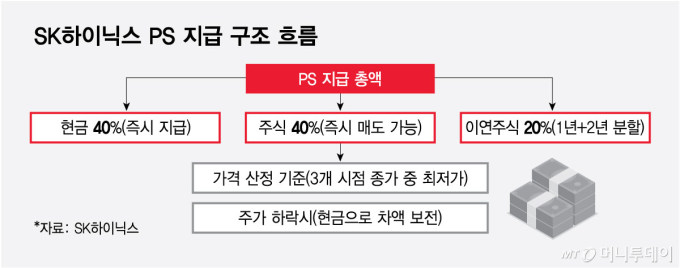
The background behind the union accepting the company's proposal as such lies in expectations for future performance and stock prices. If a cash-based compensation system is converted into stocks, employees' compensation can be linked to corporate valuation. When stock prices rise, employees can share in the gains. Conditions have also been put in place to lower risks associated with the stock conversion. Of the company shares paid out in the current year, 40% can be disposed of immediately. The stock calculation price applies the lowest amount among the closing price on the day of management performance announcement, the cash payment date for PS, and the stock payment date. If the value of the stocks falls short of the PS payment amount based on the closing price on the first day after company shares are paid out, the difference will be compensated in cash.
This differs from the share-based performance compensation Samsung Electronics established last May. Samsung Electronics paid the entire special management performance bonus for its Device Solutions (DS) division in company shares, allowing only one-third of the distributed amount to be sold immediately. The remaining portions were subject to sales restrictions for one and two years, respectively. This standard will apply to payments made from 2027 onward. The design aims not only to link compensation to stock prices over an extended period but also to prevent employee turnover.
On the other hand, SK Hynix imposes no sell restrictions on the 40th percent of its stock buyback allocation, making it a weaker incentive for long-term retention compared to Samsung Electronics. The effect of linking stock compensation to long tenure in order to prevent talent attrition is also limited. Instead, given that the company had to shift from an existing cash-based PS system to stock compensation, it can be seen as having opted to increase liquidity options to reduce the burden on employees. In 2027, allowing employees to convert up to 40 percent of their stock buyback allocation into cash if they wish serves as a buffer measure during the transition to the new system.
An industry insider stated, "The company has secured the principle of linking performance bonuses to stock prices, and from the employees' perspective, it has fully ensured the flexibility to cash out even if they receive compensation in stocks." The insider added, "The weaker selling restrictions compared to Samsung Electronics can be viewed as a compromise reached between labor and management to transition the existing cash-based compensation system into stock."
SK Hynix, Unlocks 40 Trillion Won and Adds Another 181 Trillion Won? ... "Stock Price, Having Hit Bottom, Rises Again"
Global investment bank JPMorgan has observed that SK Hynix may announce additional shareholder returns totaling at least $130 billion (approximately 181 trillion won) by next year.
According to Bloomberg on the 20th, analyst Jay Kwon stated in a report that "the key takeaway from the 40th trillion won share buyback announcement released on the 19th is that SK Hynix has decided to raise the cap on shareholder returns."
SK Hynix announced a change in its policy, shifting from the previous "up to 50%" target to committing more than half of its cumulative free cash flow (FCF) from 2025 through 2027 toward shareholder returns. Analyst Kwon analyzed that this decision implies an additional shareholder return of at least 18.1 trillion won by next year, beyond the plans already announced. This scale corresponds to 16% of its current market capitalization and is expected to support the stock price floor following the recent sharp decline.
Analyst Kwon wrote, "We believe the most difficult period has passed and expect stock prices to gradually improve from a medium-to-long-term perspective, so we recommend buying." He also evaluated that this share buyback announcement was made faster than market expectations.
Since announcing its plan to buy back and retire up to 24 million shares, SK Hynix's stock price surged nearly 13% during trading on the 20th. The company stated that this share retirement will be the largest in the history of South Korean listed companies.
On this day, SK Hynix's rebound drove the KOSPI index, and shares of major competitor Samsung Electronics also rose nearly 10% in the morning on expectations of shareholder returns. Bloomberg quoted the report, stating that "MoneyToday cited an anonymous industry source saying Samsung Electronics plans to finalize and announce a shareholder return program exceeding 100 trillion won after this month's board meeting." ☞Related article ([Exclusive] Samsung Electronics officially formalizes historic maximum shareholder return in the 100th trillion won era... "More next year")
Bloomberg assessed that expectations for this additional shareholder return are expected to help revive the recent downward trend in South Korea's memory semiconductor stocks. SK Hynix shares remain down more than 40 percent from their peak recorded last June.

 in INDUSTRY


