

The expansion of the ESS (Energy Storage System) market is not a trend unique to Korea. As AI (Artificial Intelligence) data centers spread, power demand has surged, leading to growing instability in the power grid. In this context, ESS linked with renewable energy is emerging as an alternative solution to address these issues.
The region where the ESS market is growing fastest is undoubtedly the United States. With the growth of AI-related industries including data centers, power demand is skyrocketing. Consequently, ESS linked with renewable energy such as solar and wind power, which can supplement the power grid, is establishing itself as a core pillar of power infrastructure. This is also the context in which market research firm Wood Mackenzie forecasts that the U.S. ESS market will grow to about four times its current size by 2031.
Domestic battery companies are responding quickly. With sluggish demand for EV batteries putting pressure on utilization rates and profitability, ESS is offsetting weak sales performance. In fact, as of the second quarter this year, the share of ESS in revenue has expanded to 28% for LG Energy Solution and 20% for Samsung SDI.
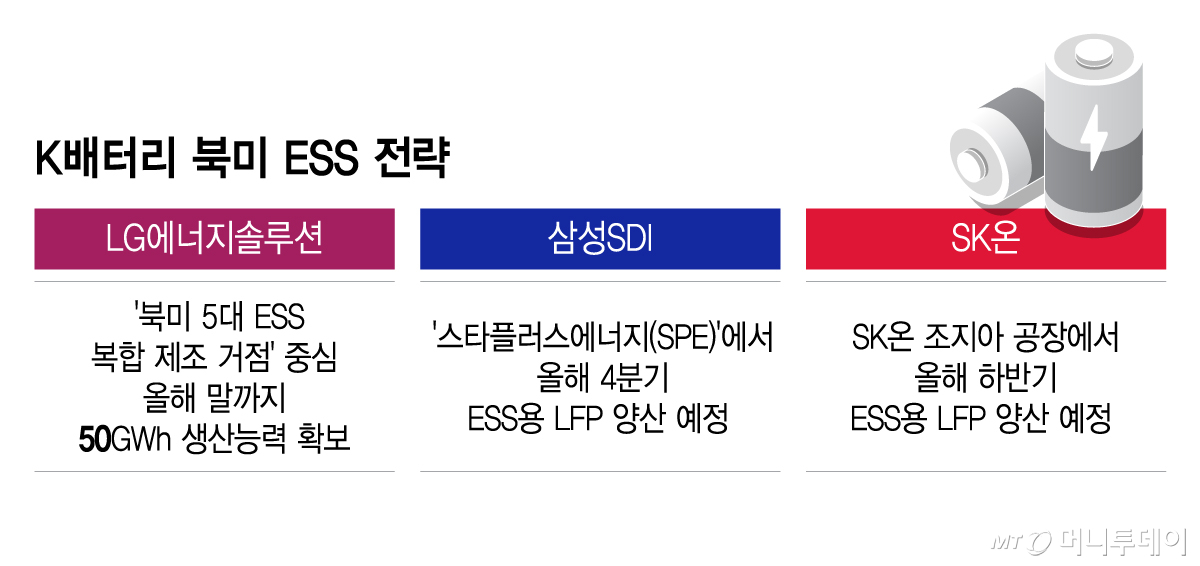
Investment by domestic battery companies in North American ESS is also accelerating. LG Energy Solution plans to establish 'five major North American ESS complex manufacturing hubs' at its Michigan Holland and L-H Battery Company Ohio plants, Ultium Cells Tennessee, Michigan Lansing, and Canada NextStar Energy Ontario facilities, securing production capacity of over 50 GWh (gigawatt-hours) by the end of this year. Currently, all factories are operating in Yangsan, with the goal of securing profitability for the ESS business itself, excluding the U.S. Inflation Reduction Act's Advanced Manufacturing Production Tax Credit (AMPTC), as of year-end.
Samsung SDI is also proceeding with converting existing production facilities to ESS. It will convert part of the electric vehicle production line at its Indiana plant, a joint venture with global automaker Stellantis called StarPlus Energy (SPE), to begin producing LFP batteries for ESS from the fourth quarter this year. This plant has been producing NCA-based ESS batteries since the fourth quarter of last year.
SK On is focusing on penetrating the North American ESS market. It is converting part of its Georgia plant's electric vehicle battery production line into an LFP (lithium iron phosphate) battery production line for ESS and will begin operations in Yangsan from the second half of this year. Additionally, it has secured sole operating rights for Blue Oval SK (now SK On Tennessee), which was previously operated as a joint venture with Ford. Industry sources expect this facility to also serve as a production hub supporting future expansion of the ESS business.

 in INDUSTRY
