

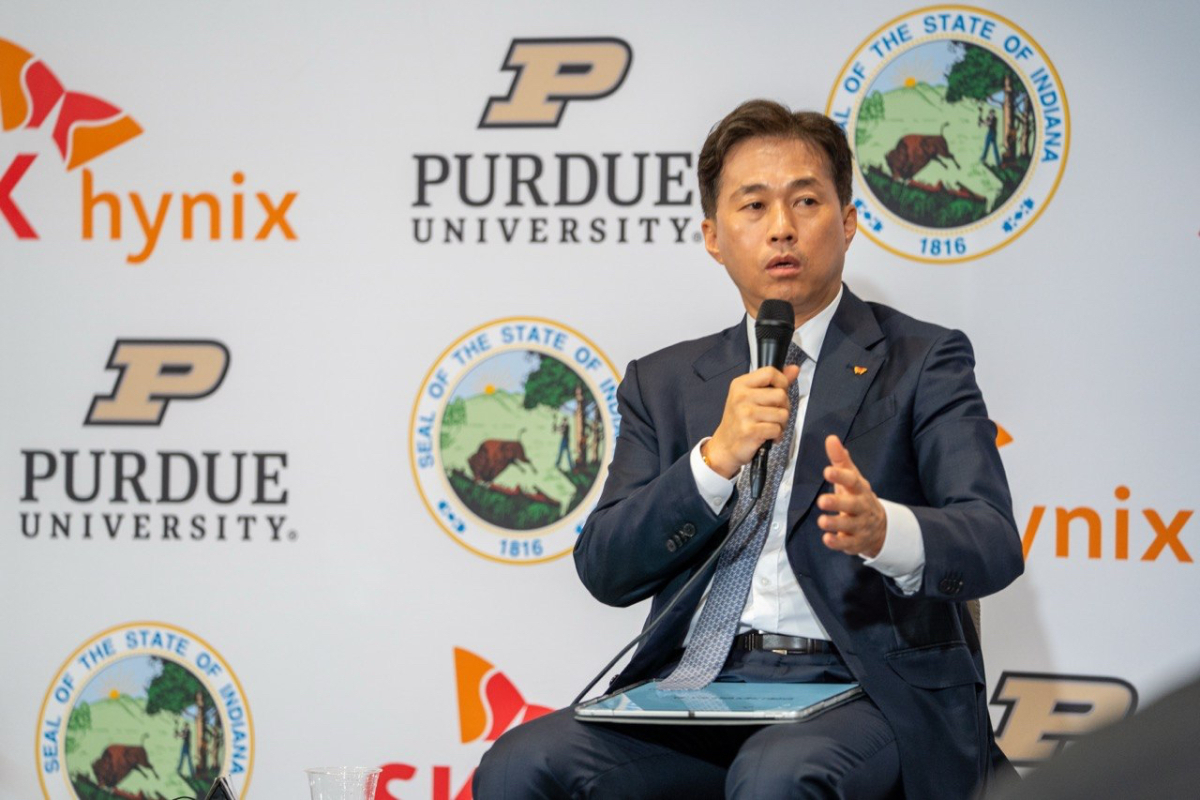
Kwak No-jung, CEO of SK Hynix, projected that the shortage of memory semiconductors driven by the spread of AI will continue until the end of 2030. He also noted that as customized products such as HBM (High Bandwidth Memory) increase, the future memory market downturn will differ from past trends. Regarding additional investment plans in the US, he reaffirmed the company's existing stance that it can consider investing anywhere that meets necessary conditions.
CEO Kwak made these remarks at a press conference following the groundbreaking ceremony for SK Hynix's advVance package fab (factory) held on the 27th (local time) in West Lafayette, Indiana. The Indiana fab is scheduled to begin producing seventh-generation HBM (HBM4E) in Yangsan starting in the second half of 2029.
CEO Kwak stated, "No one can precisely predict how long the supply shortage will last, but there are currently no clear signs of an economic downturn. We expect the supply shortage to continue until the end of 2030." He emphasized, "While AI may eventually peak or another downturn may occur, the next downturn will differ from what we have experienced over the past few decades."
CEO Kwak believes that the business structure of the memory industry itself is changing in the AI era. In the past, the industry relied on mass-producing general-purpose memory products, making demand forecasting difficult and leading to repeated price crashes due to oversupply. In contrast, HBM is co-developed with customers' AI accelerators and systems, allowing for more accurate demand prediction.
CEO Kwak explained, "In the past, companies competed in the same market by increasing production volumes, making it difficult to accurately predict demand and adjust production levels appropriately." He added, "In the AI era, business models are shifting from 100% general-purpose products to partially customized or fully customized products."
He further stated, "Customers and SK Hynix must collaborate to co-develop next-generation memory chips and maximize system performance. This allows us to predict market demand more easily than before, and even during a downturn, demand may decline gradually or remain stable rather than dropping sharply as in the past."
The possibility of additional investment in the US remains open. Regarding further investment in the US, CEO Kwak said, "Nothing has been decided yet, but we are open to investing anywhere that provides sufficient resources such as power, funding, and subsidies." On the US government's requirement for front-end process investments, he added, "We are considering any location worldwide that offers customers new business opportunities. If the conditions proposed by the counterpart are met, we would like to bring more good news to the AI industries in the US or other countries."
Regarding whether SK Hynix will continue to maintain its stake in Kioxia (formerly Toshiba Memory), a Japanese NAND flash company, he drew a line by stating, "There is no concrete or finalized plan yet." However, he emphasized, "We aim to contribute to the Japanese semiconductor industry just as we do for the US AI industry. Since we are already investing in Japan, similar to the US, we believe it is our responsibility to contribute to that community and nation."
SK Hynix also plans to expand investments related to AI. The company intends to utilize an AI firm established in the US last January as a platform for investing in relevant startups and companies. CEO Kwak said, "We are currently focusing on AI-related startups and companies that can create synergies with our existing businesses." He added, "I believe the core memory business must collaborate or, in some cases, merge with other business areas."

 in INDUSTRY
