

Hanwha Aerospace is accelerating its aviation business by investing more than 200 billion won in its U.S. subsidiary responsible for commercial aircraft engine parts.
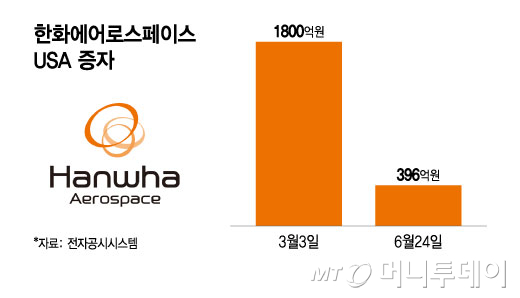
According to industry sources on the 28th, Hanwha Aerospace invested approximately 220 billion won in its U.S. subsidiary, Hanwha Aerospace USA, during the first half of this year alone. It injected 180 billion won on the 18th and 39.6 billion won in June. Both investments were made through a rights offering (paid-in capital increase) conducted by Hanwha Aerospace USA, with Hanwha Aerospace participating at 100%. As of the beginning of this year, an amount equivalent to twice the book value of Hanwha Aerospace USA (177.7 billion won) flowed in within three months.
Hanwha Aerospace USA serves as a key base for manufacturing and supplying engine parts for commercial aircraft. Major customers are known to include global engine manufacturers such as Rolls-Royce and GE. In particular, Hanwha Aerospace is considered a core hub in the international joint development project for GTF (Geared Turbofan) commercial aircraft engines with U.S.-based Pratt & Whitney (P&W), which has been underway since 2015. This signifies an important foothold for Hanwha Aerospace, currently focused on aircraft engine parts, to expand its business into complete aircraft engine products in the future.
Hanwha Aerospace is also actively participating in government-led aircraft engine development projects for the same reason. Last month, it unveiled prototypes of a 5,500-pound-force (lbf) class turbofan engine for low-observable unmanned drone swarms developed with domestic independent technology and a 1,400-horsepower class turboprop engine for medium-altitude drones. In the future, it plans to pursue development of advanced aircraft engines targeting installation in stealth drones with a thrust of 10,000 pounds and next-generation fighters including the KF-21. Previously, Hanwha Aerospace has accumulated engine development and production capabilities by resolving over 1,000 trial-and-error issues through more than 10,000 engine test runs and has also built a database (DB) of approximately 35,000 data points on materials for aircraft engines.
Expanding Hanwha Aerospace's stake in KAI (Korea Aerospace Industries) is also expected to strengthen its aviation business expansion strategy. As of early this month, Hanwha Group holds a 15.89% stake in KAI. Initially, Hanwha planned to inject an additional 500 billion won through Hanwha Aerospace by the end of this year to increase its KAI stake into the 8th% range. After deciding on additional investment in June, it raised Hanwha Aerospace's KAI stake to over 9%, while Hanwha Systems also began purchasing shares on the open market. Along with expanding its KAI stake, Hanwha changed the purpose of its shareholding from "simple investment" to "management participation."
An industry official stated, "Given that Hanwha is expanding its stake in consideration of business synergies with KAI, it may soon begin actively broadening its aviation business beyond engine parts to include its own engine development and complete aircraft manufacturing."

 in INDUSTRY
