

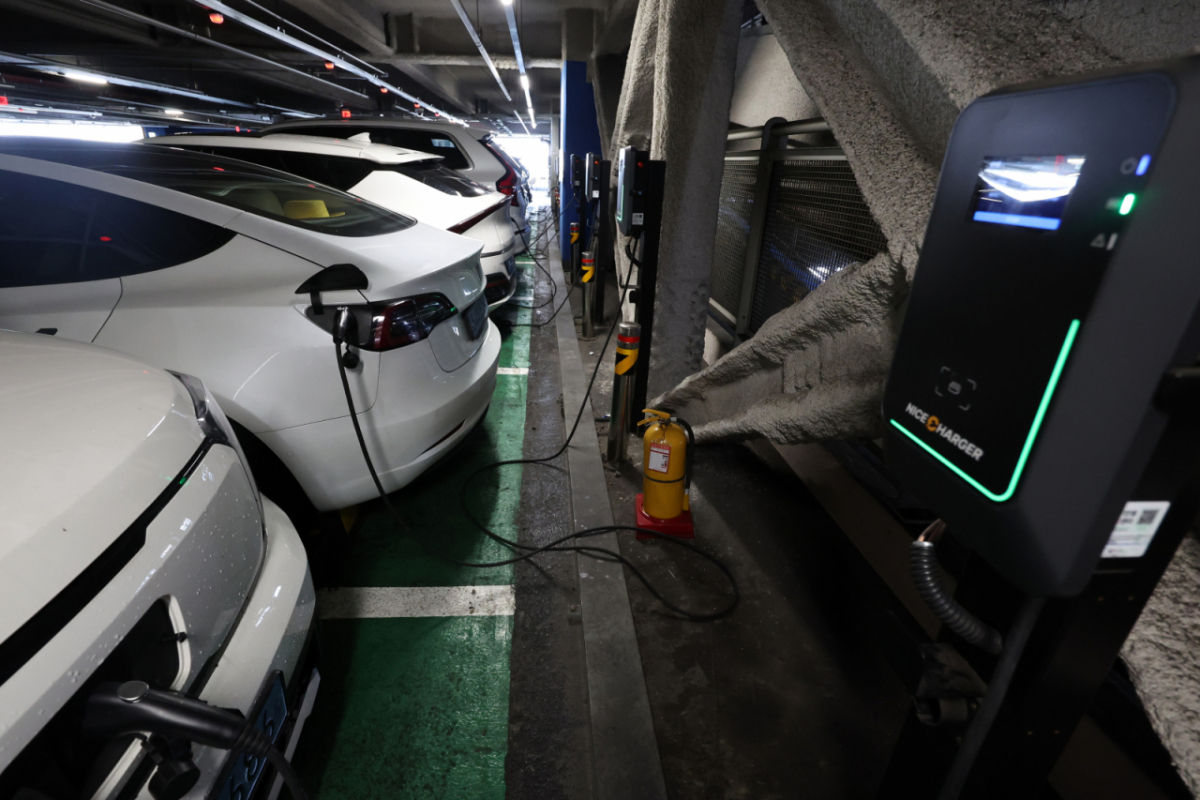
Although the budget for next year’s electric vehicle subsidies has increased significantly, concerns are rising that the benefits will flow to the U.S. company Tesla. Critics argue that as the government fails to implement proper measures to counter foreign brands and instead rushes to expand electric vehicle adoption, a situation continues where "American companies are being helped with tax money."
According to relevant ministries on the 2nd, the government plans to raise the electric vehicle subsidy budget from 1.6114 trillion won this year to 2.1403 trillion won next year, an increase of 32.8%. This will expand the number of eligible electric vehicles for subsidies from 300,000 units this year to 430,000 next year. Additionally, the government intends to broaden the scope of transition support payments—provided when disposing of internal combustion engine vehicles and purchasing electric vehicles—to include commercial vehicles such as taxis.
The government stated that the reason for significantly expanding the electric vehicle subsidy budget is "to account for the recent surge in demand." Indeed, the share of electric vehicles among newly registered cars in Korea rose from 11.1% in the first half of last year to 23.3% in the first half of this year, an increase of 12.2 percentage points (P). The problem is that Tesla is leading this "surge in electric vehicle demand," intensifying the concentration of subsidy benefits. According to the Korea Automotive Mobility Industry Association (KAMA), cumulative new registrations of electric vehicles in Korea from January to July this year reached 237,032 units, a 103.3% increase compared to the same period last year. Focusing solely on Tesla vehicle new registrations during the same period (based on data from the Korea Motor Vehicle Importers Association), numbers jumped from 26,569 to 66,376, a 150% surge that far exceeded the overall growth rate of electric vehicles. This indicates that Tesla is driving the expansion of electric vehicle adoption in Korea. Industry experts expect Tesla’s new car sales in Korea this year to exceed 100,000 units for the first time annually.
Tesla vehicles accounted for 28% of all newly registered electric vehicles in Korea from January to July this year. While exact subsidy amounts vary by model across automakers, making precise calculations difficult, it is estimated that a significant portion of this year’s subsidy budget will go to Tesla. Considering the growing popularity of Tesla vehicles in Korea, the benefits this company receives from next year’s increased subsidy budget are expected to be even larger.
The industry has long argued that since automobiles are a national strategic industry, the subsidy system should be improved to protect domestic brands. The government also took these voices into account and established new evaluation criteria for electric vehicle adoption project operators in May. It proposed five evaluation categories: △R&D capability (10 points) △Supply chain contribution (40 points) △Response to environmental policies (15 points) △Post-management and sustainability (20 points) △Safety management (15 points), predicting that Tesla and Chinese brands, which would score relatively low in the highest-weighted category of "supply chain contribution," would not be selected. However, when the government announced the selected operators for the adoption project at the end of June, Tesla remained included while China’s BYD was excluded.
An industry official stated, "There were many predictions that Tesla would be excluded because it has no manufacturing plants in Korea and contributes relatively little to employment, resulting in low scores in supply chain contribution, but the outcome differed from expectations." The official added, "Nevertheless, the government has failed to properly explain the reasons behind these evaluation results."
In fact, the government stated that under the Act on Public Disclosure of Information by Public Institutions, the evaluation scores of each automaker are considered "information whose disclosure may significantly harm the legitimate interests of corporations or other entities as they relate to corporate management and business secrets," and therefore cannot be disclosed.
The industry is raising voices questioning whether the government is focusing too much on the goal of "expanding electric vehicle adoption" while being relatively neglectful of protecting domestic brands. Previously, the government set a target to distribute 4.2 million electric vehicles by 2030. Considering that the cumulative number of electric vehicles distributed in Korea so far is around 1 million units, achieving this target would require selling 700,000 to 800,000 units annually starting next year. Another official remarked, "It seems regrettable that the government is focusing on unrealistic adoption targets rather than protecting and supporting the domestic automotive industry."

 in INDUSTRY
