

"A 5.5-meter unmanned boat sank a large warship."
The Russia-Ukraine war has changed the formula for naval warfare. In February 2024, several 5.5-meter Ukrainian unmanned surface vehicles (USVs), known as 'Magura V5', attacked and sank the Russian Black Sea Fleet's large amphibious assault ship 'Tsar Kuniakov' near Crimea. The Russian missile patrol ship 'Ivanovets' and the patrol boat 'Sergey Kotov' were also sunk in succession by unmanned surface vehicle attacks. With the fact that unmanned surface vehicles can threaten expensive warships proven in actual combat, countries around the world are now focusing on USVs as the "game-changer" of future naval warfare.
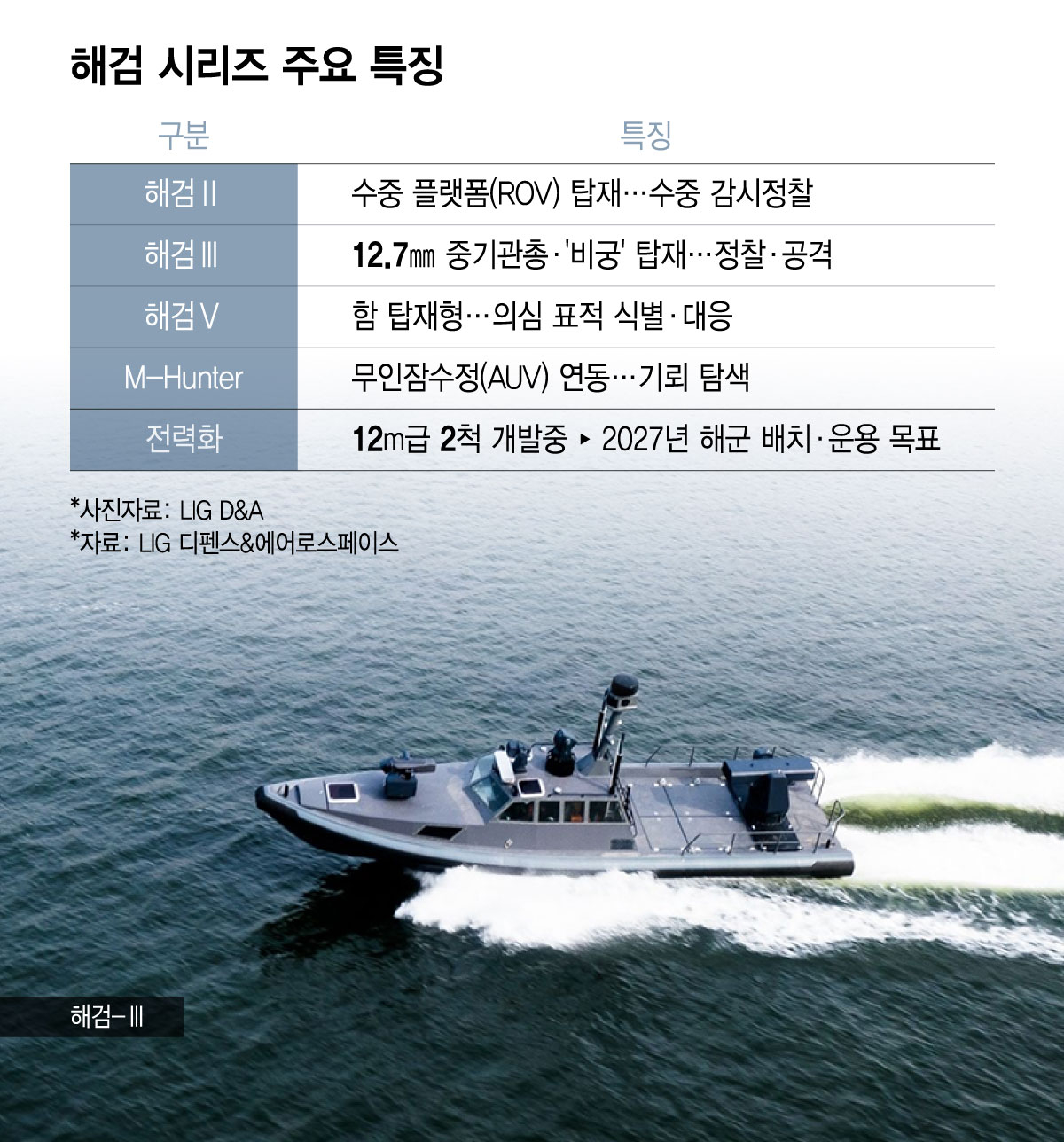
South Korea also has a "sea-based unmanned force" that has evolved for over 10 years. The protagonist is LIG Defense & Aerospace (LIG D&A)'s 'Haegyeom (Sea Sword)'. Over the past decade, Haegyeom has expanded its domain from underwater surveillance and armament to shipboard mounting. Instead of putting all functions into a single unmanned surface vehicle, it is characterized by being categorized into Haegyeom-II, Haegyeom-III, and Haegyeom-V to perform various operations according to mission equipment.
The "Sea Sword," evolved over 10 years... From reconnaissance to attack
Each model specializes in different missions ranging from underwater surveillance to armament and shipboard mounting. Haegyeom-II is a model that enhances underwater surveillance and reconnaissance capabilities. It is equipped with an underwater platform (ROV) module that can be automatically deployed and recovered underwater. This expands the operational domain of unmanned surface vehicles not only patrolling above the sea surface but also into the underwater realm.
Haegyeom-III has capabilities beyond 'reconnaissance' to include 'attack'. It is equipped with a 12.7mm heavy machine gun and a 2.75-inch guided rocket 'Bigeung' launcher at the front. For the first time in Korea, it successfully completed sea trials in "Sea State 4," which has a significant wave height of up to 2.5 meters, allowing for 24-hour operation without manned forces even in harsh maritime environments.
Haegyeom-V is a ship-mounted unmanned surface vehicle designed to be carried on warships and deployed into the sea when needed. When a suspicious target appears, it can separate from the mother ship to identify the target and respond immediately. Its strength lies in reducing the burden of having manned warships directly approach dangerous areas while expanding the scope of surveillance and reconnaissance.
In addition, M-Hunter, developed through a Korea-Australia international joint research project, expanded the mission domain of unmanned surface vehicles to mine countermeasures (MCM). Through heterogeneous swarm operations linking different unmanned systems such as autonomous underwater vehicles (AUVs) that search for mines underwater, it is possible to search for mines without directly deploying manned ships into dangerous areas.
"It can also fire guided missiles"... All six shots hit their targets at RIMPAC
A notable part of Haegyeom's evolution is its 'armament'. Unmanned surface vehicles are evolving from platforms that merely scout dangerous areas in place of humans to those capable of performing attack missions when necessary. While Ukraine demonstrated the power of unmanned surface vehicles ramming enemy warships with explosives, LIG D&A is developing armament capabilities by firing guided weapons from unmanned surface vehicles to precisely strike distant targets.
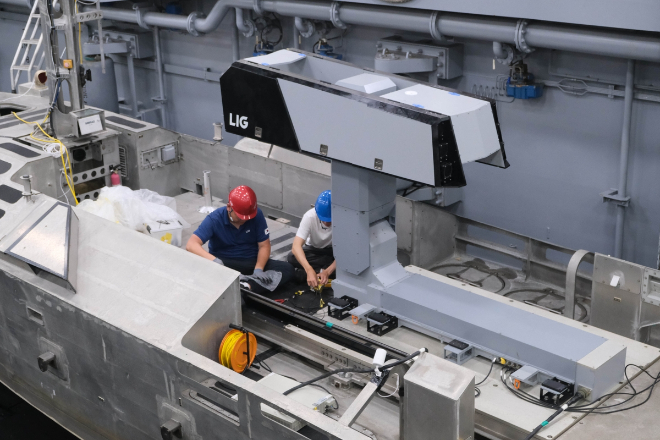
A representative example is the 2.75-inch guided rocket 'Bigeung' mounted on Haegyeom-III. Bigeung, which applies the 'Fire and Forget' method, is a missile optimized for application in unmanned systems, as if foreseeing the era of unmannedization. This is because it autonomously tracks targets after launch. It is a function that other guided weapons of the same class could not implement due to spatial constraints no larger than a paper cup. LIG D&A has also developed its own Bigung launcher for export and is moving into overseas markets.
It showed its potential in actual tests as well. During the final test firing of the Foreign Comparative Test (FCT) held during the Rim of the Pacific Exercise (RIMPAC) conducted in Hawaiian waters in July 2024, all six Bigung missiles mounted on a US unmanned surface vehicle hit their targets. This is the first case to apply the concept of unmannedization to the entire process, including 'unmanned target-airborne unmanned aircraft detection-satellite communication-unmanned surface vehicle-mounted guided missile launch' across both South Korea and the United States, verifying the combat capability of maritime unmanned systems.
Deployed in the Navy by 2027... A key force for 'Navy Sea Ghost'
Haegyeom is now on the verge of actual deployment as a naval force. LIG D&A plans to develop two 12-meter class unmanned surface vehicles by 2027 through an intelligence-gathering unmanned surface vehicle system development project signed with the Defense Acquisition Program Administration in 2024. This development aims to enhance surveillance and reconnaissance capabilities for forward naval bases and major ports, as well as rapid on-site response capabilities. Upon completion of development, the goal is to deliver and deploy an unmanned surface vehicle that has received combat suitability certification for the first time in Korea to the Navy.
This also aligns with the Navy's push to build 'Navy Sea Ghost'. Navy Sea Ghost is a maritime manned-unmanned complex combat system that connects manned warships with unmanned surface vehicles, unmanned underwater vehicles, and unmanned aircraft to conduct operations. Its core lies in increasing the survivability of personnel by assigning high-risk missions to unmanned systems while responding to troop reductions.
LIG D&A is also investing in the advancement of unmanned platforms. Last year, it completed the 'Unmanned Surface Vehicle Dedicated System Integration Test Facility' at Gumi House. The system integration test facility can perform system integration tests by inspecting each subsystem unit composed of △platform, △autonomous navigation device, △central control unit, △wireless communication unit, △armament, △surveillance and reconnaissance unit, and △underwater search unit in a water tank with a capacity of about 1,000 tons. Based on this, the plan is to support the realization of the maritime manned-unmanned complex system being promoted by the Navy.
To the scene of 'sea-based unmanned force' rescue... Targeting Southeast Asia and the Middle East as well
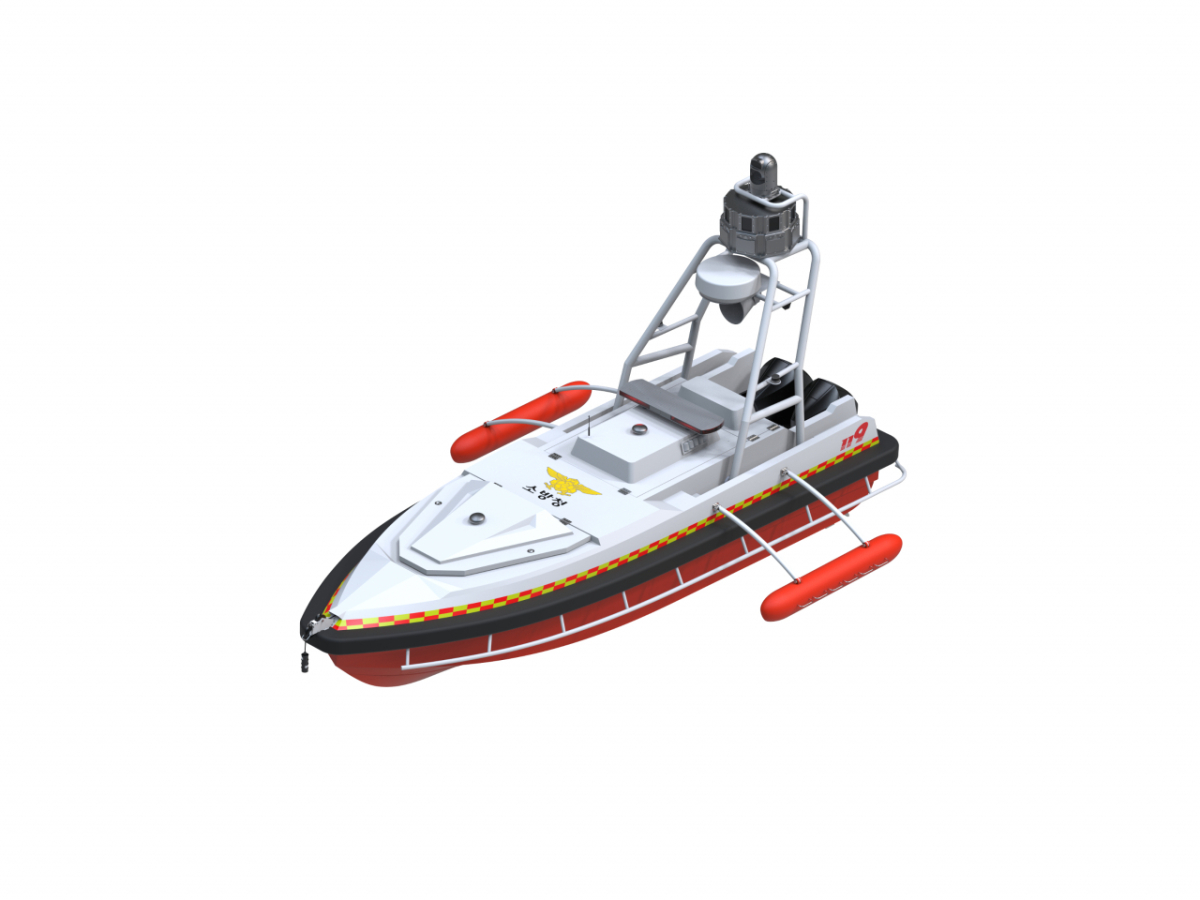
The utility of technology secured through Haegyeom is not limited to the military. LIG D&A was selected as the lead research and development institution for a National Fire Agency disaster rescue unmanned surface vehicle project in July and has begun developing a 'disaster rescue unmanned surface vehicle'. The plan is to deploy unmanned surface vehicles before humans at disaster rescue sites with many risk factors such as strong currents, bad weather, and low visibility, ensuring the safety of rescue team members. The developed unmanned surface vehicles are expected to grasp on-site situations in real-time in high-risk areas and take initial action.
LIG D&A plans to develop an unmanned surface vehicle optimized for disaster rescue missions by integrating technologies such as autonomous navigation, obstacle avoidance, remote command and control, and sensor integration that have already been verified through the development of military unmanned surface vehicles. In particular, it will launch a 'field-centered development process' where it directly visits the disaster rescue teams under the National Fire Agency from the design stage to hear about actual rescue environments and operational difficulties and reflect them in development.
Ultimately, the target market is overseas. It views Southeast Asia and the Middle East, where maritime activities are active but infrastructure for rescue is relatively lacking, as potential markets. The plan is to secure operating references from domestic military and disaster rescue sites and then promote the export of unmanned surface vehicles based on them.
An LIG D&A official said, "With the award of the disaster rescue unmanned surface vehicle project, we will expand our business scope to the entire maritime unmanned system." He added, "We have accumulated relevant experience and technology by developing the 'Haegyeom' series of unmanned surface vehicles as a civil-military project since 2015, and plan to deliver and deploy an unmanned surface vehicle that has received combat suitability certification for the first time in Korea to the Navy through intelligence-gathering unmanned surface vehicle system development by 2027."

 in INDUSTRY


