

Domestic chemical materials companies are seeking new growth drivers within the semiconductor supply chain. As competitiveness in conventional general-purpose products weakens, they are accelerating portfolio shifts by expanding semiconductor material businesses and restructuring revenue models.
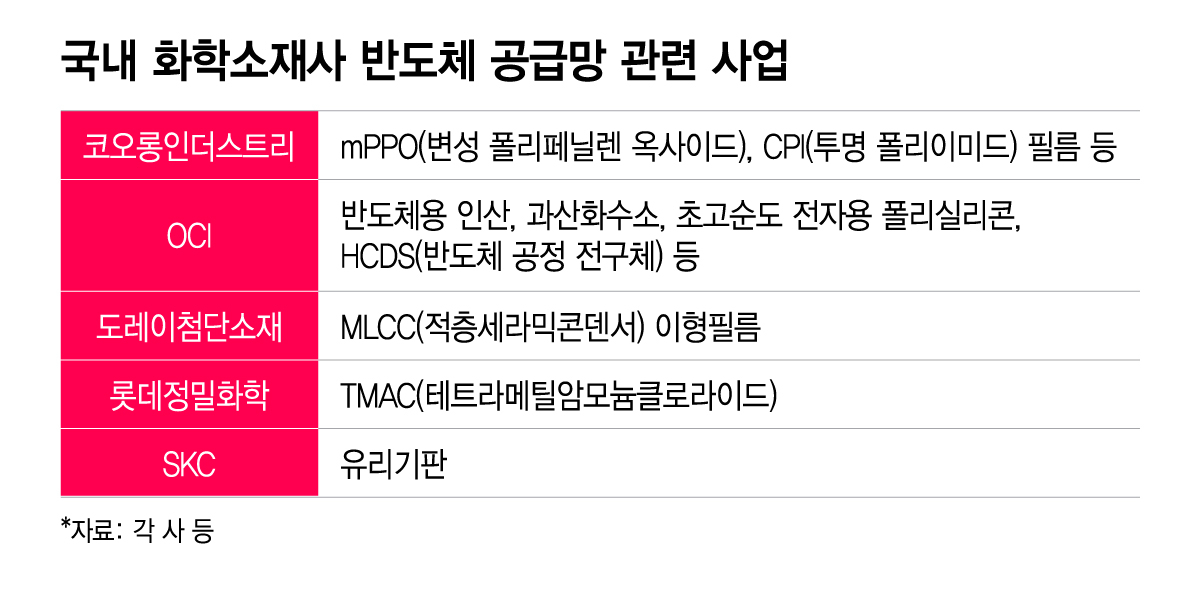
According to industry sources on the 7th, Kolon Industries recently began producing prototype Yangsan at its newly expanded mPPO (modified polyphenylene oxide) production facility at its Gyeongbuk Gimcheon No. 2 plant, which cost approximately 340 billion won. mPPO is a key material for copper-clad laminates (CCL), the raw material for high-performance printed circuit boards (PCBs) used in artificial intelligence (AI) servers, and offers excellent energy-saving performance. With the expansion of the AI industry driving increased demand for CCLs, demand for mPPO is also rising.
Kolon Industries' para-aramid business is also benefiting from the expansion of AI data centers. Para-aramid, known for its high strength and elasticity, is used as a reinforcement material to enhance the tensile strength and durability of optical fibers. Additionally, Kolon's CPI (transparent polyimide) film business, which serves as a material for foldable phones, recorded its first profit in the first half of this year since facility completion in 2018, following the acquisition of new overseas customers.
Front-end materials repeatedly used in semiconductor production are also markets targeted by chemical companies. Notably, OCI, which produces phosphoric acid for semiconductors, plans to expand its production capacity from 25,000 tons to 30,000 tons—a 20% increase—by the third quarter of this year. This expansion aims to respond to increased orders from existing customers and secure new clients. OCI holds a portfolio of front-end materials consumed repeatedly in semiconductor manufacturing processes, including high-purity phosphoric acid, hydrogen peroxide, ultra-high-purity electronic-grade polysilicon, and HCDS (semiconductor process precursors). Phosphoric acid is used in the etching process for wafers (thin discs used to make semiconductor chips), while HCDS is utilized in thin-film deposition processes for DRAM and NAND flash memory.
Demand for Dojei Advanced Materials' MLCC (multilayer ceramic capacitor) release film continues to grow steadily. MLCCs are core components that regulate stable current flow in electronic circuits and prevent signal interference between components, while release film is a process material used during MLCC manufacturing to create thin and uniform ceramic layers. In response, the company has decided to accelerate its expansion of the release film business.
Lotte Fine Chemical's second-quarter operating profit surged more than sixfold year-on-year as sales of TMAC (tetramethylammonium chloride), a key raw material for semiconductor developing solutions, increased. Lotte currently holds the world's largest TMAC production capacity and plans to further expand production by 16% through facility expansions by the second quarter of 2028.
Appolic, a subsidiary of SKC that is targeting the next-generation semiconductor packaging market with its glass substrate business, recently announced a 400 billion won rights offering (paid-in capital increase). The company plans to deploy the raised funds for product evaluation and customer certification. It will also pursue upgrades to select facilities and equipment aimed at improving production yield and quality.
An industry official stated, "The growth of the semiconductor industry is leading to improved profitability for material companies," adding, "There is a growing trend of companies internally reviewing which businesses they can further enter within the semiconductor value chain."

 in INDUSTRY
