

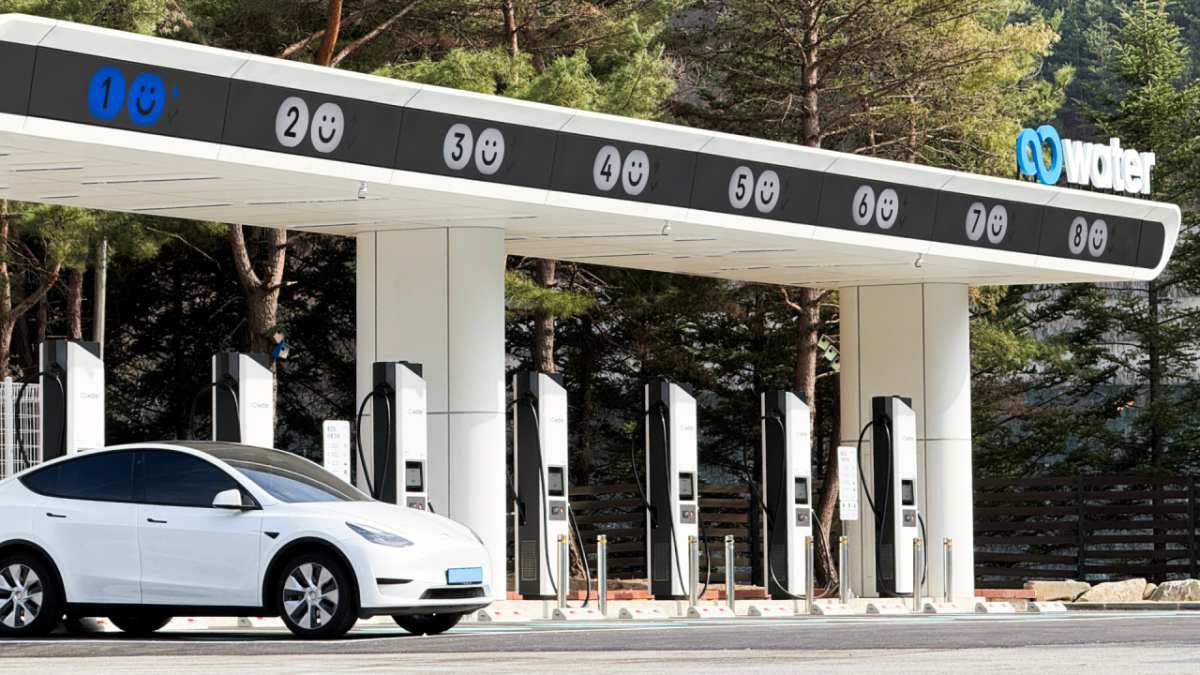
As international oil prices approach $100 per barrel, the cost competitiveness of electric vehicles is once again coming to the fore. Assuming an annual driving distance of 13,800 kilometers, the maintenance cost for the Ioniq 5, an electric vehicle, is 1.11 million won, while the similarly priced gasoline-powered Grandeur 2.5 costs 3.19 million won, resulting in a difference of 2.08 million won.
On the 9th, Water, an electric vehicle fast-charging network, compared maintenance costs including fuel, car taxes, and consumable replacement expenses based on the national average annual driving distance of 13,800 kilometers per vehicle. The results showed that the Ioniq 5 Long Range cost 1.11 million won and the Tesla Model Y Long Range cost 1.06 million won, whereas the Sonata 2.0 cost 2.93 million won and the Grandeur 2.5 cost 3.19 million won.
Even when calculated using the most expensive public charging rate for ultra-fast charging (393.1 won), the Ioniq 5 comes to 1.23 million won and the Model Y to 1.17 million won. Utilizing slow charging at home or workplaces further widens the gap.
Connecting to a highway ultra-fast charger for 10 minutes allows an additional 165 kilometers of driving, with a charging cost of 11,200 won. Driving the same distance in a Grandeur 2.5 costs 25,600 won just for gasoline. By item, fuel and charging costs are 940,000 won for the Ioniq 5 versus 2.14 million won for the Grandeur 2.5, and car taxes also diverge at 130,000 won and 650,000 won respectively. Consumable replacement costs differ by a factor of ten. The Grandeur 2.5 requires regular replacement of engine oil, automatic transmission fluid, air cleaner filters, and spark plugs, costing 400,000 won annually, while the Ioniq 5 only needs brake pad replacements at a cost of 40,000 won.
When oil prices rise, the gap widens further. Gasoline prices rose to 2,011.8 won per liter in the second week of May but have fallen for 16 consecutive weeks and are currently around 1,860 won. If prices return to May levels, the annual maintenance cost for the Grandeur 2.5 would increase to 3.36 million won, while the two electric vehicles remain unchanged. This is because charging fees are calculated based on electricity rates and facility operating costs rather than international oil prices, and petroleum accounts for only about 1% of domestic power generation.
International oil prices are facing upward pressure in the second half of the year. On the 8th (local time), Brent crude futures closed at $97.92 per barrel, and Dubai crude, the benchmark for domestic imports, rose to $99.9 in the first week of September.
The longer the ownership period, the more the difference accumulates into a substantial sum. Under the same conditions over five years, the Ioniq 5 would cost 5.54 million won and the Model Y 5.28 million won, while the Grandeur 2.5 would require 15.74 million won. The gap ranges from 10.20 million to 10.46 million won; if May oil prices are applied, the difference widens to between 11.07 million and 11.34 million won.
Water operates 274 fast and ultra-fast chargers at 50 highway rest areas nationwide and has secured new business rights for 123 units across 23 rest areas. Including private rest areas, the total reaches 397 units at 73 locations.
Yoo Dae-won, representative of the Electric Vehicle Charging Business Division at Bright Energy Partners, stated, "Even when adding fuel costs, taxes, and consumables, the cost advantage of electric vehicles is clear." He added, "Data confirms that even when charging exclusively with the highest-output ultra-fast chargers, the cost gap between internal combustion engine vehicles and electric vehicles remains very significant."

 in INDUSTRY
