

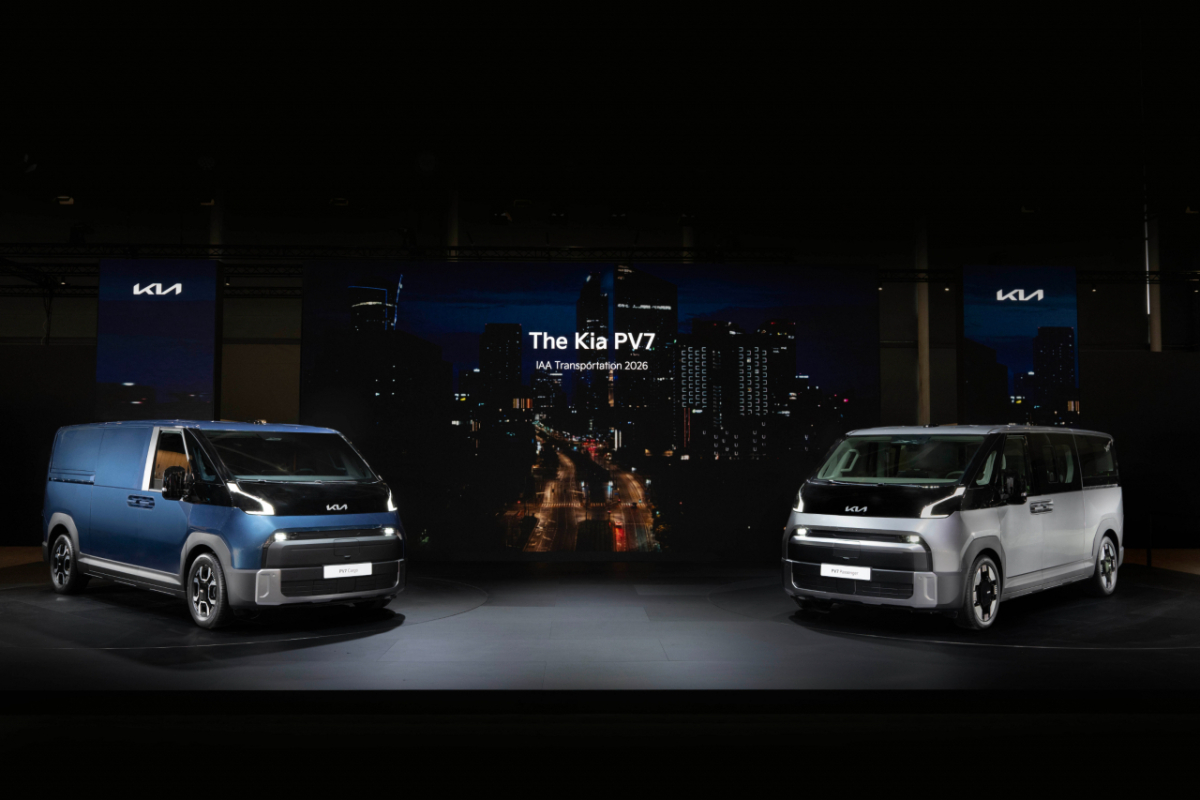
Kia has unveiled the large-scale electric Purpose-Based Vehicle (PBV) 'The Kia PV7', featuring spacious interiors and fast-charging capabilities. By lowering the floor to facilitate cargo loading and diversifying body and seat configurations according to usage, Kia is accelerating its entry into the electric commercial vehicle market, targeting everything from logistics and delivery to passenger transport.
On the 14th (local time), at the world's largest commercial vehicle exhibition 'IAA Transportation 2026' held in Hanover, Germany, Kia made the world premiere of the PV7. As the second dedicated electric PBV following the PV5, it is scheduled for initial launch in Korea and Europe in the second half of next year.
Song Ho-sung, Kia President, stated on this day, "What customers want is not simply a better vehicle, but better business outcomes," emphasizing that "we are not just building vehicles; we are providing practical business solutions." He further added, "The PV7 has been designed to elevate the value of PBVs as a true business solution. Through its dedicated EV platform and flexible body system, it will offer various customized spaces tailored to customer needs."
Based on the long model, the PV7 measures 5,350mm in length, making it 195mm longer than the Carnival. While its width remains identical at 1,995mm, its height reaches 1,990mm, which is 215mm taller than the standard gasoline model of the Carnival. The wheelbase, which determines interior space, extends to 3,500mm—410mm longer than the Carnival's. Built on Kia's dedicated electric vehicle platform 'E-GMP.S', the floor has been designed flat to maximize space utilization.
The vehicle also incorporates the 'Flexible Body System,' a development and manufacturing technology that allows for creating vehicles of different sizes and shapes by altering designs in key areas such as the side panels and roof. From high-roof models with expanded cargo capacity upward to compact versions with shortened body lengths, the PV7 can be transformed into models suited to various customer operations.
Sufficient driving range for long-distance travel has also been secured. The standard and long-range models are equipped with nickel-cobalt-manganese (NCM) batteries of 71.5kWh (kilowatt-hours) and 96.2kWh capacity, respectively. According to Kia's own measurements, the cargo long model in its long-range configuration can travel more than 460km on a single charge under European WLTP standards. With an 800V charging system applied, recharging the battery from 10% to 80% takes only around the mid-20-minute range based on Kia's internal testing.
For the first time in Kia history, two charging ports are provided. A fast/slow charging port is located at the front, while a slow-charging port is positioned on the rear side, allowing users to select the appropriate port depending on parking direction and charger placement. The vehicle also features V2L (Vehicle-to-Load) functionality, enabling external power supply from the vehicle battery so that tools and electronic devices can be connected and used at job sites.
The cargo model focuses on reducing the physical burden on workers loading and unloading goods. The height from the ground to the cargo floor has been lowered to 550mm, eliminating the need to lift heavy cargo upward. Cargo capacity reaches 6.1 cubic meters for the long model and up to 8 cubic meters for the high-roof model. It can carry up to three Euro pallets, which measure 1,200×800mm.
Rear doors offer a choice between twin-swing style, which opens widely to both sides, or lift-up style, which opens upward. The three-seater cargo variant includes a 'Load-Through' bulkhead that allows long items to be pushed through the space beneath the passenger seat.
The passenger model is available in 7-seat, 9-seat, and 11-seat configurations. The compact 7-seater features a 'Long Rail Easy Remove Seat System,' allowing rear seats to be moved or removed. When fewer passengers are on board but more cargo is needed, seats can be relocated or detached to secure additional storage space.
Management functions for companies operating multiple vehicles are also provided. Users can download business applications from 'Fleeto Connect,' while the generative AI agent 'Gleoo AI' controls vehicles and provides information through voice conversations. The vehicle management system 'Fleeto Fleet' offers services to monitor vehicle status and driving data, detect anomalies in advance, and reduce downtime.
Following its launch, Kia plans to sequentially introduce 23 types of PV7 derivative and conversion models—including chassis cabs for specialty vehicle manufacturing—to the global market, thereby expanding the vehicle's versatility.

 in INDUSTRY
