

LG Electronics is set to significantly expand its production capacity and establish a local production base in the United States to meet the surging cooling demand of artificial intelligence (AI) data centers.
Leveraging its competitiveness in independently developing and producing core components for cooling equipment, the company aims to shorten supply lead times and accelerate its offensive into the North American AI data center market with integrated solutions covering everything from chips to cooling systems.
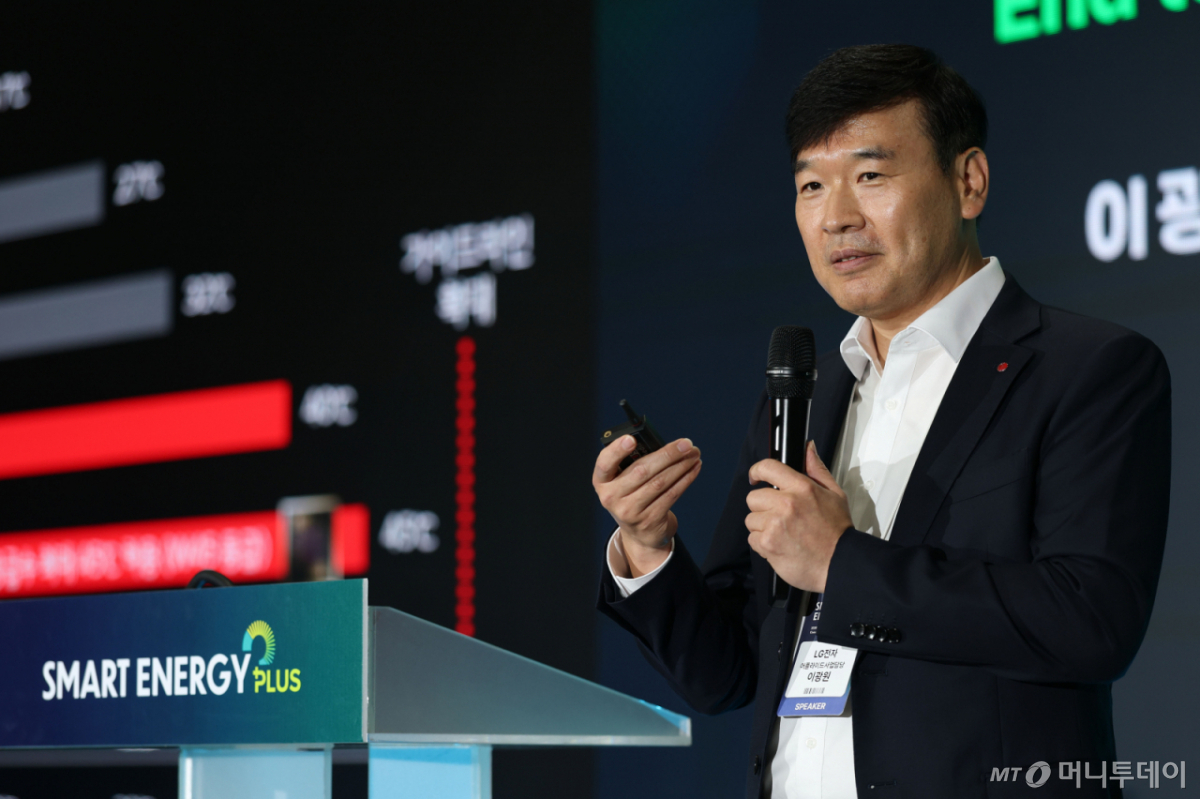
Lee Gwang-won, head of the Applied Business Division at LG Electronics, stated at the "Smart Energy Plus (SMART ENERGY PLUS·SEP) 2026" conference held on the 29th in Hall B of COEX in Samsung-dong, Seoul, that "LG Electronics is expanding its cooling equipment production capacity by approximately 10 times next year compared to this year." He added, "Because we possess the underlying technology for core components, we can rapidly scale up our production capacity."
In a presentation titled "Global Data Center Trends and End-to-End LG Integrated Cooling Solutions," Lee noted that the data center cooling market is undergoing rapid transformation due to the high performance of AI semiconductors.
He explained that as heat generation from server racks equipped with NVIDIA's next-generation AI chips has increased significantly, a technological shift is occurring from traditional air-cooling to liquid cooling.
Lee emphasized, "Liquid cooling will inevitably become the main system going forward," adding, "Given current power shortages, it has become crucial how to utilize the allocated power for AI services rather than consuming it on cooling." This underscores that "Time to Market"—the speed at which data centers can be built—and AI processing efficiency per unit of power have emerged as key competitive factors in the cooling market.
In response, LG Electronics is prominently featuring its "Chip-to-Chiller" integrated solution, which connects chillers that produce cooling water, coolant distribution units (CDUs) that supply cooling water to servers, and cold plates that directly dissipate heat from semiconductors.
The company has secured supply stability by independently developing and producing major components such as compressors, inverters, and heat exchangers used in chillers. Currently, the system is set up so that chillers and CDUs can be supplied within 30 weeks based on factory shipment standards.
The company is also establishing a local production base to target the North American market. Following its facilities in Pyeongtaek and Changwon in South Korea and Qingdao in China, LG Electronics plans to open a new cooling equipment manufacturing plant in Virginia, United States, in 2027. Lee stated, "We began official deliveries to the U.S. at the beginning of this year," explaining, "We will actively target the North American market by expanding our local production sites."
The company is also pursuing technological innovation and securing verification infrastructure to enhance data center construction efficiency. By pre-fabricating power, server, and cooling equipment in modular forms for on-site assembly, LG Electronics aims to shorten construction periods by 50% and reduce installation area by 25%.
Additionally, it has established a system to provide integrated services from energy storage systems (ESS) to cooling and operations in collaboration with affiliates such as LG Energy Solution. Alongside this, the company has completed the registration of its CDUs ranging from 600 kilowatts (kW) to 2.6 megawatts (MW) on the NVIDIA Marketplace and is accelerating the expansion of the liquid cooling ecosystem by verifying the performance and stability of combined liquid-air cooling systems through its self-built 1.5 MW-scale demonstration facility.
Addressing recent issues regarding water usage and waste heat in data centers, Lee explained, "We are building our entire system centered on equipment that does not use water." He added, "We are also developing technologies to utilize generated heat for smart farms or district heating, as well as methods to reabsorb the heat for recycling in cooling processes."

 in INDUSTRY
