

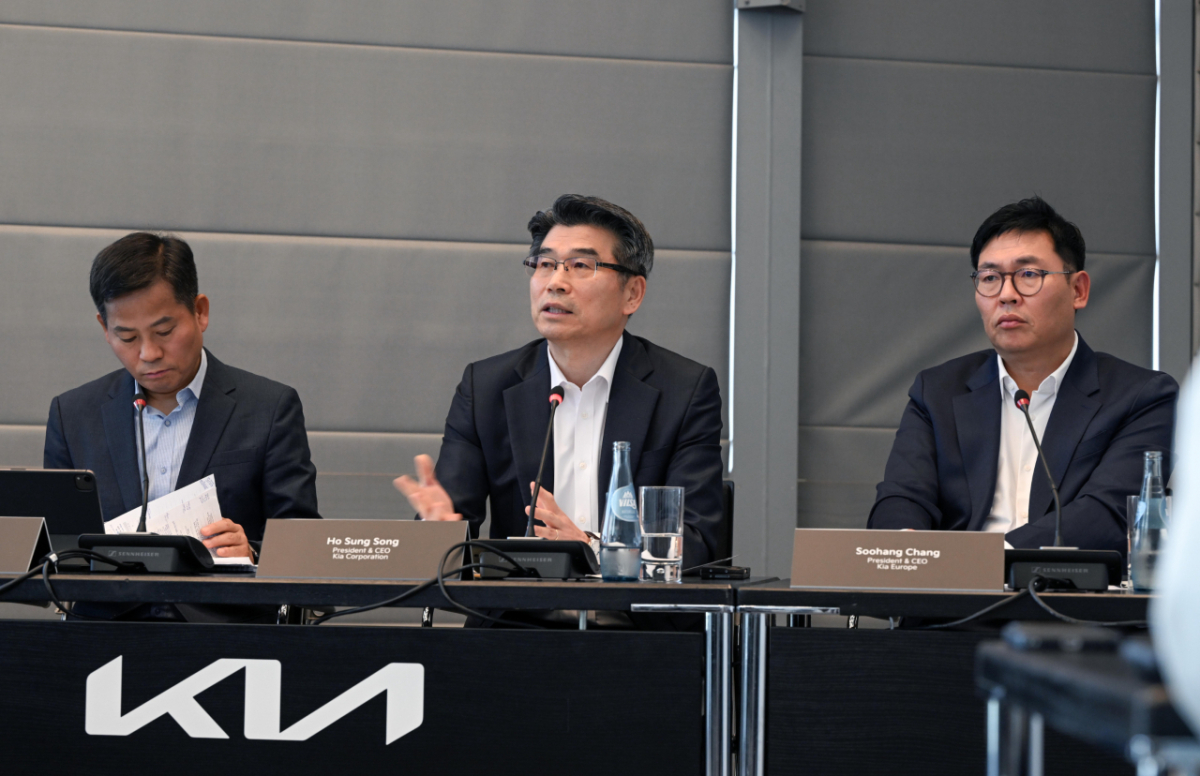
"I believe this game has just begun."
Song Ho-seong, Kia's president, expressed his ambition to target the European light commercial vehicle (LCV) market with the second purpose-built vehicle (PBV), the PV7. This statement was made during a meeting with reporters at 'IAA Transportation 2026' in Hannover, Germany, on the 14th (local time). Having gained experience in Europe's electrified commercial vehicle market through the PV5, Kia now intends to fully enter the midsize van (M-VAN) segment—a larger and more competitive market—with the PV7.
Kia's decision to launch the smaller PV5 before the PV7 was part of this strategy. Song (President) explained, "We believed that introducing the PV7 first would be extremely challenging without prior market experience. Therefore, we decided to enter the PV5 market first, learn extensively from it, and then use those insights to enter the PV7 market."
The key to PV7's success lies not only in the vehicle's inherent product quality but also in the ecosystem that supports corporate customers' vehicle operations. Song (President) emphasized, "Customers do not simply want a good car; they look for an ecosystem that enables them to run their businesses effectively. Manufacturers must be able to fully provide services ranging from downtime management to data management of fleet management systems."
Kia is already securing corporate customers with the PV5. Currently, it has finalized contracts for approximately 4,000 units and is proceeding with deliveries. The company will supply around 400 units to Bravida, a Swedish facility services provider; about 300 units to Motability, a UK public corporation operating mobility lease vehicles for people with disabilities; and another 300 units to Kone, a Finnish elevator manufacturer.
Kia is also in ongoing negotiations with major global retailers targeting both the PV7 and the upcoming PV9. This means that specifications required by these companies during their transition from internal combustion engine institutional investor vehicles to electric vehicles are being reflected from the product development stage onward. Song (President) stated, "We have been negotiating for a long time to incorporate the specifications that companies need. Given the sheer volume of operational units, if deals are finalized, the contract size could reach four digits rather than three." He expressed confidence in these prospects.
In response to aggressive low-price campaigns by Chinese electric commercial vehicle manufacturers, Kia's strategy is to compete on quality and service networks rather than price. Song (President) noted, "We cannot compete with Chinese vehicles on price alone, but we will build competitiveness in product quality, service networks, and customer management." He also highlighted Kia's strength of having over 2,500 service networks established across Europe.
Compared to existing European manufacturers, Kia pointed out the spatial efficiency and product appeal derived from its dedicated electric vehicle platform as key differentiators. He added, "Many existing electric vans are models derived from internal combustion engine institutional investor vehicles. In terms of space and specification levels, the PV7 holds a competitive edge."
Kim Sang-dae, Executive Vice President and Head of Kia's PBV Business Division, also emphasized the vehicle's inherent competitiveness over price reductions driven by subsidies. He stated, "Continuously relying on subsidies risks overshadowing innovative features and product quality, leaving only subsidy benefits visible. We hope people will recognize how seriously Kia is pursuing market expansion and extending its reach through the PV5, PV7, and PV9 lineup."
During the same interview, Karim Habib, Executive Vice President of Global Design at Kia, responded to questions about PBV design philosophy by saying, "Our focus was on creating the most efficient box possible. A key design feature is the low beltline that widens the driver's field of view, accentuated with black coloring."
Following the PV5 and PV7, Kia plans to unveil the larger PV9 in 2029. The PV9 is being developed in two specifications: a gross vehicle weight of 3.5 tons and 4.25 tons. Through this, Kia aims to gradually expand its PBV lineup and establish a sales system capable of delivering 250,000 PBVs annually by 2030.

 in INDUSTRY
