

"We will proceed with a public tender offer for shares on the Korea Exchange to strengthen our control over Korea Zinc."
On Sept. 13, 2024, one day before the Chuseok holiday, Yeungpoong, the largest shareholder of Korea Zinc, and MBK Partners, a private equity fund, formalized their alliance and announced this. With the intention of acquiring approximately 7% to 14.6% of Korea Zinc's shares to seize control of management, it was effectively a surprise attack targeting the Choi Yun-beom (Chairman) side.
MBK and Yeungpoong cited allegations of breach of trust and market manipulation by Korea Zinc's management as their justification. The Choi (Chairman) side countered with "hostile, predatory M&A (mergers and acquisitions) by corporate hunters." This marked the beginning of the Korea Zinc incident that has dragged on tediously for the past two years. Since then, mutual defamation and lawsuits, along with nerve-wracking battles over shareholder meetings, have continued day after day.
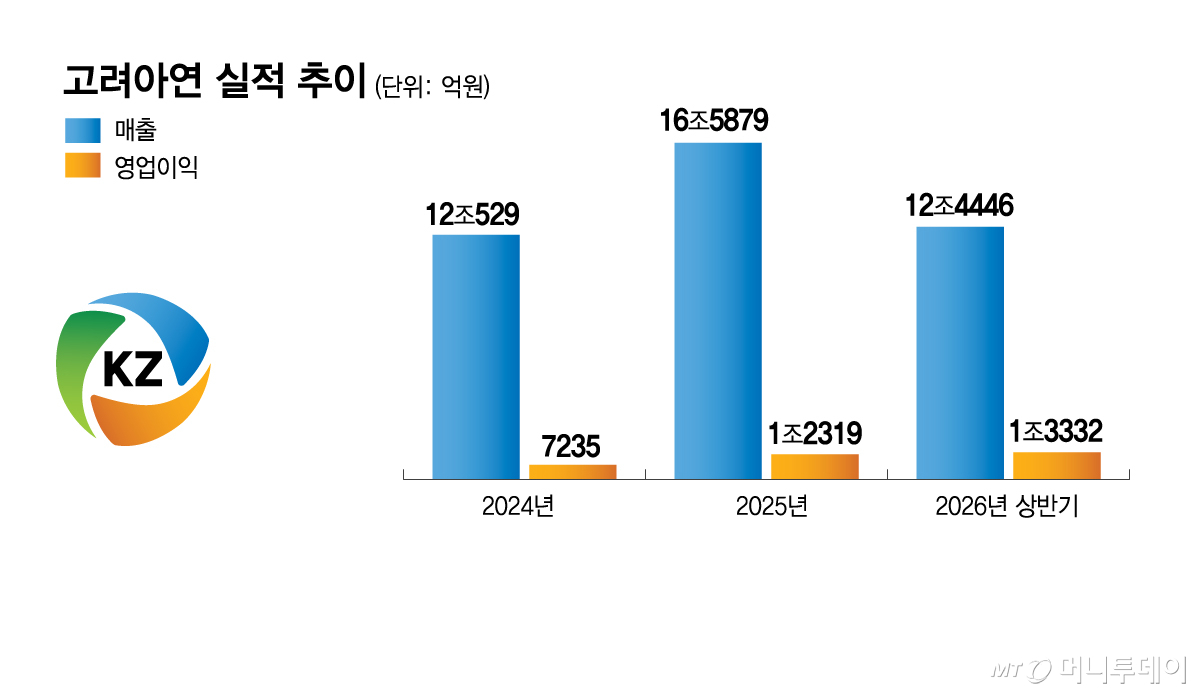
However, behind all this noise, Korea Zinc achieved a perfect step-up. Its annual operating profit, which was 723.5 billion won in 2024, increased to 1.2319 trillion won last year. This year alone, it earned 1.3332 trillion won in the first half of the year. Aiming for an annual operating profit in the 2nd trillion won range, it has already signaled record-breaking performance.
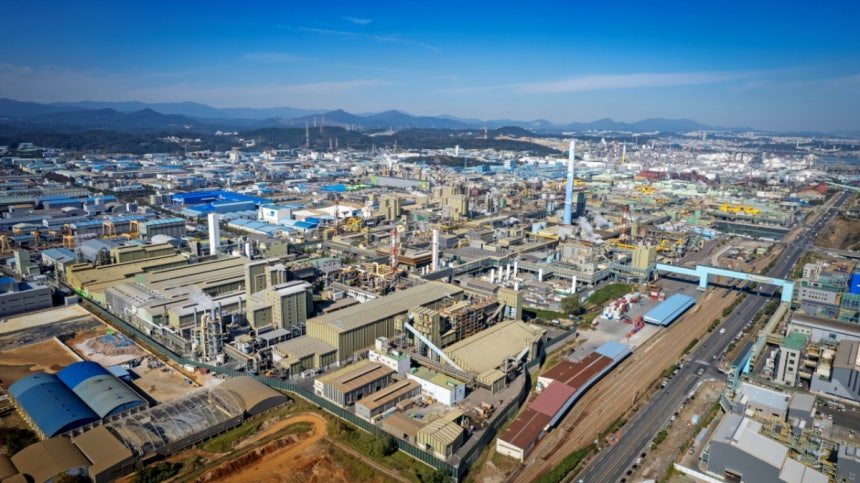
The company is solidifying its position as the world's No. 1 comprehensive non-ferrous metal smelting company, producing over 1.2 million tons annually of approximately 20 types of non-ferrous metals, including base metals (zinc, lead, copper), precious metals (gold, silver), rare metals (antimony, indium, bismuth, tellurium, etc.), and semiconductor sulfuric acid. As a result, it achieved profit growth by increasing recovery rates for key minerals such as antimony, silver, and gold in the precious metal sector, and effectively responding to increased demand and rising prices for rare metals.
With the advent of the AI (artificial intelligence) era, Korea Zinc's strategic value is becoming even more important. The semiconductor sulfuric acid production capacity at Korea Zinc's Onsan Refinery is 280,000 tons annually, and from the second half of this year, it will be expanded to 320,000 tons annually. Korea Zinc supplies about 95% of the total domestic semiconductor sulfuric acid volume to major Korean semiconductor manufacturers.
Amid a geometric surge in copper demand driven by the AI data center boom, Korea Zinc is implementing plans to increase its annual copper production capacity from the early 30,000-ton range to approximately 150,000 tons—about five times higher—by 2028. Korea Zinc's wholly-owned subsidiary KZAM recently began supplying copper foil for ESS (energy storage system) batteries in Yangsan.
Recently, it has even secured a symbolic position as the representative of the "US-Korea Mineral Alliance." Following last year's agreement to supply germanium and gallium to Lockheed Martin in the United States, Korea Zinc is now pursuing Project Crucible, a $7.4 billion project to build a large-scale integrated smelter in Tennessee. Analysts suggest that since this project proceeds based on strategic investments from the U.S. Department of Defense and other entities, the U.S. government may have become an ally of Korea Zinc.
In fact, it was reported that when U.S. Commerce Secretary Howard Lutnick cited Korea Zinc as a successful case of key mineral investment attraction in August this year, President Donald Trump evaluated it as a "Great Success." U.S. Treasury Secretary Scott Bessent also pointed to Korea Zinc's U.S. smelter project as a model for private investment at the January G7 (Group of Seven) finance ministers' meeting.
Amid a flood of love calls from all directions, Choi (Chairman) has been busy this year with schedules including speaking engagements at the Davos Forum, dialogues with the Atlantic Council, IEA (International Energy Agency) Ministerial Council meetings, meetings with Canada's Strategic Economic Cooperation Envoy, interviews with the Australian Prime Minister, and participation in the Korea-Chile Business Roundtable.
Regarding this, business leaders unanimously agree that Korea Zinc currently classified as a target of an ownership dispute led by private equity funds, "has nothing to gain." This is because there are no companies or countries that would wish for increased management uncertainty in a company that has re-emerged as a pillar of the de-China mineral supply chain.
One official stated, "The non-ferrous metal products produced by Korea Zinc have a wide ripple effect and support the stable maintenance of major national infrastructure industries such as semiconductors, defense, steel, and secondary batteries," adding, "At the very least, we should refrain from wasteful mutual defamation and lawsuits surrounding the ownership dispute."

 in INDUSTRY


