

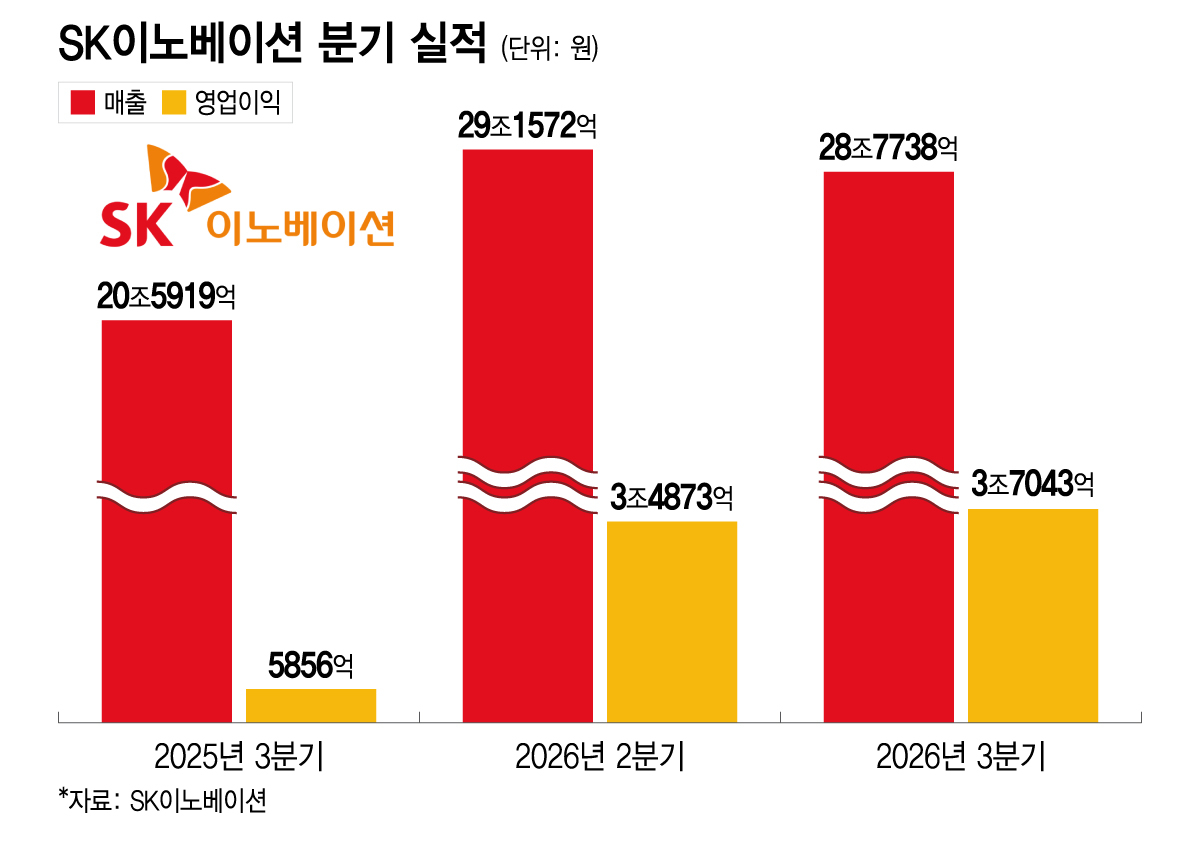
SK Innovation posted its highest-ever operating profit for the third quarter of this year, driven by strong performance in its refining and lubricants businesses.
Battery subsidiary SK On saw its results slow down compared to the previous quarter, but it is aiming for a turnaround by expanding its energy storage system (ESS) business, leveraging U.S. regulations on China as an opportunity.
SK Innovation said Thursday that it recorded revenue of 28.7738 trillion won and operating profit of 3.7043 trillion won in the third quarter. These figures represent year-on-year increases of 39.7% and 532.5%, respectively.
The refining and lubricants businesses led the strong results. Tight supply of petroleum products, driven by declining utilization rates at Middle Eastern refineries and Russia’s restrictions on diesel exports, pushed up export margins. SK Energy’s operating profit rose by 554.6 billion won from the previous quarter to 1.2058 trillion won.
SK Enmube posted a record quarterly operating profit of 1.0906 trillion won. This was thanks to base oil spreads remaining at high levels due to global supply disruptions in lubricant base oils. In just one quarter, it surpassed its previous record annual operating profit of 1.0712 trillion won set in 2022.
SK Innovation E&S’s operating profit increased by 668.5 billion won from the previous quarter to 774.4 billion won. Profitability in the power generation business improved due to rising spot market prices (SMP) and the securing of long-term contract liquefied natural gas (LNG). SK Geo Centric recorded an operating profit of 86.7 billion won.
In contrast, SK On reported revenue of 1.5263 trillion won and an operating loss of 80.5 billion won. The decline was influenced by reduced sales volumes and the base effect from one-time gains in the previous quarter. However, the company explained that profitability excluding one-time factors had improved.
SK On is expanding its business structure, which has been focused on electric vehicles, into energy storage systems (ESS). It has signed a supply contract for approximately 9 GWh of lithium iron phosphate (LFP) batteries for ESS with U.S.-based NeoVolta and is in discussions for additional orders in North America and domestically.
The strategy involves converting existing electric vehicle battery production lines in Korea and North America for ESS use rather than building new facilities, thereby reducing the investment burden. Future conversion plans will be determined by considering order volumes, electric vehicle demand forecasts, and regional policies.
The strengthening of U.S. regulations on Chinese batteries also presents an opportunity. Kim Young-gwang, head of SK On’s Financial Management Division, said, “Interest in non-Chinese cells and stable supply sources is rising, particularly among U.S. ESS operators that have previously used Chinese-made cells.”
Kim added, “Inquiries regarding supply volumes, pricing, and long-term contracts are increasing.” He projected that the North American ESS market will grow by more than double from 80 to 100 GWh this year to 2030.
The company is also viewing artificial intelligence (AI) data centers as a new demand source and is jointly developing multi-functional integrated ESS products with group companies such as SK Telecom.
The refining business is expected to maintain its solid momentum in the fourth quarter as well. J
ung Young-gyu, head of SK Energy’s Management Planning Division, said, “Unless there is a sharp drop in oil prices, we expect to maintain quite solid results.”
He projected that high volatility driven by geopolitical uncertainties, such as the situation in the Middle East, will continue next year. Analysts note that as the situation persists, the capacity to absorb supply shocks through inventory and production diminishes, which could push up oil prices and refining margins.

 in INDUSTRY
