

China’s LNG (liquefied natural gas) ship order volume, which had slowed last year, is showing signs of recovery this year. With major Chinese private shipyards also preparing to place orders for LNG ships, competition is expected to intensify further. While the prevailing view remains that a clear technological gap still exists between China and Korea, voices are also calling for early efforts to boost competitiveness in next-generation vessels in anticipation of China’s pursuit.
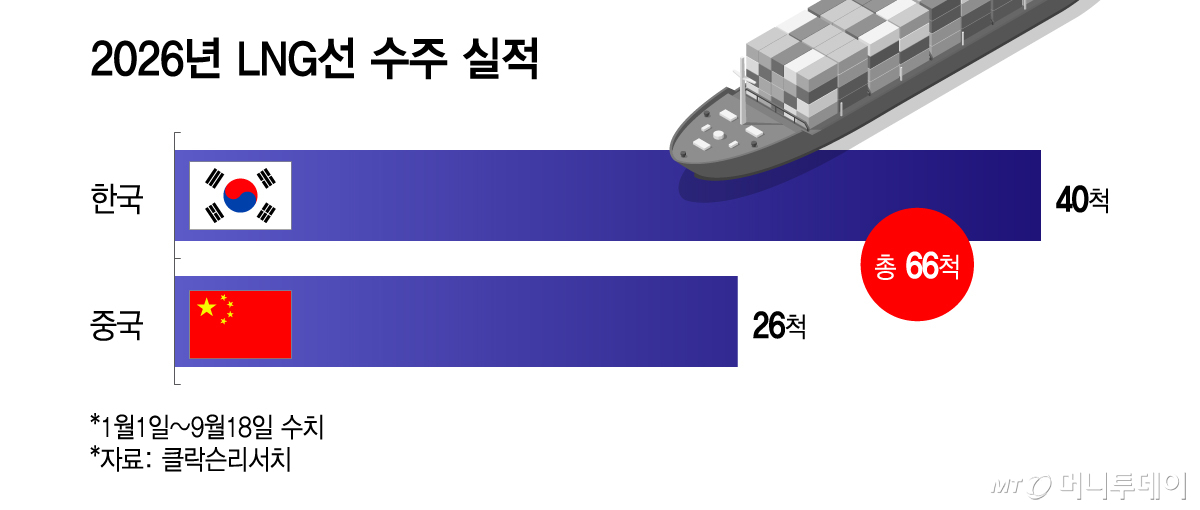
According to Clarkson Research, an institutional investor specializing in shipbuilding and shipping market analysis in the UK, global LNG ship orders from January this year through the 18th of this month totaled 66 vessels. Of these, Korea secured 40 ships, accounting for 61.2% of the total, while China took 26 ships, holding a 38.8% share. China’s LNG ship market share had plummeted from 42.8% in 2024 to just 8.1% last year, but it is now showing signs of recovery this year.
Analyses also suggest that China’s pursuit of LNG ships will intensify. Hengli Heavy Industry, which has previously held the top spot globally in order backlog per single shipyard, is a prime example. Hengli has expanded its order portfolio primarily around large crude oil tankers, bulk carriers, and container vessels, and it is widely known that its first new LNG carrier order is imminent. As a result, the number of Chinese shipyards with established capabilities to build large LNG ships is expected to increase from five to six.
China has seized opportunities amid the Iran war this year, experiencing a boom in its shipbuilding industry, with warmth spreading even to LNG ship orders. Concerns over potential blockades of the Strait of Hormuz have heightened uncertainty in crude oil supply chains, leading to a surge in large tanker orders. Chinese shipbuilders, leveraging their price competitiveness, absorbed a significant portion of these orders. It is observed that the accumulated order backlog and production experience are now extending to high-value vessel orders, including LNG ships. In the first half of this year, new orders in China’s shipbuilding sector reached 120.6 million DWT (deadweight tonnage), exceeding 80% of the global total. Hengli alone secured more than 200 vessels in the first half, aggressively building its backlog.
For now, industry experts believe it is not easy for Chinese shipbuilders to replace Korean counterparts in the LNG ship market. LNG ships must transport cargo at extremely low temperatures around minus 163 degrees Celsius, requiring advanced technical capabilities in cargo tank design, insulation, and gas handling systems. Gaining the trust of shipowners through long-term construction experience and actual operational records is also difficult to achieve in a short period. Additionally, LNG ship orders typically take three to four years from placement to delivery, and shipowners often require significant verification periods before entrusting their first orders to new entrants, further raising entry barriers.
Nevertheless, the domestic shipbuilding industry cannot remain entirely optimistic about China’s pursuit. China is expanding its shipyards’ production capacity and rapidly accumulating construction experience based on massive order volumes. As more Chinese shipyards secure licenses for LNG cargo tanks from France’s GTT, the scarcity of technology once monopolized by Korea will inevitably diminish. Even if a technological gap currently exists, it is difficult to rule out the possibility that this gap will narrow as Chinese shipbuilders repeatedly secure and construct LNG ships.
This is why there are calls to maintain a technological super-lead in next-generation vessels alongside LNG ships. An industry executive stated, “The high-value vessel market is expanding beyond LNG ships to include liquefied carbon dioxide carriers and ammonia carriers.” He emphasized that “it is essential to secure competitiveness not only in construction technologies for next-generation vessels but also in eco-friendly fuels and key equipment.”

 in INDUSTRY
