

"Is a robot that looks like a human really necessary? Wouldn't it be more efficient to build wheeled robots or industrial robots optimized for specific tasks?"
The answer from Persona AI, a global physical AI company, is not "because humanoid forms are technically superior." Rather, existing industrial sites, including shipyards and steel mills, have been designed around the human body for decades. Therefore, the form that allows for the fastest automation without tearing up these facilities is the humanoid (human-shaped) robot.
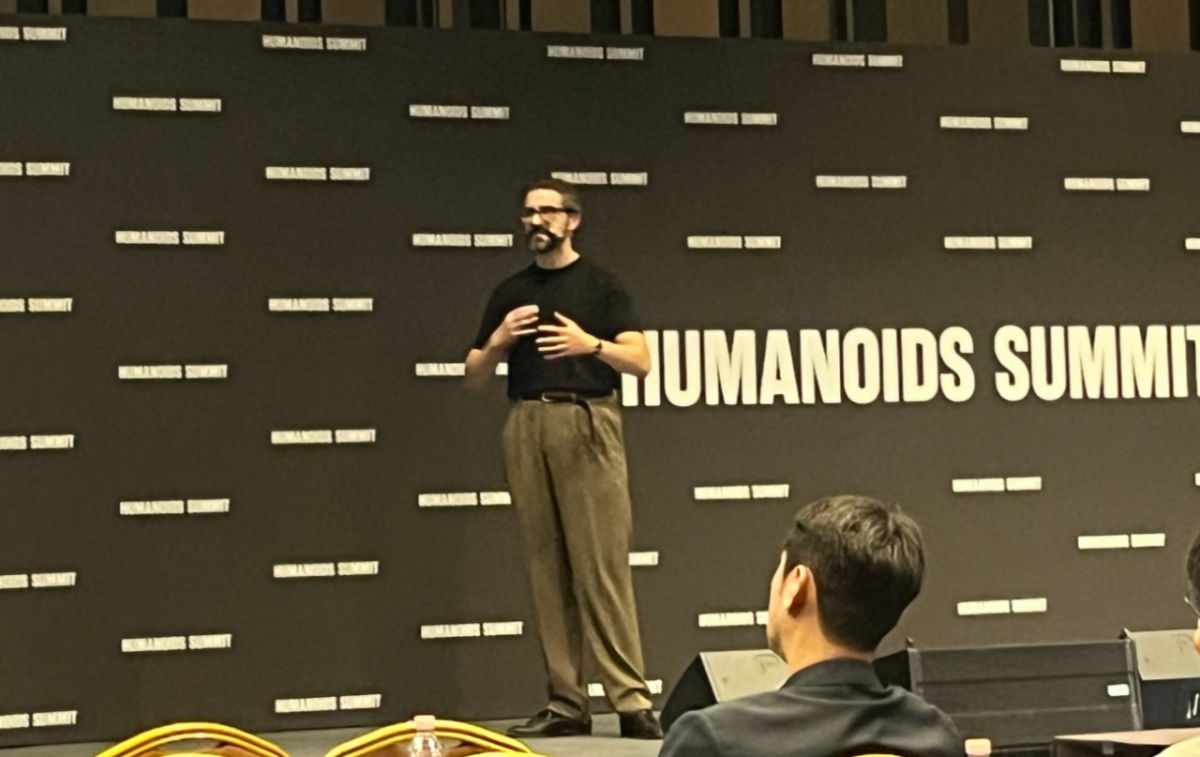
Michael Perry, Head of Commercial Strategy at Persona AI, stated on the 22nd during his opening keynote at 'Humanoid Summit Seoul 2026' held at COEX in Seoul: "The reason humanoids are better is not because human evolution has created a perfect form for all robots." He added, "It is because they are the most suitable form to solve the problems we aim to address," thereby explaining this point.
The problem he identified is the shortage of skilled labor in the shipbuilding, steel, construction, and energy industries. He diagnosed that if the structural decline in industrial labor force over the next 5 to 10 years is not addressed, the very methods of producing ships and steel, as well as maintaining construction sites and energy assets, could be shaken. Heavy industry, in particular, is vulnerable to labor shortages. Perry described shipyards as "a nightmare for robotics engineers." This is because the shapes of work targets constantly change, non-standardized structures are scattered around, and these spaces were not created with automation in mind from the start.
Existing automation methods lie at two extremes. If production facilities are designed specifically for automation like in automobile factories, high productivity and utilization rates can be secured, but this requires massive capital expenditure (CAPEX). Furthermore, production facilities must stop during the retrofitting of existing factories. There is also the issue that if processes change, automation equipment must be redesigned.
Perry stated, "Industry has already standardized all these tasks into a single form factor." That single form factor is humans. He said, "The value of non-residential factories and facilities designed for human use in the United States reaches 56.6 trillion won." He added, "To replace them with forms different from humans, we must consider how to retrofit existing investment assets worth tens of trillions of dollars."
Humanoids do not change existing processes to fit robots; instead, they adapt robots to fit existing processes. They move through spaces where actual people walk, use stairs and ladders, and utilize tools that humans use as-is. If one unit can perform tasks beyond welding, such as transport, grinding, inspection, and other duties, it means the utilization rate of the robot itself can be higher than having multiple robots dedicated to specific tasks.
Data is cited as the second strength of humanoids. For physical AI to perform actual work, vast amounts of data must be learned; however, robots with forms similar to humans can directly acquire data from humans who are already performing the same tasks.
Even for those not specialized in robotics, the usability of humanoids is another advantage, as existing workers at shipyards and steel mills can easily operate them. It is explained that human-shaped robots can be taught remotely in a manner similar to how workers move their own bodies, and intervention is relatively easy when problems occur.
This is about to undergo actual verification at domestic heavy industry sites. Persona AI is jointly developing humanoid robots for welding at shipyards with HD Hyundai and is promoting the application of these robots to logistics operations at steel mills in collaboration with POSCO Group. In this regard, HD Hyundai aims to complete prototype development by 2026 and conduct on-site demonstration and commercialization by 2027.

 in INDUSTRY
