

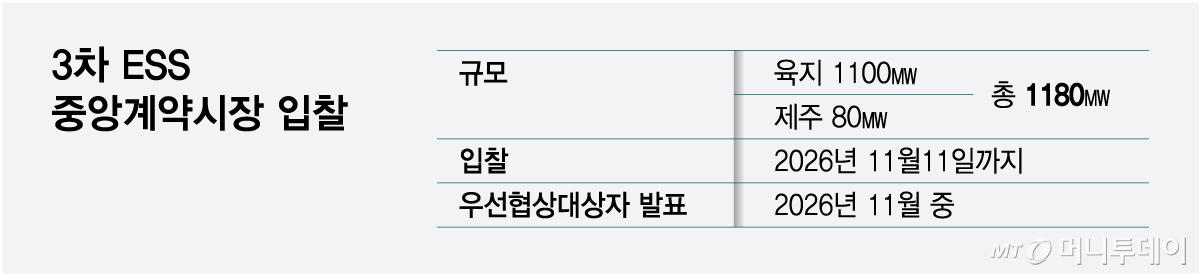
LG Energy Solution will compete in the bidding for the government's 3rd central contract market for energy storage systems (ESS) with a 'fully domestic LFP (lithium iron phosphate) battery' produced entirely in Korea, from key materials to cells. Compared to ternary batteries such as NCM (nickel-cobalt-manganese) and NCA (nickel-cobalt-aluminum), LFP batteries offer lower output but excel in price competitiveness and long lifespan. Known for their superior safety and low cost, they are gaining attention not only for budget electric vehicles but also for ESS applications.
According to industry sources on the 27th, LG Energy Solution plans to source all four key battery materials—cathode material, anode material, separator, and electrolyte—from domestic companies in this 3rd central contract market bidding. While some LFP battery cell products were imported from Nanjing, China, for the first two rounds of bidding, the company intends to supply the entire volume of orders through its Ochang Energy Plant in North Chungcheong Province for the third round. Having previously secured experience with ESS-grade LFP batteries in China and the United States, the company aims to significantly increase its domestic share.
This move appears aimed at capitalizing on the fact that contributions to the domestic industry and economy are reflected as key non-price evaluation factors. Specifically, evaluations of industrial and economic contribution comprehensively assess domestic supply chain stability, contributions to the domestic industry, and job creation effects. Submissions include proof of origin for cathode materials, anode materials, separators, and electrolytes, as well as details on cell production facilities.
LG Energy Solution's Ochang Energy Plant is currently establishing a system to produce ESS-grade LFP batteries with an annual capacity of 1 GWh (gigawatt-hour) starting in 2027. The company believes that by 2028, when the volume from the third central contract market begins to be supplied in earnest, it will be able to meet LFP battery demand through a stabilized domestic production base.

 in INDUSTRY
