

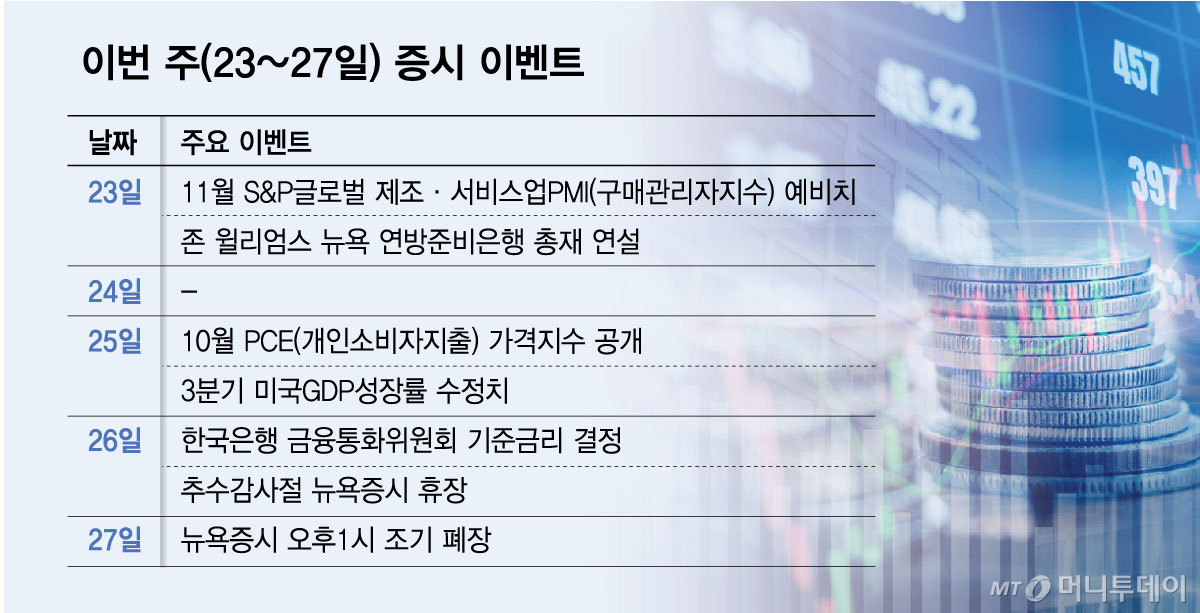
With Korean and U.S. stock markets experiencing consecutive sharp declines, this week’s decision on the base rate by the Bank of Korea and the release of U.S. inflation indicators are seen as key variables that will determine the direction of the domestic stock market. Given the significant drop in stock prices, there is potential for a rebound; however, if concerns over interest rate hikes intensify and foreign selling continues, an unstable trading environment may persist. In particular, whether the selling pressure on large-cap semiconductor stocks, which had driven the rise in the domestic market, subsides will likely determine the sustainability of any rebound.
According to the Korea Exchange on the 22nd, the KOSPI closed at 4,869.96 on the 20th, marking a 7.95% decline over the week. This is the lowest level since January 20 (4,885.75) based on closing prices. After the close of domestic trading, the U.S. NASDAQ Composite Index plunged 5.28%, and the Philadelphia Semiconductor Index dropped 10.73%. NVIDIA and AMD also fell by 14.01% and 13.25%, respectively.
KOSPI 200 night futures also declined by 6.99%, which could increase selling pressure in the early trading session on the 23rd. However, since the domestic stock market has already fallen more than 5% on the 20th, some of the negative news from the U.S. may have been priced in beforehand. In fact, while the KOSPI fell 3.48% on the 30th of last month and the NASDAQ dropped 2.86% that same night, the KOSPI rebounded by 2.24% on the next trading day, the 2nd. This illustrates why it is difficult to definitively determine the direction of the domestic stock market based solely on the magnitude of declines in U.S. markets.
The Bank of Korea will decide on the base rate at its Monetary Policy Board meeting on the 26th. Forecasts suggest that the current annual interest rate of 3.00% will be raised by 0.25 percentage points. Not only the decision on whether to hike rates, but also future interest rate trajectories and projections for economic growth and inflation are expected to impact the stock market.
Interest rate hikes can increase corporate funding costs and reduce the relative investment appeal of stocks. Conversely, if concerns over additional hikes ease, it could help restore investor sentiment. In particular, the Bank of Korea’s explanation regarding the pace of future interest rate increases may also influence the corporate earnings forecasts and appropriate stock price levels presented by securities firms. This is because higher sustained interest rates lower the valuation of future earnings, potentially increasing pressure on growth stock prices.
In the U.S., the October Personal Consumption Expenditures (PCE) price index, a key indicator for the Federal Reserve (Fed), will be released on the 25th (local time). The September PCE price index rose 3.6% year-on-year. If October inflation comes in higher than market expectations, concerns over further tightening by the Federal Reserve may intensify. Conversely, if the pace of inflation slows, it could work in favor of stabilizing U.S. Treasury yields and a rebound in tech stocks.
U.S. interest rate outlooks can also impact foreign investor flows in the domestic stock market. If rising inflation pushes up U.S. Treasury yields and strengthens risk-averse sentiment, foreign selling of domestic stocks may continue. Conversely, if pressure on interest rates eases, there is room for improved investor sentiment toward deeply discounted stocks, including domestic semiconductor shares.
On the 23rd, preliminary readings of the U.S. Manufacturing and Services Purchasing Managers’ Index (PMI) and a speech by John Williams, President of the New York Federal Reserve Bank, are scheduled. On the 25th, the revised growth rate for the U.S. third-quarter gross domestic product (GDP) will also be released. The U.S. stock market will be closed on the 26th for Thanksgiving and will have an early close on the 27th.
Foreign selling pressure and the won/dollar exchange rate are also variables. If the sharp drop in U.S. semiconductor stocks leads to further selling of Samsung Electronics and SK hynix, a rebound in the KOSPI could be limited. Conversely, if U.S. stock index futures and the exchange rate stabilize and foreign selling subsides, there is a possibility that the decline will narrow. The securities industry views not only whether a short-term rebound occurs, but also whether earnings forecasts for semiconductor companies are maintained and whether foreign buying flows in consistently, as criteria for judging a trend-based recovery.

 in STOCK
