

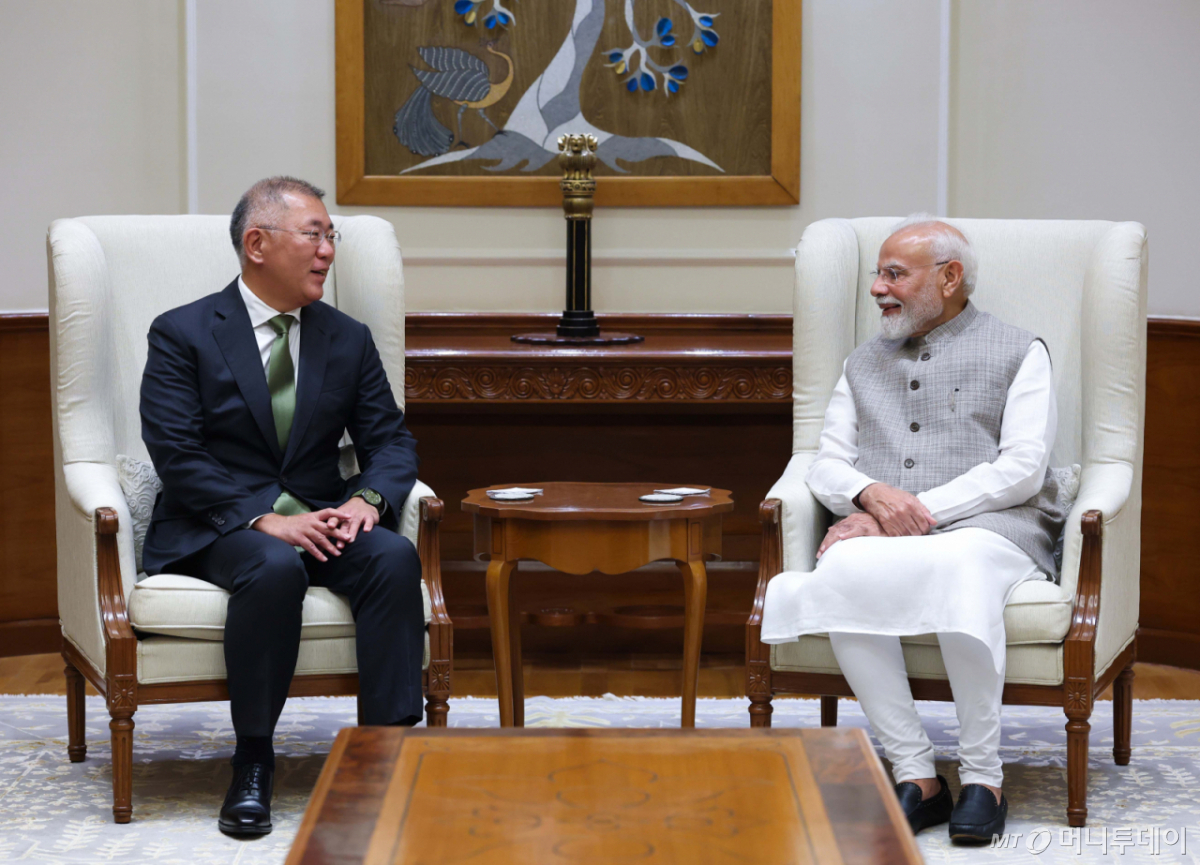
Hyundai Motor has begun operations at its third production base in India, marking 30 years since its entry into the market. The company also unveiled a medium-to-long-term investment plan at the group level, outlining a strategy to develop India as a key hub for electrification and exports.
On Wednesday (local time), Hyundai Motor held the groundbreaking ceremony for its new Pune plant in Talegaon, Maharashtra state, India. The annual production capacity of the Pune plant is 170,000 units, with plans to increase it to 250,000 units by 2028 and 320,000 units by 2030.
Adding the Chennai Plant 1 and 2 (824,000 units), Hyundai Motor's annual production capacity in India will approach 1 million units. Including Kia's Anantapur plant, the group-wide total reaches 1.425 million units, and after the completion of Phase 1 expansion of the Pune plant in 2028, it will establish a production system capable of manufacturing 1.5 million units.
The Pune plant, which required an investment of approximately 1 trillion won and employs over 4,700 people, has an employment effect reaching over 12,400 when including group companies and suppliers. It is a facility reconstructed after acquiring the former General Motors (GM) plant, which ceased operations in 2020, in 2023.
The site spans 1.2 square kilometers and features finished vehicle and engine plants, a test track, and educational facilities. Panel quality inspection is possible through an AI-based crack detection system, and body process welding is handled by over 200 industrial robots. A flexible multi-model production system capable of producing the HYBE lead car in the future is also planned to be established.
The first Yangsan model produced at the Pune plant is the compact SUV (Sport Utility Vehicle) 'All New Venue'. Hyundai Motor will export this vehicle to over 30 countries, including Mexico, Chile, South Africa, and Saudi Arabia, alongside domestic sales in India.
With the Pune plant taking full responsibility for Venue production, the existing Chennai plant can accelerate its transition to electric vehicles. The Indian government is implementing a Production Linked Incentive (PLI) scheme with the goal of increasing the share of electric vehicles in new car sales to 30% by 2030.
Following the Ioniq 5 and Creta Electric, Hyundai Motor plans to launch a compact electric SUV as a local strategic model in the first quarter of next year.
Separately, Hyundai Motor announced on the same day a group-level investment plan for India, committing $15.5 billion (approximately 20.7 trillion won) over seven years from this year through 2032. The funds will be invested not only in expanding production capacity but also in R&D, parts supply chains, and new businesses.
Additionally, the company aims to increase the localization rate of parts through joint investments with local suppliers and equip new cars with Level 2 autonomous driving technology.
It is also developing an electric three-wheeler with local two-wheeler manufacturer TVS, aiming for commercialization by the end of next year. The company is also promoting the establishment of a dedicated investment corporation in India jointly with affiliates.
In his welcome address, Chung said, "Since we first entered India 30 years ago, we have strived to earn the trust of local customers," emphasizing that "since launching our first model, the Xcent, India has become a key pillar in our global growth process."
He further expressed confidence, saying, "The groundbreaking ceremony for the Pune plant will be an occasion where Hyundai Motor opens a new chapter locally in India."
Meanwhile, Hyundai Motor's Indian subsidiary became the first local automobile company to achieve cumulative passenger car exports of 4 million units. By model, the Grand i10 (over 1.757 million units), Accent (over 679,000 units), and Xcent (over 637,000 units) lead the rankings.
Hyundai Motor, which established its Indian subsidiary in May 1996, launched the local strategic model Xcent in 1998, reaching the top spot in the compact car market share within three years of launch, and currently sells around 600,000 units annually.
Since reaching its first 10 thousand won units in exports in 2010, it has set new records locally each time. In October 2024, it conducted the largest initial public offering (IPO) in the history of the Indian stock market. Hyundai Motor plans to raise the export ratio of its Indian subsidiary to 30% by 2030.
The number of domestic parts companies that entered India alongside the Hyundai Motor Group has increased to over 120. In 2011, when only Hyundai Motor's Chennai plant was operating, there were 68 companies; this number rose to 84 in 2019 after the construction of Kia's Anantapur plant, and reached 120 with the completion of the Pune plant. During the same period, the revenue of suppliers in India also grew.
Seongwoo Hi-Tech, which operates parts plants in Chennai, Anantapur, and Pune, saw its Indian revenue increase by 54.6% from 345.8 billion won in 2019 to 534.6 billion won last year. Soyeon E-Hwa increased by 97.3% from 300.3 billion won to 592.5 billion won, and HL Mando increased by 90.4% from 529.4 billion won to 1 trillion 8.1 billion won.

 in INDUSTRY
