

TSMC, the world's largest foundry (semiconductor contract manufacturing) company, is set to expand its production capacity for 2-nanometer semiconductors. As the gap with TSMC widens in the advanced process market, Samsung Electronics is expected to face increasing pressure in the competition to secure new customers. Voices are emerging that it is necessary to quickly secure yield and Yangsan stability at its Taylor plant in the United States.
According to semiconductor industry sources on the 16th, TSMC announced during a Q3 earnings conference call the previous day that it will expand annual production capacity for its 2nm process family by more than twice this year's level by 2027.
The company plans to expand production lines centered in Hsinchu and Kaohsiung, Taiwan, to meet growing demand for semiconductors for AI (artificial intelligence), high-performance computing (HPC), and smartphones.
Since starting 2nm Yangsan in Q4 last year, TSMC has been rapidly increasing the revenue share of this process. The proportion of 2nm in total wafer revenue rose from 3% in Q2 this year to 8% in Q3. The company also maintained its full-year capital expenditure forecast at $60 billion to $64 billion, keeping it at existing levels.
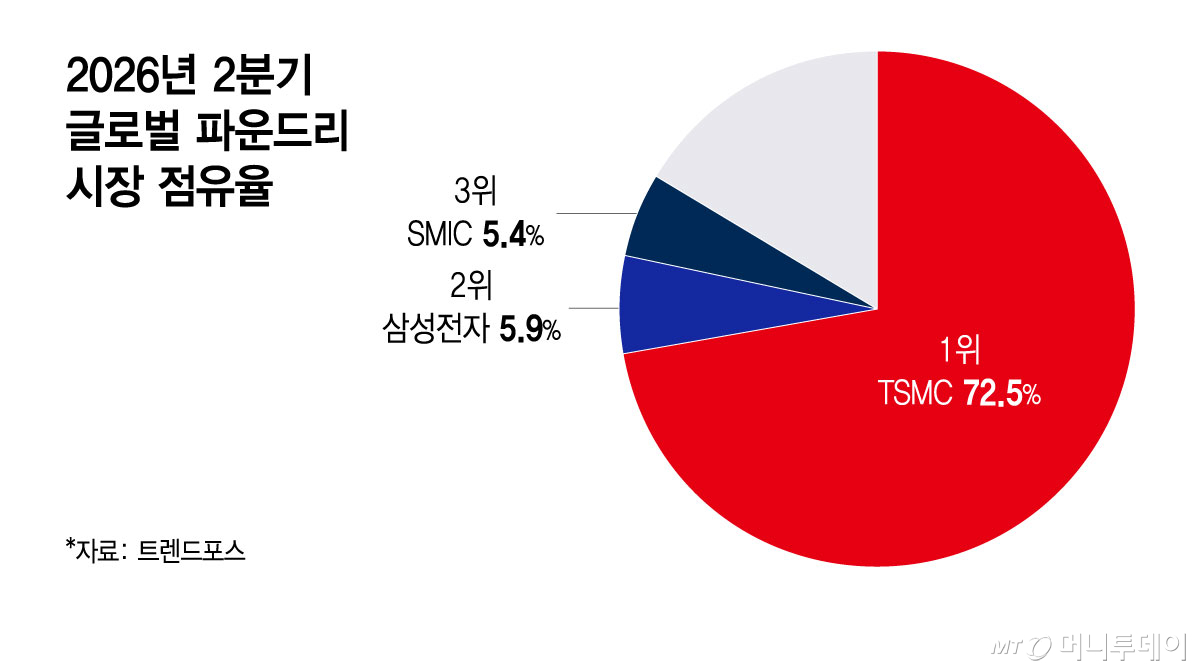
In contrast, Samsung Electronics shows a significant gap with TSMC in the overall foundry market. According to market research firm TrendForce, TSMC's revenue-based share of the global foundry market in Q2 this year was 72.5%, up 0.2%p (percentage points) from the previous quarter.
Samsung Electronics declined from 6.5% to 5.9% over the same period. Although Samsung Electronics' revenue increased by 1.8% from the previous quarter, it failed to keep pace with competitors' growth rates, causing the share gap between the two companies to widen to 66.6%p.
Samsung is pushing for a turnaround by expanding advanced process production capacity. The company is preparing to operate its Taylor Plant 1 in Texas, U.S., within the year and to begin full-scale Yangsan in 2027.
Following a semiconductor contract manufacturing deal worth approximately $16.5 billion with Tesla last year, it has also moved to secure additional customers. In its earnings release in July, the company projected that the number of 2nm orders this year would more than double compared to the previous year.
However, industry experts believe TSMC's production capacity expansion could impact Samsung Electronics' efforts to attract new customers. TSMC determines capital investment based on customers' product development plans and production schedules for the coming years.
Because advanced semiconductors are developed tailored to specific foundry processes from the early design stage, switching manufacturers requires additional time and cost for verification. If TSMC presents stable supply schedules to customers based on its increased 2nm production capacity, it could gain an advantage in securing orders for next-generation products.
Nevertheless, the fact that AI semiconductor demand exceeds supply presents an opportunity for Samsung Electronics. Since TSMC itself has stated that its own supply capacity cannot keep up with demand, there is a possibility that customers developing new chips will consider Samsung Electronics as an alternative from the early stages.
An industry official said, "It is true that by proactively increasing advanced process production capacity, TSMC is securing a favorable position in both retaining existing customers and winning new orders." The official added, "For Samsung Electronics, ultimately how quickly it can prove the yield and Yangsan stability of its Taylor plant will be the variable determining whether it can attract new customers amid the supply shortage situation."

 in INDUSTRY
