

Lithium and nickel pour out from POSCO factory... Over 90% of used batteries are re-resourcized
"Ta0"① Reborn as critical minerals"Tb0"
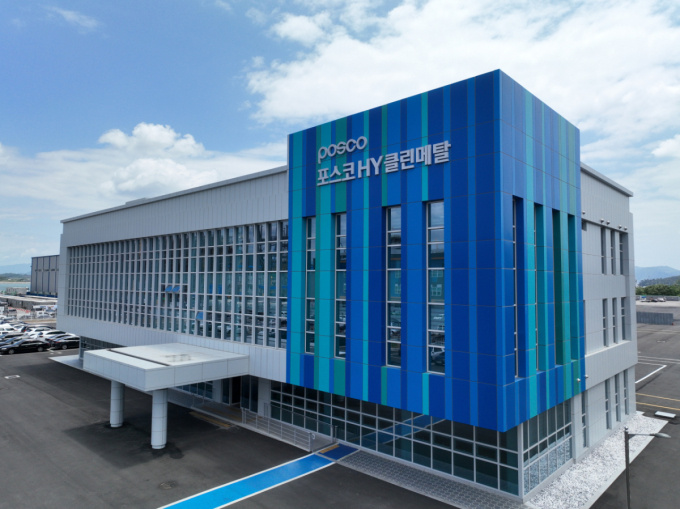
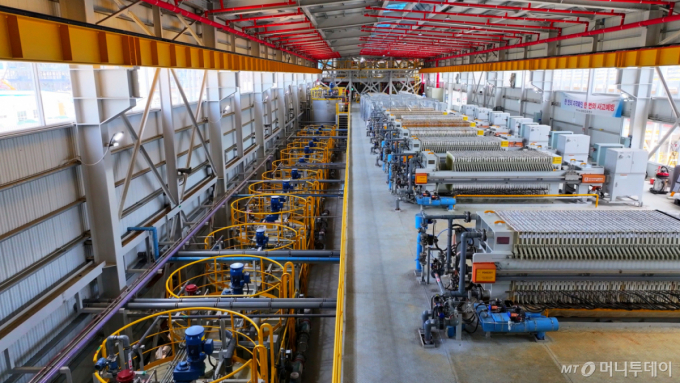
On the 17th of last month, upon entering a large raw material warehouse inside the 19,000-pyeong-scale POSCOHY Clean Metal factory located in the Yulchon Industrial Complex in Gwangju, South Jeonnam Province, over 1,000 sacks (ton bags) containing black powder caught our attention. Packed tightly within these sacks is "black mass," produced by crushing used batteries and scrap generated during the battery manufacturing process. As one sack hooked onto a crane was lifted above the raw material input port, the black powder poured out. Production equipment connected via piping began processing it. This is the first step in discarded batteries being reborn as critical minerals.
Black mass is a black powder containing critical minerals such as lithium, nickel, cobalt, and manganese. Because it can be reused as battery material after undergoing recycling processes, it is considered a key raw material for "urban mines." POSCOHY Clean Metal utilizes 12,000 tons of black mass annually to produce 2,500 tons of lithium carbonate, 12,000 tons of nickel sulfate, 3,800 tons of cobalt sulfate, and 2,000 tons of manganese sulfate. The recovered valuable metals are sufficient to produce over 60,000 electric vehicles. Kim Ho-young, Gyeong Yeong-gi-hoek (Head) at POSCOHY Clean Metal, emphasized, "The recovery rate for major valuable metals is over 90%, and the quality non-conformance rate is less than 0.1%, representing a globally top-tier level."
The recycling of used batteries is becoming increasingly important in tandem with the restructuring of global supply chains. This is because movements to reduce dependence on Chinese critical minerals are spreading, and demand for recycled metals is increasing as tax credit requirements have been strengthened under the U.S. Prohibited Foreign Institutional Investor (PFE) regulations. This is why domestic companies such as Hyundai Motor Group, LG Energy Solution, Samsung SDI, and SK On are accelerating efforts to build a used battery resource circulation system.
As used batteries emerge as a new source of supply, the Lisa cycle market is also expected to grow. According to market research firm SNE Research, global used battery generation is projected to increase from 44 GWh (gigawatt-hours) in 2025 to 3,339 GWh by 2040. This represents a surge of approximately 76 times over 15 years. The market size is also expected to reach approximately 230 trillion won by 2040. Lee Hang-gu, a special professor at Seoul National University, stated, "It is a means not only for waste treatment but also for reducing overseas dependence on critical minerals, stabilizing supply chains, and securing cost competitiveness."
POSCO, which has built a mineral business supply chain through 'Lisa cycling'... How it contributes to the circular economy [Report]
"Ta0"② Visiting POSCOHY Clean Metal"Tb0"
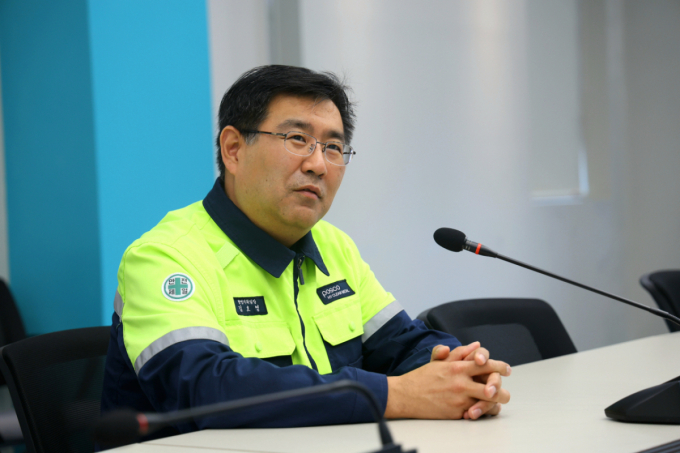
"POSCOHY Clean Metal is responsible for Lisa cycling, the final button in the POSCO Group's secondary battery material value chain (value chain), and is a core company completing the 'Resource Circulation System (Closed Loop).'"
Kim Ho-young, Gyeong Yeong-gi-hoek (Head), whom we met at the POSCOHY Clean Metal factory located in the Yulchon Industrial Complex in Gwangju, South Jeonnam Province on the 17th of last month, stated, "We are playing a key role as part of the 'indispensable resource security company' and 'supply chain guardian' that the group aims to be." He further revealed pride in the battery recycling business, saying, "It is highly significant that we produce raw materials to replace critical secondary battery materials that our country, which lacks natural resources, relies on imports for."
POSCOHY Clean Metal is the only domestic company that recovers critical minerals from used batteries and manufacturing scrap to produce high-quality lithium carbonate, nickel sulfate, cobalt sulfate, manganese sulfate, as well as Busan substances such as copper, all within a single factory. Director Kim emphasized, "Since the production of initial products in May 2023, we have increased our operating rate, which currently exceeds 95%."
He also answered why the POSCO Group entered the battery recycling business while directly securing critical minerals such as lithium and nickel from overseas mines and salt lakes. Director Kim explained, "If mineral procurement through mines and salt lakes is the 'axis of large-scale raw material procurement' to respond to the surge in demand for core raw materials, then Lisa cycling is the axis of resource virtuous circulation and supply chain stability," adding that "recycled raw materials play an important role in securing cost competitiveness."
The POSCO Group is building a supply chain spanning from mines to battery material production and recycling through its affiliates. Nickel secured from Western Australia and other regions is processed into nickel sulfate through its own supply chain connected to affiliates. In fact, graphite secured from mines in Tanzania and Australia is utilized as anode material raw material, while coal tar is transformed into needle coke and pitch at POSCO MC Materials. These raw materials are also fed into the production of precursors, cathode materials, and anode materials by POSCO Future M.
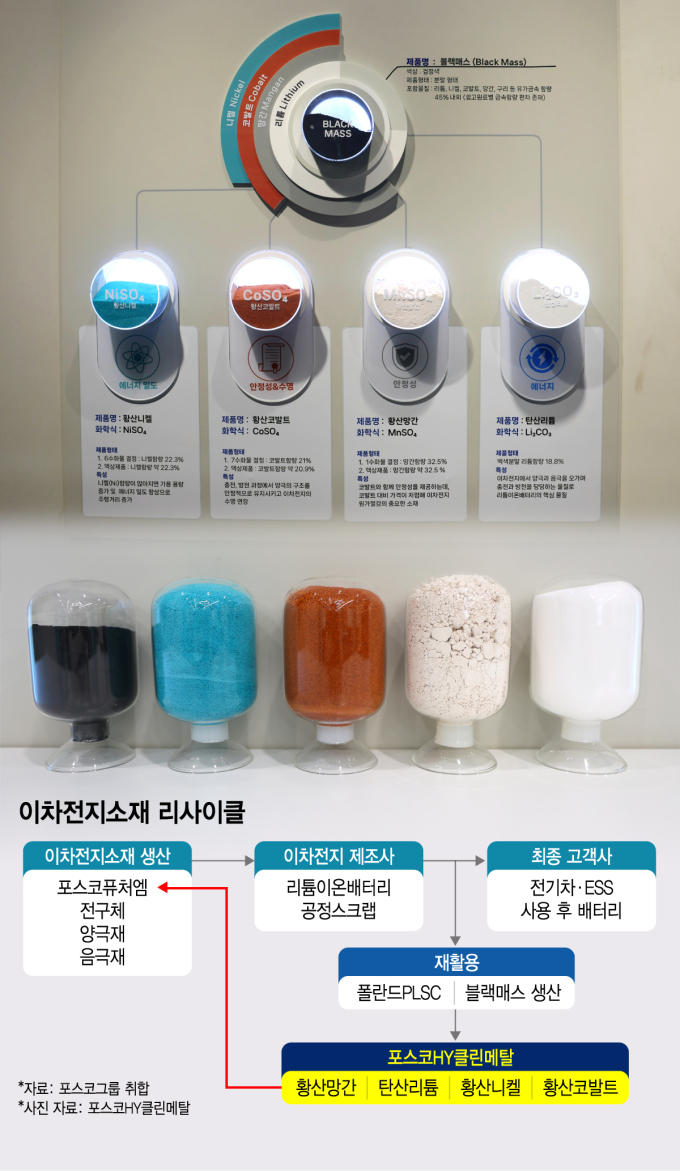
Recycling will play a role in completing the supply chain within the group. POSCO Holdings operates a pre-treatment subsidiary (PLSC) for black mass (black powder containing critical minerals such as lithium, nickel, cobalt, and manganese) in Poland. The black mass produced there is supplied to domestic POSCOHY Clean Metal. Subsequently, through post-processing, it is refined into lithium, nickel, cobalt, and manganese, and then supplied to domestic and overseas companies such as POSCO Future M. In this way, POSCOHY Clean Metal serves as the final button in the resource circulation system.
Director Kim conveyed, "Visits from companies seeking recycled minerals produced in non-China supply chains have continued, allowing us to feel a year-on-year increase in demand." He added, "Battery and finished vehicle manufacturers in the U.S. and Japan are making inquiries, and European finished vehicle manufacturers are also visiting factories to discuss cooperation."
The successive love calls from global companies show that recycled raw materials are emerging as strategic resources. The U.S. has restricted the overseas export of black mass and tungsten waste/scrap since August 27 last year. It mandates priority supply to domestic purchasers and allows overseas sales only in cases where prior exception approval has been granted. POSCOHY Clean Metal is currently conducting negotiations for such exception approval.
This is in the same context as Jang In-hwa, Chairman of the POSCO Group, previously proposing a "Triple Core" strategy that designates steel, secondary battery material minerals, and energy resources as three core businesses, declaring an initiative to strengthen national industrial security and supply chains. Director Kim stated, "In Korea, where minerals are not mined, producing critical minerals through recycling and contributing to the transition from a mining economy to a circular economy is the direction that the group and the company aim for."
[Lisa Cycle Resource Powerhouse]"E0"4"E1" Rewriting Used Batteries (Part 2)
LFP used batteries are increasing rapidly... "Is it a loss the more you strip them?" The recycling dilemma

 in INDUSTRY


