

Driven by rising copper prices and expanded orders in the power infrastructure sector, the Q3 operating profits of LS Cable & System and Daehan Cable are expected to increase year-on-year. However, financial burdens from raw material purchases and production expansion are also growing. Since both companies recorded negative cash flows from operating activities in the first half, the key issue is whether the earnings growth will translate into actual cash inflows.
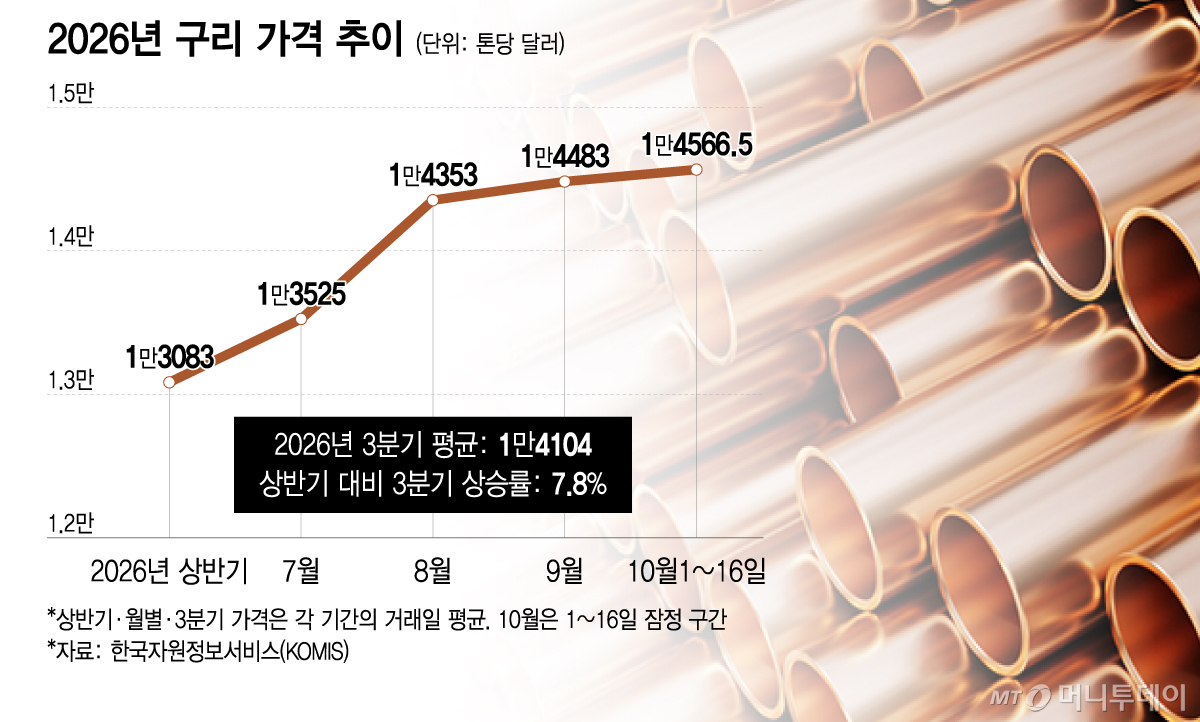
According to Korea Mineral Information Service (KOMIS) on the 20th, the average spot price of copper on the London Metal Exchange (LME) in Q3 this year was recorded at $14,104 per ton (t). This is 7.8% higher than the first-half average ($13,083). Monthly figures also showed an increase from $13,525 in July to $14,483 in September. The average for the 1st through the 16th of this month also reached $14,566.5, indicating that the upward trend continues.
Typically, copper prices are linked to wire product prices, which helps boost earnings. The securities industry also anticipates improved Q3 results. Korea Investment & Securities estimated that LS Cable & System's operating profit would reach 145.9 billion won, an 81.9% increase year-on-year. SK Securities forecast Daehan Cable's operating profit to rise by 54.8% to 46 billion won. However, Daehan Cable's Q3 operating profit forecast is 24.3% lower than its Q2 figure (60.8 billion won).
Despite earnings expectations, the cash positions of both companies are tight. LS Cable & System's first-half cash flow from operating activities showed a net outflow of 704.2 billion won, reversing from a net inflow of 298.2 billion won in the same period last year. Daehan Cable also recorded a net outflow of 318 billion won. This is because even if revenue and profits increase, funds are first invested in raw material purchases and production, creating a time lag before actual cash inflows occur.
This burden is evident in the first-half financial indicators as well. LS Cable & System's inventory increased by 45.2% from 1.4566 trillion won at the end of last year to 2.1149 trillion won at the end of June this year. Accounts receivable also rose from 1.4770 trillion won to 1.7939 trillion won. Cash outflows due to inventory increases in the first half reached 645.3 billion won, while outflows due to changes in accounts receivable amounted to 255 billion won. Daehan Cable's inventory also increased by 59.3% year-on-year to 1.1400 trillion won as of the end of June, and accounts receivable rose by 28.1% to 705.6 billion won over the same period.
Future demand for production funds is also substantial. As of the end of June, LS Cable & System's consolidated backlog, including subsidiaries, was 9.5535 trillion won, a 53.6% increase year-on-year. Daehan Cable's backlog reached 4.0629 trillion won, surpassing the 4th trillion won mark for the first time in history. In particular, extra-high voltage and submarine cables have long manufacturing periods, requiring significant working capital from securing raw materials to recovering payment for delivery. This is why increased orders do not immediately translate into cash acquisition.
Since the strong trend in copper prices continued in Q3, the financial burden of raw material purchases may have increased. Cash flow varies depending on the timing of purchases and the scale of recovered payments. Ultimately, for improved earnings to lead to expanded financial capacity, it must be supported by the speed at which increased inventory is converted into sales and accounts receivable are collected.
An industry official in the wire sector stated, "Rising copper prices are both a positive factor and a burden for the wire industry," adding, "While revenue and profits increase through price adjustments, the structure requires funds to be invested first in copper purchases and production, so increased orders may not necessarily lead to increased cash."

 in INDUSTRY
