

[Exclusive] Chairman Lee Jae-yong personally oversees robotics business... First on-site inspection of 'RX'
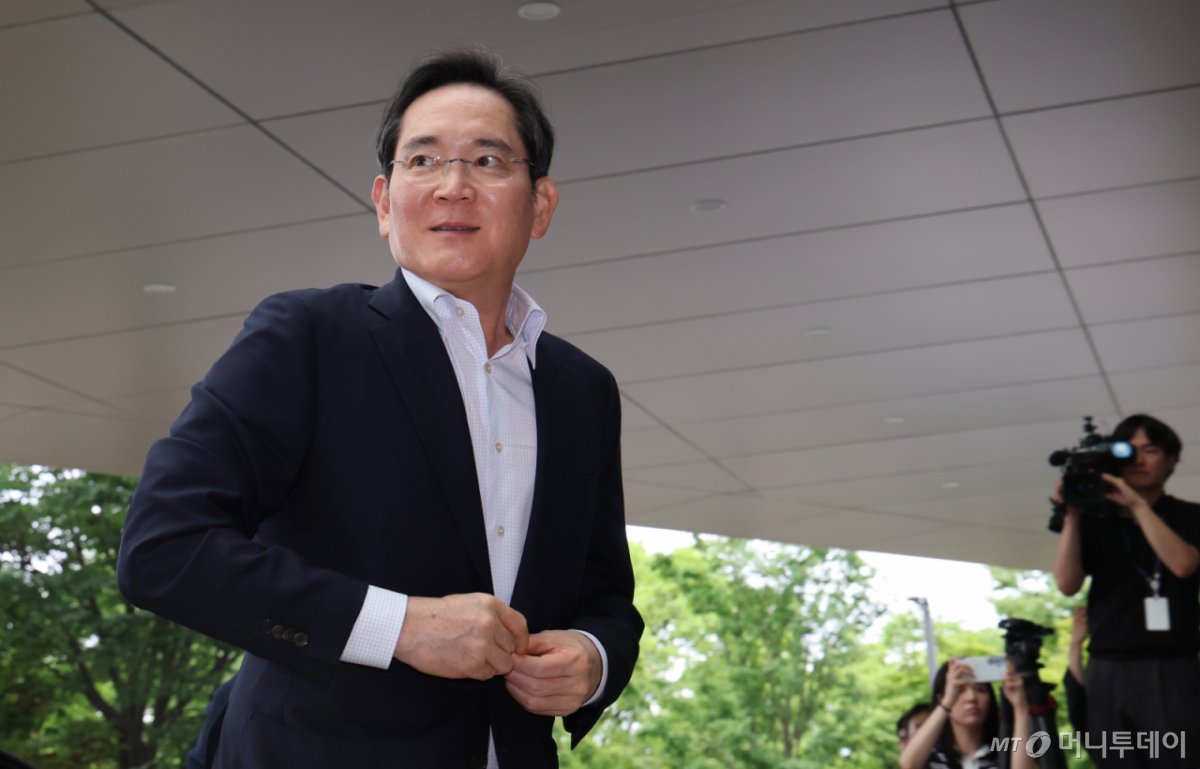
Samsung Electronics Chairman Lee Jae-yong is stepping up efforts to drive the company's robotics business. He is expected to visit the company's RX (Robotics eXperience) Business Development Office soon to review the status of its robotics operations.
It will be his first visit since the office was launched in July. As Samsung seeks to develop robotics into a key future growth engine, Lee's on-site inspection is expected to accelerate efforts to commercialize humanoid robots.
According to industry sources on Wednesday, Lee is expected to visit the RX Business Development Office at Samsung Electronics' Seoul R&D Campus in Umyeon-dong, Seoul, as early as next week. Researchers are expected to demonstrate precision manipulation technology using the arms and hands of humanoid robots.
Lee is also expected to personally review the maturity of the robotics technology and preparations for its unveiling at CES 2027, the world's largest consumer electronics and IT trade show, scheduled to take place in Las Vegas in January.
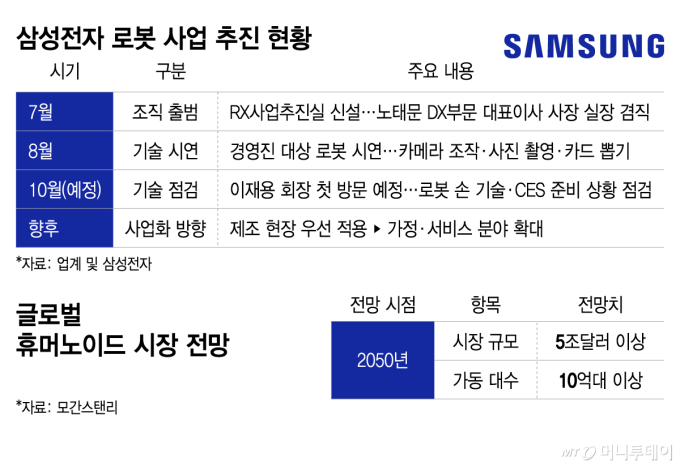
Previously, Samsung Electronics established the RX Business Promotion Office directly under Lee Sa (President), following the appointment of Roh Tae-moon as head of the DX (Device Experience) division in July.
It is an organization designed to consolidate technology development capabilities related to robotics and promote everything from research and development to commercialization in an integrated manner. In August, a robotics technology demonstration for executives was also held with the attendance of Noh (President) and others.
This visit is significant in that it follows the technical inspection by DX division executives, as Lee (Chairman) will directly verify development results. The move is interpreted as showing the will to grow robotics into Samsung Electronics' next-generation core business.
Samsung Electronics plans to prioritize applying robots in manufacturing sites before expanding their use to household and service sectors. This is a strategy to verify actual work capabilities and reliability at its own production facilities, accumulate operational data to refine technology, and then gradually broaden the scope of application.
Behind Samsung Electronics' focus on the robotics business lies expectations for long-term market growth. Global investment bank Morgan Stanley forecasts that the global humanoid market size will exceed 5 trillion dollars (approximately 6,624 trillion won) by 2050. It also predicted that the number of operating humanoids worldwide will surpass 1 billion units. Goldman Sachs also projected that the global humanoid market size will reach 138 billion dollars (approximately 182.8224 trillion won) by 2035.
Han Jae-gwon, a professor in the Department of Robotics at Hanyang University, said, "It is a welcome signal that a giant company like Samsung is fully entering the robotics industry, indicating that the market pie is growing, but it also means competition will be equally fierce."
He added, "The fact that even the chairman is stepping in directly means they are putting significant effort into the robotics business. The participation of large corporations is also a positive signal for nurturing the entire robotics industry."
"Even with a backflip, it couldn't open a bottle cap"... Samsung's 'unique' robotics strategy
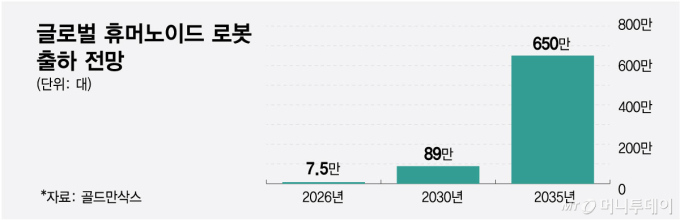
Lee Jae-yong, Chairman of Samsung Electronics, visiting the RX (Robotics eXperience) Business Promotion Office directly to inspect development status is interpreted as a will to strengthen efforts in securing future growth engines through the robotics business.
Samsung Electronics is focusing its robot development on 'actual work capabilities and economic efficiency' rather than 'flashy movements.' Specifically, it is planning a timeline of △ technology verification in manufacturing sites △ expansion of industrial robot application scope △ entry into the household robot market.
According to electronics industry sources on the 21st, Samsung Electronics is considering featuring robots as a major exhibition content at 'CES 2027,' the world's largest home appliance and IT exhibition, to be held in Las Vegas, USA, next January. It could serve as a stage to externally showcase Samsung Electronics' robotics technology capabilities and business strategy. It is observed that the scope of public disclosure for robotics technology and exhibition methods will become more concrete following Lee (Chairman)'s on-site inspection.
Samsung Electronics established the RX Business Promotion Office directly under Roh Tae-moon, President and head of the DX (Device Experience) division, in July to consolidate its robotics business capabilities. It is taking the Seoul R&D campus in Umyeon-dong, Seoul, as a major hub, recruiting specialized personnel, and expanding investments in research and development infrastructure such as office space and laboratories necessary for commercialization.
Although Samsung Electronics' robotics technology has not yet been disclosed externally, it is reported to have reached a considerable level. In an internal demonstration attended by Division Head Roh in August, the robot demonstrated actions such as operating a camera to take photos and drawing out cards. This requires precisely adjusting finger movements and force depending on the shape and thickness of objects. Within Samsung, there are evaluations that it has shown precision manipulation technology beyond simple object grasping.
A large-scale manufacturing base is a strength held by Samsung Electronics. The company operates more than 100 product production lines worldwide. It can directly utilize robots in various manufacturing environments and verify their performance. Samsung Electronics plans to first verify the work capabilities and reliability of robots at its own production sites, and accumulate actual work data to improve performance. Based on this, it aims to broaden the application scope of industrial robots before expanding into service and household robot markets.
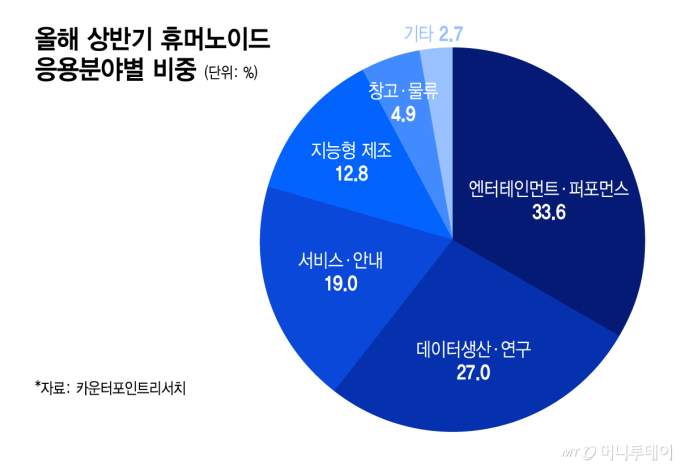
The global humanoid robot market is also growing rapidly. Goldman Sachs forecasts that annual shipments of humanoid robots will reach 6.5 million units by 2035. This is approximately 4.6 times the 1.4 million units projected in 2024.
However, the utilization of humanoid robots in actual industrial sites remains limited. According to market research firm Counterpoint Research, among global humanoid robots shipped in the first half of this year, those for entertainment/performance and data collection/research purposes accounted for more than 60%. The shares for intelligent manufacturing and warehouse/logistics sectors were only 13% and 5%, respectively.
What Samsung Electronics is paying attention to is the actual work capability of robots. Chris Hauser, Lab Head of Samsung Electronics' RX Business Promotion Office, said at the 'Samsung AI Forum 2026' held on the 30th of last month, "A robot may be able to do a backflip, but it might not be able to open a water bottle cap." This means that even if full-body control technology for robots has developed, fine manipulation capabilities remain insufficient.
This is why 'robot hand' technology is drawing attention. Samsung Electronics is developing methods such as the tendon approach, which moves fingers using cables like human tendons, to secure precise movement and force control technology. The core capability is adjusting force finely so that objects can be grasped stably without being damaged. Securing economic efficiency is also a challenge. Humanoid robots have significant costs not only in hardware price but also in the cost of teaching them tasks and maintenance fees. It is currently evaluated that hiring humans is more economically advantageous.
An industry official said, "Samsung has favorable conditions for nurturing the robotics business at the group level," adding, "Within the group, it holds related business capabilities such as camera modules, sensing, batteries, and motors, which are core components of robots."
'80-year and 60-year speaker legends' gathered in one place... Samsung boosts audio synergy
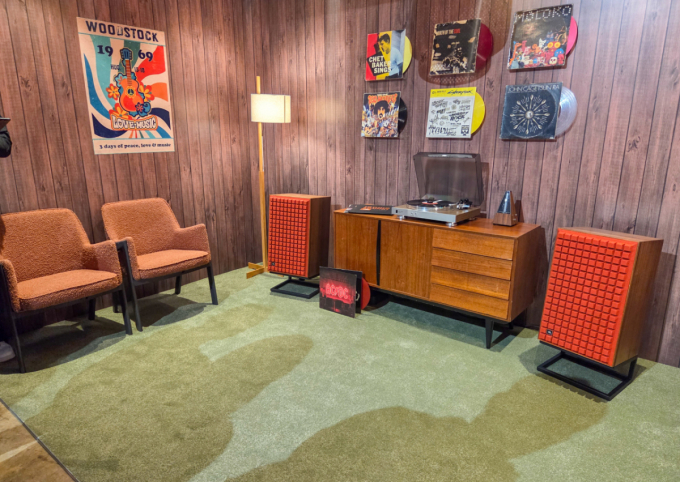
In a space recreating a 1970s home, The Hollies' song 'Long Cool Woman' played. From a wood speaker equipped with an orange 'Quadrex Foam Grille,' lively electric guitar riffs and the heavy bass low tones resonated clearly note by note. It was the sound of the 'L100 Century,' a speaker representing JBL, an audio brand under Harman, a subsidiary of Samsung Electronics.
Samsung Electronics held the 'JBL 80th Anniversary · Bowers & Wilkins 60th Anniversary Commemorative Exhibition Media Day' on the 21st at 'Project Space LINE' in Gangnam-gu, Seoul. In the three-story exhibition hall, visitors could review the history of audio technology development through more than 100 representative products from each era of the two brands.
JBL's L100 Century is a speaker that implemented the audio technology of the '4310 Studio Monitor,' used in professional recording studios in the 1960s, for home use. It allows users to experience at home the studio monitor technology utilized in the production of albums by world-renowned musicians such as John Lennon and Michael Jackson.
JBL's high-end audio 'JBL Summit K2' was also showcased. Inspired by the names of world-famous peaks like Everest and K2, it carries the meaning of aiming for the pinnacle of audio technology. It achieves precise and clear sound by applying technologies such as the 'D2 Compression Driver.' When Adele's song 'All I Ask' played, even the subtle tremors in her voice and the sound of her inhaling were conveyed delicately.
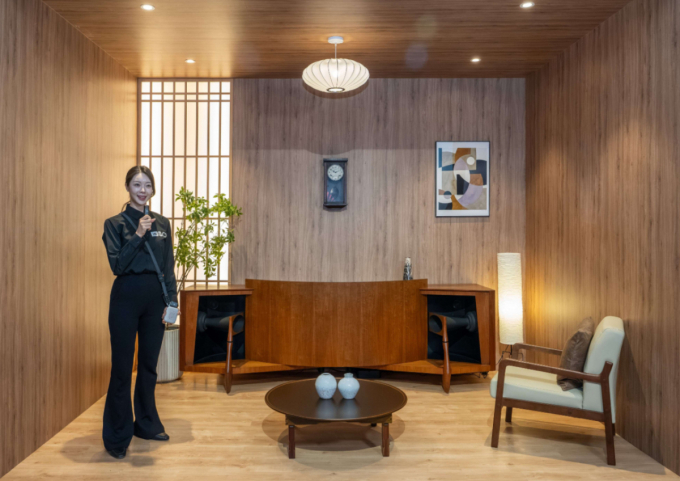
JBL has also pursued innovation in design. The 'Paragon,' released in the 1950s, is a stereo speaker that houses left and right speakers and an acoustic reflection structure in a single cabinet. It was designed to add aesthetic appeal to audio equipment so it could be used as an interior object. The Paragon placed in a space recreating a 1950s home evoked the image of a high-end solid wood living room table.
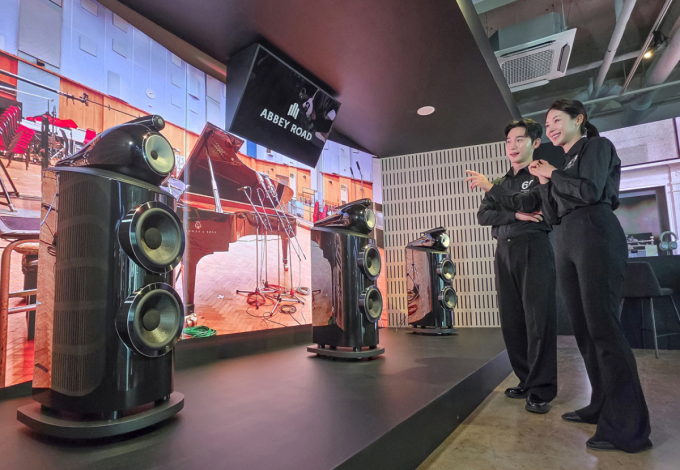
Bowers & Wilkins' latest flagship speaker, the '800 Series Diamond D5,' was also exhibited. It is designed to reproduce high-frequency ranges precisely by incorporating a tweeter made of synthetic diamond material. A Bowers & Wilkins official explained, "Bowers & Wilkins, established in 1966, has developed with the goal of creating speakers that achieve 'True Sound.' The D5, designed and produced in Woking, UK, is a product that embodies decades of accumulated research results, engineering capabilities, and craftsmanship." In addition, Bowers & Wilkins' first speaker, the 'P2H,' and the 'Nautilus,' inspired by the spiral structure of a nautilus shell, were exhibited.
It was an exhibition where one could glimpse Samsung Electronics' future audio strategy. Samsung Electronics plans to strengthen competitiveness by integrating the audio technologies of Harman and Bowers & Wilkins into its main products such as smartphones, TVs, and soundbars. Samsung Electronics announced the acquisition of Harman in 2016 and completed it the following year for approximately 8 billion dollars (approximately 940 trillion won at the time). It was the largest overseas mergers and acquisitions (M&A) by a domestic company at that time. Last year, through Harman, it additionally acquired premium audio brands such as Bowers & Wilkins, Denon, and Marantz.
Son Young-gwon, Advisor at Samsung Electronics (Harman Lee Sa-hoe (Chairman)), stated, "This is an opportunity to experience the 80th-year history of JBL's sound and the 60th-year legacy of Bowers & Wilkins in one place," adding, "Samsung Electronics will continue audio technology innovation together with Harman so that customers worldwide can enjoy the best sound in every moment of their daily lives."
The 'Sound Legends' exhibition commemorating JBL's 80th Anniversary and Bowers & Wilkins' 60th Anniversary will run from the 24th to the 31st.

 in INDUSTRY


