

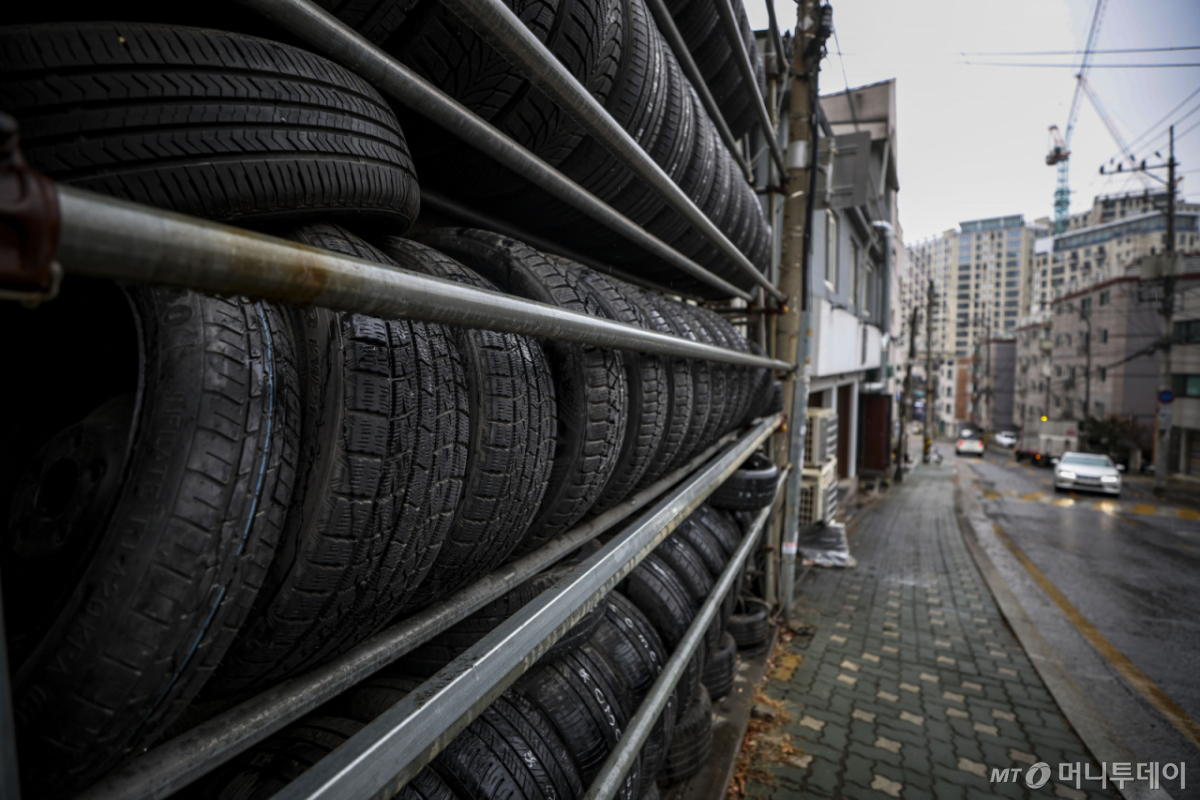
Concerns within the tire industry are growing as raw material prices rise again and ocean freight rates remain high. Ahead of third-quarter earnings releases, Kumho Tire and Nexen Tire are expected to fall short of market expectations, while profitability improvements are also projected to be difficult in the fourth quarter due to the time lag in price increases.
According to industry sources on the 21st, as of mid-month, natural rubber prices stood at $2,645 per ton, up 48% year-on-year. Synthetic rubber prices rose 50% to $2,380 per ton. Prices for butadiene and styrene, raw materials for synthetic rubber, also surged by 55% and 78%, respectively. This is due to the combined effects of rising oil prices, disruptions in natural rubber supply, and decreased synthetic rubber production resulting from the restructuring of global naphtha cracker (NCC) facilities. Key raw material prices had fallen until July before turning upward again in the third quarter. Natural rubber and synthetic rubber prices have risen by 3% and 7%, respectively, over the past month.
The burden of ocean freight for finished product exports is also significant. As of the 16th, the Shanghai Containerized Freight Index (SCFI) stood at 3,679.58 points, up 0.4% from Jeonju. It has continued an upward trend since the outbreak of the US-Iran war at the end of February last month. Although recent gains have slowed, it has surged 176% compared to the 1,333.11 points at the time the war broke out. While it falls short of the 5,000-point level seen during the COVID-19 pandemic (global outbreak), it is approaching the peak of 3,700 points recorded during the Red Sea crisis.
Third-quarter earnings outlooks vary by company. Hana Securities forecast that Hankook Tire & Technology’s third-quarter operating profit would be 554 billion won, a 5% decrease year-on-year but in line with market expectations. Kumho Tire is predicted to post an operating profit of 109.6 billion won, falling 24% short of market expectations. Its operating profit margin is expected to drop by 4.7 percentage points from the previous quarter to 9%. Korea Investment & Securities projected that Nexen Tire’s third-quarter operating profit would decrease by 31.5% year-on-year to 32 billion won, with an operating profit margin of just 3.8%. This is due to rising costs, a high proportion of production from domestic factories, reduced operating days due to the Chuseok holiday, and lower converted selling prices in won terms due to a stronger won.
The issue lies in the fourth quarter. Although companies have raised selling prices by 2% to 5% depending on the region, the effect of these increases is reflected with a lag of about one quarter. Conversely, raw materials purchased two to six months prior are being used in production, meaning that price increases during that period will be fully reflected in fourth-quarter costs. The industry expects the bottom of the gap (spread) between selling prices and costs to be delayed from late fourth quarter to the first half of next year.
Tariffs and exchange rates are also a burden. The European Union (EU) has imposed anti-dumping tariffs on Chinese-made tires since July last month, at 4.3% for Hankook Tire and 24.4% for Kumho and Nexen Tires. Kumho Tire, which sources about half of its European sales from Chinese factories, is expected to see its tariff costs increase from 40 billion won in the third quarter to 47.7 billion won in the fourth quarter. The fact that the won-euro exchange rate has fallen by 13% over the past three months is also unfavorable for companies with a large European share. Hankook Tire’s European sales account for 47%, while Kumho Tire’s account for 30%.
Companies are responding by reallocating production sites. Kumho Tire plans to reduce tariff exposure by utilizing its Korean and Vietnamese factories, and to expand production capacity with the completion of its Poland and Hampyeong factories in 2028. Hankook Tire is shifting US export volumes from its Korean factory to Europe as utilization rates at its Tennessee plant rise. Song Sun-jae, a researcher at Hana Securities, stated, "Due to demand slowdown, rising input costs, and the impact of tariffs, the profit momentum of tire companies will decline in the short term."

 in INDUSTRY
