

As electricity demand surges due to the expansion of artificial intelligence (AI) data centers, the future of small modular reactors (SMRs), which have emerged as a next-generation energy source, can be examined all in one place. Attendees can explore everything from commercialization strategies to construction, investment, industrial heat utilization, and safety regulations, as well as the technological competitiveness of domestic companies.
A special SMR session will be held at "Smart Energy Plus (SEP) 2026," taking place on the 28th in Hall B of COEX in Gangnam-gu, Seoul. Speakers from SK Innovation, Samsung C&T, Samsung Asset Management, SMR ventures, and the Nuclear Safety and Security Commission will discuss the commercialization potential of next-generation nuclear power and strategies for building an industrial ecosystem.
Yoo Hyung-geun, team leader of the Energy Solutions Business Division at SK Innovation, will introduce the market potential of SMRs being pursued as a future energy business and the Korean-style sodium SMR business model under the theme "Opening Next-Generation SMRs with K-Natrium."
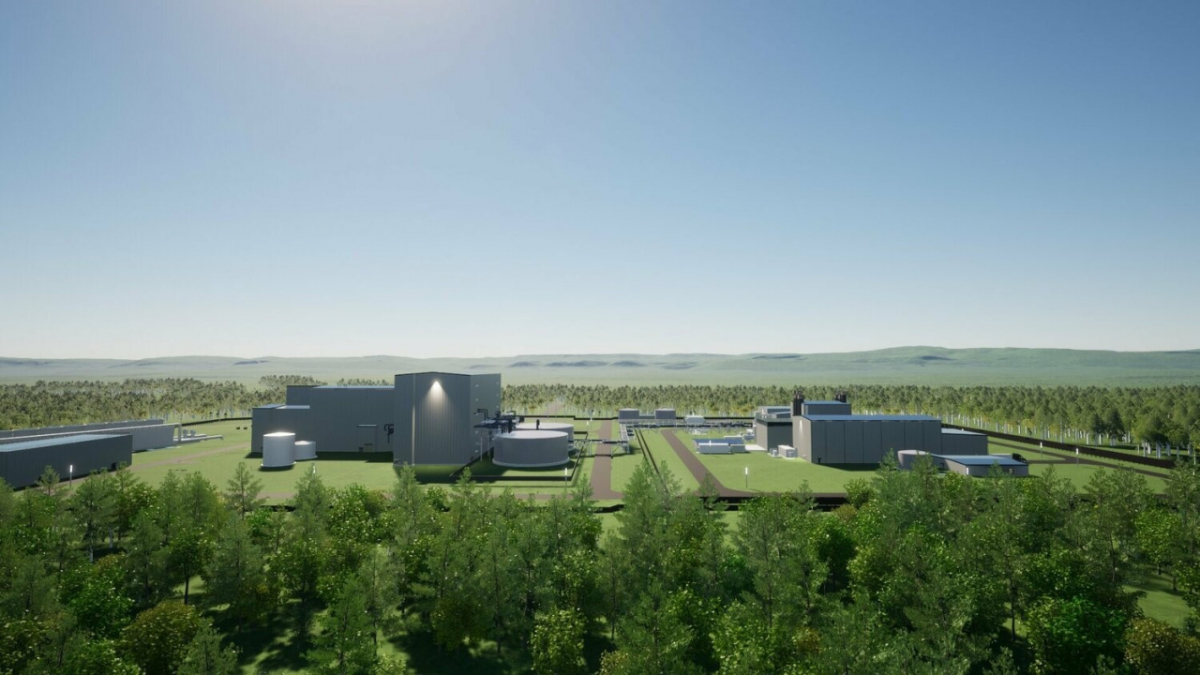
In 2022, SK Innovation jointly invested a total of $250 million in Terah Power, a U.S. SMR company founded by Bill Gates, alongside SK Inc., becoming one of its two major shareholders. Terah Power plans to complete the construction of a fourth-generation sodium SMR in Wyoming, U.S., by 2030. The two companies plan to concretize the "K-Natrium" business model after reviewing global regulatory and industrial conditions, as well as power grid infrastructure.
The increase in electricity demand driven by the spread of AI data centers is cited as a key factor heightening the need for SMRs. Team Leader Yoo recently appeared on a YouTube channel, stating, "SMRs themselves hold significant meaning in the energy mix and are valuable as a new market," and emphasized, "We cannot simply wait until the first commercial unit project in the U.S. is completed." He also revealed that SK Innovation is considering participating in the SMR business as a private power generator.
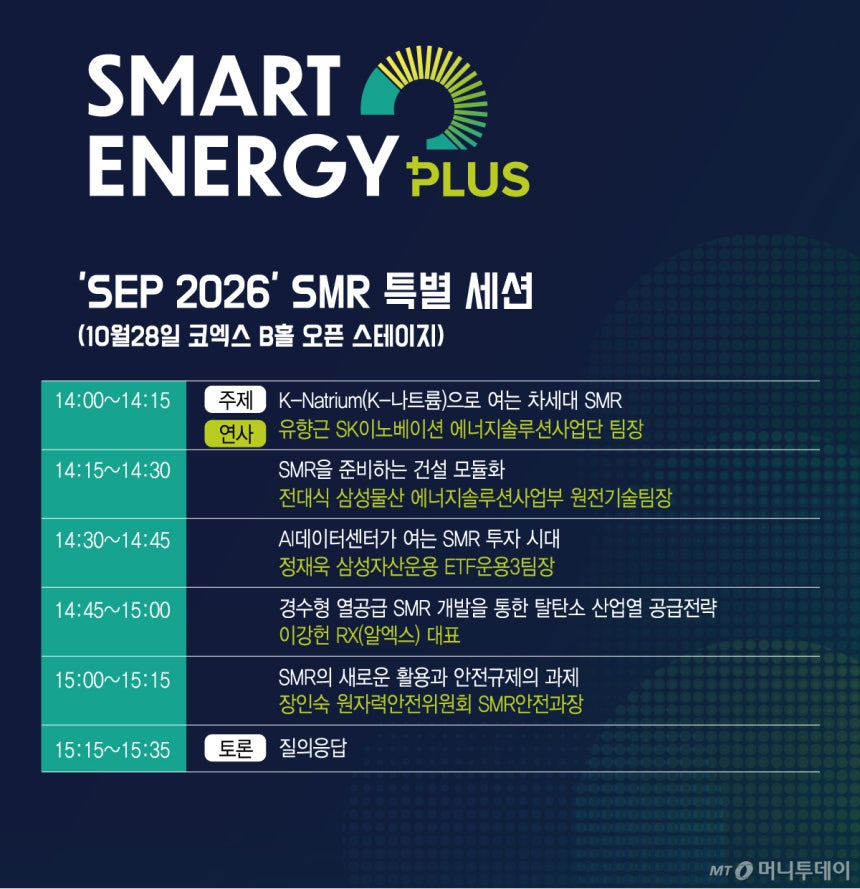
The event will also address challenges that must be overcome to commercialize SMRs. Jeon Dae-sik, Won Jeon-gi-sul (Team Lead) of the Energy Solutions Business Division at Samsung C&T, will present on "Construction Modularization for SMR Preparation," while Jung Jae-wook, team leader of ETF Management Team 3 at Samsung Asset Management, will speak on "The Era of SMR Investment Opened by AI Data Centers."
Lee Kang-heon, CEO of RX, will introduce a "Decarbonized Industrial Heat Supply Strategy through the Development of Light Water Reactor Heat Supply SMRs," and Jang In-sook, section chief of the SMR Safety Division at the Nuclear Safety and Security Commission, will discuss "New Utilization of SMRs and Challenges in Safety Regulation." Experts from key areas of the SMR ecosystem, including business planning, construction, investment, technology, and regulation, will gather in one place.
At the exhibition hall, attendees can also review the business strategies of domestic companies entering the global SMR market. Doosan Enerbility is participating in supply chain development with global firms such as NuScale Power, X-energy, Terah Power, and Rolls-Royce SMR. The event will feature a model of NuScale Power's SMR to introduce next-generation nuclear technology and Doosan Enerbility's business competitiveness.
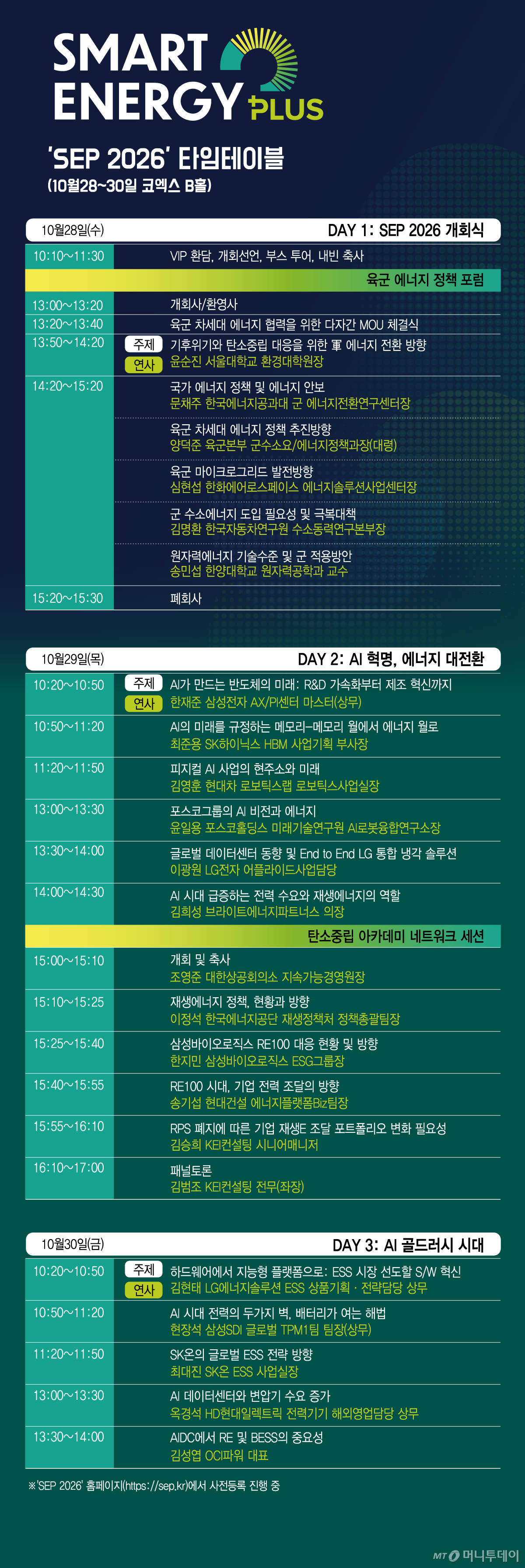
Meanwhile, "SEP 2026" will be held from the 28th to the 30th in Hall B of COEX. This year's themes are "Energy Circulation in the AI Era" and "Energy Security Amid Rapidly Changing International Conditions." A Land Forces Energy Policy Forum will begin at 1 p.m. on the 28th. On the 29th and 30th, senior executives from Samsung Electronics, SK Hynix, Hyundai Motor, LG Electronics, POSCO, Bright Energy Partners, LG Energy Solution, Samsung SDI, SK On, HD Hyundai Electric, and OCI Power will deliver lectures.
The three-day exhibition will feature booths from companies including LG Group, HD Hyundai Electric, Doosan Enerbility, and Yuneec, as well as institutional investors such as the Land Forces, Seoul Metropolitan Government, Korea Atomic Energy Research Institute, Korea Machinery Research Institute, Korea Institute of Energy Technology, Electronics and Telecommunications Research Institute, Korea Research Institute of Chemical Technology, Korea Research Institute of Standards and Science, Korea Institute of Geoscience and Mineral Resources, Korea Construction Technology Institute, and the Technology Guarantee Fund.
In a separately designated mobility zone, visitors can experience the competitiveness of electric and hydrogen vehicles from Hyundai Motor, BMW, Mercedes-Benz, Audi, Porsche, and Polestar. Hyundai Rotem will create a space where attendees can experience a hydrogen fuel cell tram through virtual reality (VR).

 in INDUSTRY


