

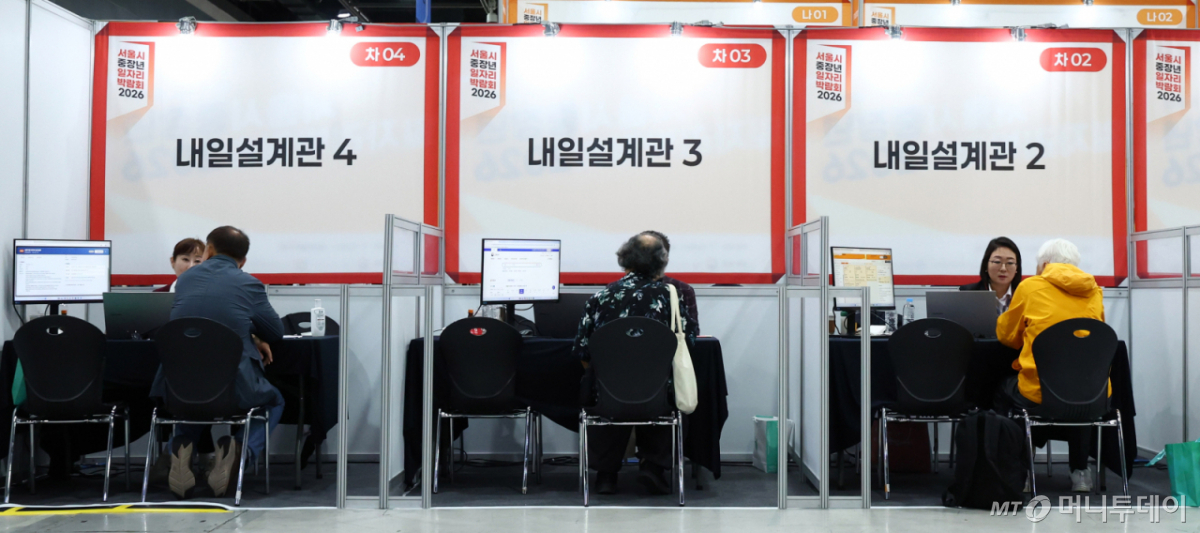
# Company A in the IT (Information Technology) industry, which typically hires about 100 new graduates each year, has cut its new graduate recruitment by more than 20% this year. The preference for experienced workers who can be immediately deployed to the field is not a recent phenomenon, but it has intensified recently. Concerns are emerging that AI (Artificial Intelligence) sweeping through industrial sites and so-called AX (AI Transformation) are further squeezing youth hiring.
According to business circles on the 23rd, as companies' preference for experienced workers overlaps with the spread of AI, the door to new graduate recruitment for young people is narrowing.
With mass recruitment for new graduates disappearing at major groups excluding Samsung, companies are placing their center of gravity on hiring experienced workers. According to an analysis by the Korea Chamber of Commerce and Industry (KCCI) of job postings listed on private recruitment platforms in the first half of last year, 82% of approximately 144,000 listings sought only experienced candidates. Only 2.6% of companies were looking exclusively for new employees.
As the AI era has fully taken hold this year, this trend is becoming even more pronounced. An HR executive at a major domestic group stated, "The more advanced AX becomes, the more people with planning skills will use AI as a tool to perform their duties, which can lead to a situation where fewer new hires are needed immediately." This means that one experienced worker can replace the work of several new graduates.
Given these circumstances, existential anxiety is growing. In a survey conducted by The Korea Economic Daily Association (The Korea Economic Daily (Hankyung) Association) at the end of July this year targeting 1,000 young people nationwide (aged 19 to 34), 53.9% of respondents said it was highly likely that their "current or desired job" would be replaced or reduced by AI within the next five years. More than half, at 53.6%, agreed with the anxiety that they could fall behind in competition due to gaps in AI utilization skills.
The burden on young people who cannot find jobs continues to grow. According to a "Survey on Job Preparation Costs for Job-Seeking Youth" conducted this month by The Korea Economic Daily (Hankyung) Association, commissioned from polling firm Mono Research, targeting 1,000 young people nationwide (aged 19 to 34) currently engaged in job hunting, the average monthly job preparation cost over the past three months was calculated at approximately 580,000 won. The longer the job preparation period, the greater the financial burden tended to be. The average monthly preparation cost for young people who had been preparing for more than three years reached approximately 800,000 won, significantly higher than those who prepared for less than six months (560,000 won) or from six months to less than one year (520,000 won).

The solution lies in creating practical touchpoints that consider the demands of industrial sites. A business circle official stated, "Due to rapid changes in the industrial environment such as AI, it is inevitable that companies prefer experienced workers and mid-level new hires who can be immediately deployed to practical work," adding, "To ease employment barriers for young job seekers, the government should expand work experience programs and strengthen corporate incentives, while companies must significantly increase internship and on-site training opportunities."
At the individual company level, efforts are also being made to resolve such mismatches. This is an attempt to provide young people with work experience while allowing companies to secure talent that can be relatively quickly deployed to the field.
This is so-called "recruitment-linked internships." It is a system that provides young people with practical employment opportunities by operating internship processes premised on conversion to regular employment, going beyond mere experiential levels. R&D (Research and Development) industry-academic scholarship programs are also being introduced or considered by several companies. This method involves selecting master's and doctoral students in core fields of major science and engineering majors as industry-academic scholars and granting them eligibility for employment after graduation. In many cases, scholarships and welfare benefits are provided even before employment.
Considering such environmental changes, companies are in a mood to activate employment systems based on field experience. For example, LS Cable & System is considering expanding its "recruitment-linked internship" program beyond the existing once-a-year operation because the competition ratio approaches 200 to 1 each time it recruits.
Institutional support and the establishment of a national ecosystem are also necessary. Another business circle official stated, "Educational sites such as universities should also restructure their curricula centered on job-based practical training, and the government, companies, and academia must work together to build an ecosystem that helps young people accumulate real-world experience."
Above all, there is much criticism that the government should support companies so they can create jobs. The argument is that if anti-corporate laws and regulations are imposed on businesses, youth jobs will disappear accordingly. Business leaders are raising their voices, stating, "Conditions must be created for high-quality youth jobs to be continuously generated through regulatory improvement and investment activation."
In addition, the extension of mandatory retirement age is also an issue. A business circle official stated, "The statutory retirement age extension currently under discussion by the government and ruling party could squeeze youth employment, so cautious deliberation is needed."

 in INDUSTRY

