

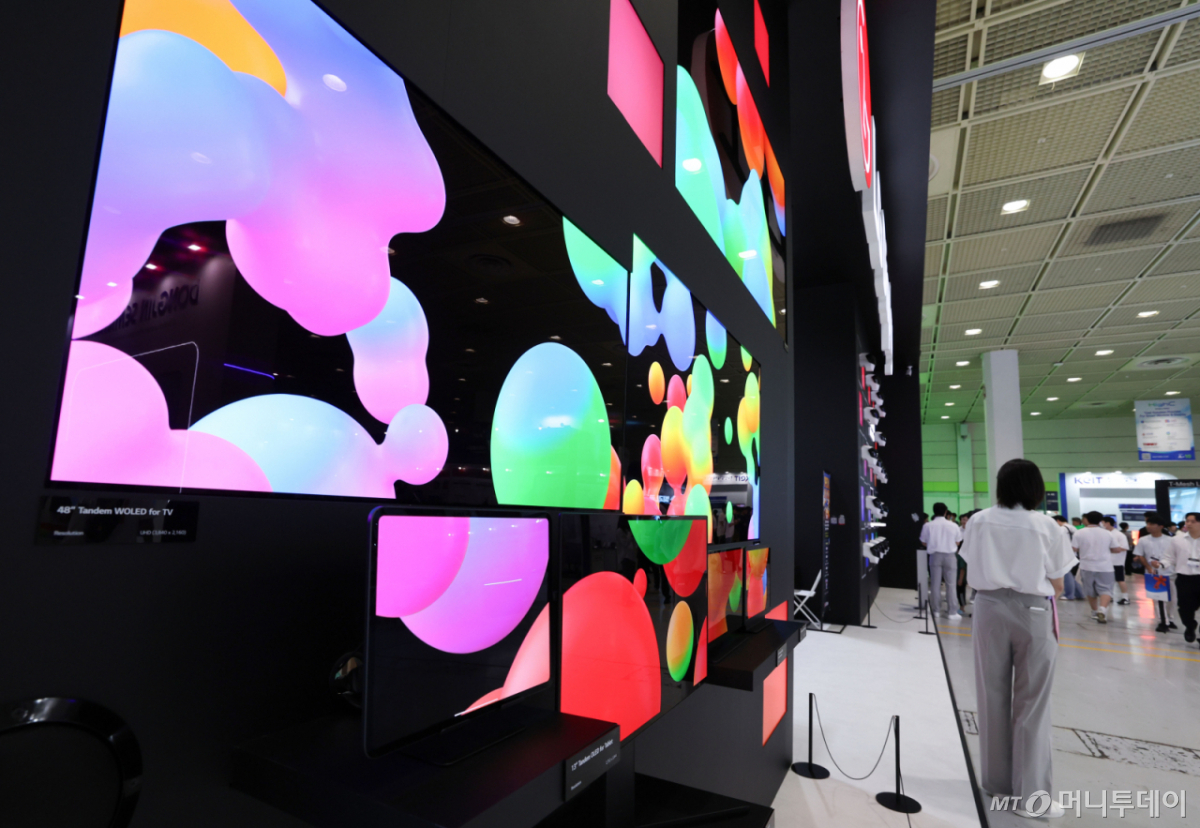
Domestic display companies leading the global OLED (organic light-emitting diode) panel market have moved to reduce their dependence on a key component that has been effectively monopolized by Japan through a technological shift. They are pursuing both improved panel performance and technological self-reliance not only by domesticating Japanese-made components, but also by developing new processes that do not use the components themselves.
According to the electronics industry on the 27th, Japanese companies account for approximately 90% of the global FMM (fine metal mask) market. An FMM is a component made by drilling tens of millions of microscopic holes smaller than a human hair into a metal sheet thinner than paper. Much like a painter uses a stencil to spray paint, OLED red, green, and blue (RGB) light-emitting materials are deposited through these holes to form pixels.
Domestic companies lead the OLED panel market with approximately 70% market share. Since becoming the first in the world to sell large-size OLED TV panels in 2013, LG Display has expanded its business into monitors and achieved cumulative sales of 50 million large-size OLED panels. However, the supply chain for FMMs, a key component in OLED panel production, is effectively controlled by Japanese companies. Dependence on Japanese-made products is close to 100%.
In particular, Japan's DNP (Dai Nippon Printing) holds approximately 70% of the global FMM market, occupying a near-monopoly position. It is estimated that domestic companies spend at least 60 billion won annually on FMM purchases from DNP alone. An industry official explained that DNP holds the upper hand in supply negotiations based on its high market share and technological capabilities.
Japan's influence is also formidable in the raw materials sector for FMMs. 'Invar,' a thin film of iron-nickel alloy that serves as the core material for FMMs, is supplied primarily by Japan's Proterial (formerly Hitachi Metals). In the equipment market for depositing light-emitting materials using FMMs, Canon Tokki, a subsidiary of Japan's Canon, also exerts strong influence. A single Canon Tokki deposition machine costs well over 1 trillion won (based on 8.6-generation lines). Japanese companies thus exert strong influence across the entire spectrum of materials, components and equipment that are central to OLED production.
Domestic display companies have begun developing next-generation OLED processes that do not use FMMs in order to change this supply chain structure. A representative technology is 'FLiPP' developed by LG Display. FLiPP is a process that forms RGB pixels using photolithography technology, which is used in semiconductor manufacturing, instead of the conventional FMM. It involves depositing organic light-emitting material across the entire substrate and then using light to remove unnecessary parts. Because it does not use an FMM, it can reduce dependence on key Japanese-made components.
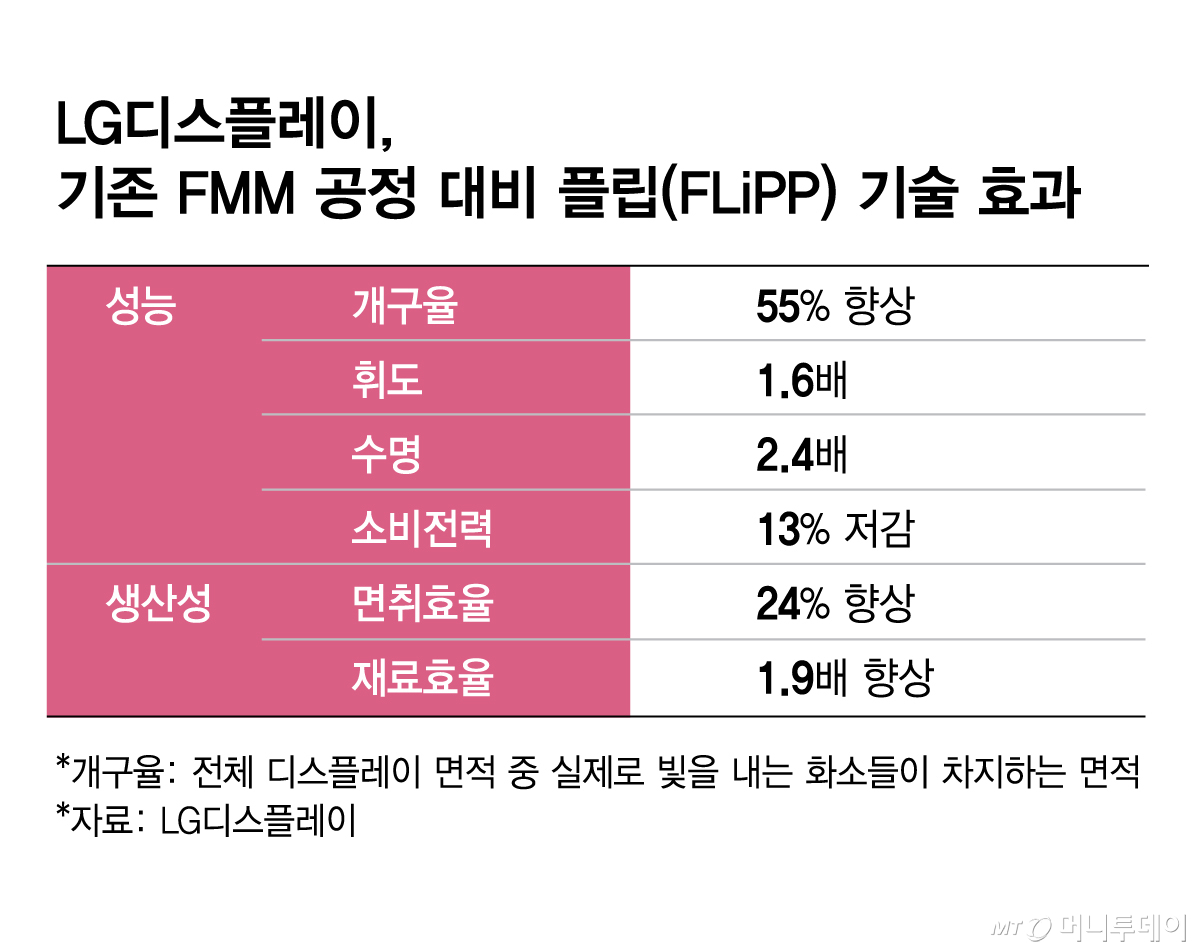
The effect on panel performance improvement is also significant. According to LG Display, utilizing FLiPP can raise the aperture ratio from approximately 42% in existing processes to 65%. The aperture ratio is the proportion of the total pixel area that actually emits light. As the light-emitting area expands, brightness can be increased by up to 1.6 times or lifespan extended by up to 2.4 times compared to conventional methods. A reduction in power consumption is also expected.
Furthermore, the existing FMM method has a problem where the center of the metal mask sags downward as its size increases. Consequently, the existing FMM method involves the constraint that large glass substrates must be cut for use. In contrast, FLiPP can utilize an entire 8.5-generation mother glass sheet measuring 2.2 meters wide and 2.5 meters long. Theoretically, it can produce everything from 1-inch-class smartwatches to ultra-large TVs of 100 inches or more using a single process. Material utilization efficiency can be raised from 40% to 74%.
The significance of FLiPP lies in changing the approach to technological self-reliance itself. It secures a new production process that does not require the component, going beyond merely domesticating components imported from overseas. LG Display is first pushing for application in IT products such as laptops and monitors, with plans to expand the scope of application according to future customer demand. Samsung Display is also researching and developing next-generation OLED patterning technology that does not use FMMs.
However, it is expected that new processes will be difficult to completely replace the existing FMM method in the short term. Investment burdens associated with introducing new equipment, securing mass production yields, and stabilizing the process are cited as challenges to be resolved. An industry official said, "It will be difficult to introduce non-FMM methods into all OLED production immediately," adding, "Even if the new technology enters the mass production stage, it is highly likely that it will run in parallel with existing FMM processes for a while."

 in INDUSTRY

