

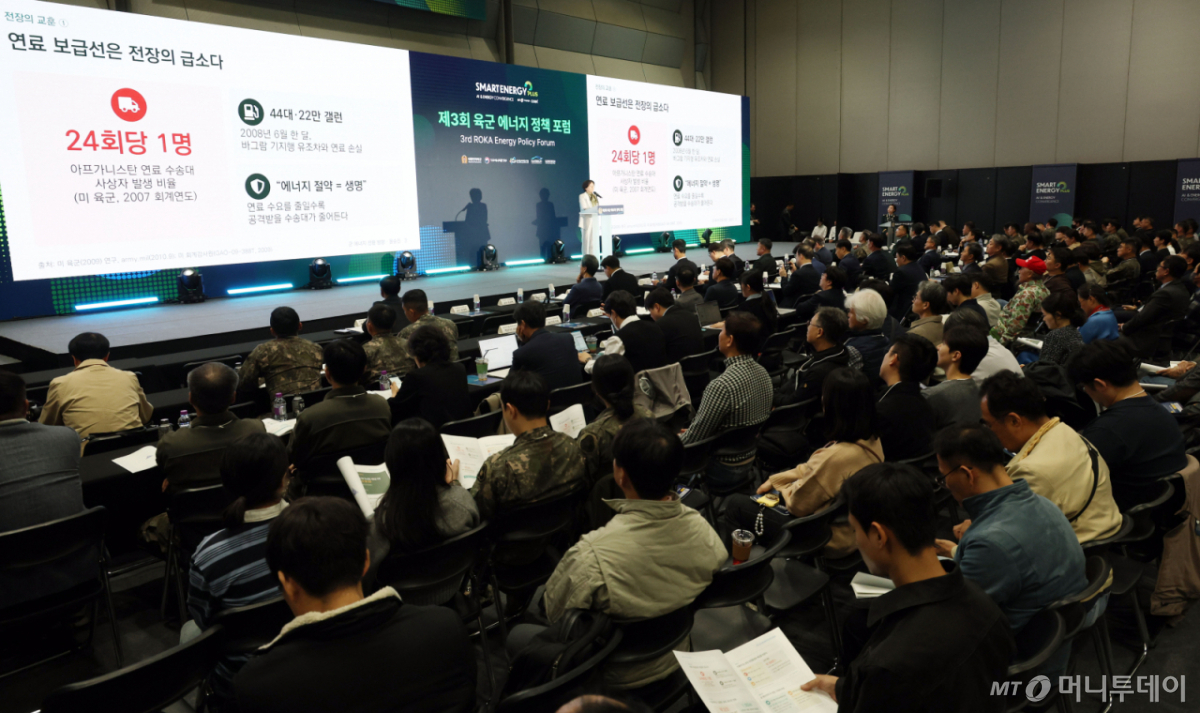
A proposal has been put forward that the military should shift away from reliance on a single power source and transition to a multi-source system combining renewable energy, energy storage systems (ESS), hydrogen, and other sources to strengthen energy security. A long-term plan was also presented to enhance energy self-sufficiency by utilizing small nuclear reactors.
The "3rd Army Energy Policy Forum" at "Smart Energy Plus (SEP) 2026," held on the 28th in Hall B of COEX in Samsung-dong, Seoul, discussed the direction of the military's energy transition and technology adoption challenges with microgrids as the central theme. Experts emphasized the need to build an energy system that not only improves energy efficiency during peacetime but also enables sustained operations without relying on external power grids during wartime.
In modern warfare, energy supply is considered a core factor determining military combat capability. Yang Deok-jun, colonel and head of the Military Requirements and Energy Policy Division at the Army Headquarters, stated, "Russia has struck all of Ukraine's thermal and hydroelectric power plants and substations since the war began, and continues to do so," adding, "Ukraine is also continuously attacking Russia's energy infrastructure."
He further noted, "Our country relies on oil- and nuclear-based electricity from Korea Electric Power Corporation, and the Army is no different," diagnosing that "the domestic and international energy security environment is not favorable, and military energy consumption will continue to increase." He explained that as the spread of advanced weapon systems such as drones and quadruped robots increases power demand, the stability of energy supply must be secured.
The microgrid project being pursued by the Army aims to respond to these threats. A microgrid is a small-scale power network capable of generating and storing electricity and supplying it independently as needed. Colonel Yang stated, "The Army is making various attempts to introduce weapons that reduce noise exposure to the enemy, equipment that minimizes heat generation to reduce the likelihood of detection by enemy thermal imaging devices, and weapons and equipment that can supply high-efficiency electricity even with small batteries," adding, "The Sangmu-dae microgrid pilot project is the first initiative among these Army efforts."
Experts emphasized that such energy independence is not only important during wartime but also has the effect of reducing energy costs in peacetime. Shim Hyun-seop, head of the Energy Solution Business Center at Hanwha Aerospace, stated, "Based on a battalion-level operational area, deploying microgrids is expected to reduce fuel consumption by approximately 40%," adding, "This translates to an annual reduction of 113,000 liters, or roughly 170 million won in fuel costs."
Experts attending the forum on the day recommended expanding the power supply system beyond solar energy. Kim Myung-hwan, head of the Hydrogen Power Research Division at the Korea Automotive Technology Institute, stated, "Hydrogen fuel cells produce almost no noise and generate heat below 100 degrees," adding, "Existing mobile generators can be modified for military suitability and applied, and hydrogen forklifts can be introduced at supply depots and maintenance facilities, allowing phased demonstration to begin in the areas of power support and logistics support."
A long-term plan was also presented to enhance the sustainability of power supply by utilizing nuclear energy. In particular, it was assessed that Micro Modular Reactors (MMR), which are smaller in scale than large nuclear plants or Small Modular Reactors (SMR), may be suitable. Song Min-seop, a professor in the Department of Nuclear Engineering at Hanyang University, analyzed, "Nuclear power is an energy source with high energy density, and MMRs can operate for more than eight years without replacing nuclear fuel once manufactured," adding, "This can reduce the burden of fuel supply and play an important role on future battlefields with high power demand."

 in INDUSTRY
