

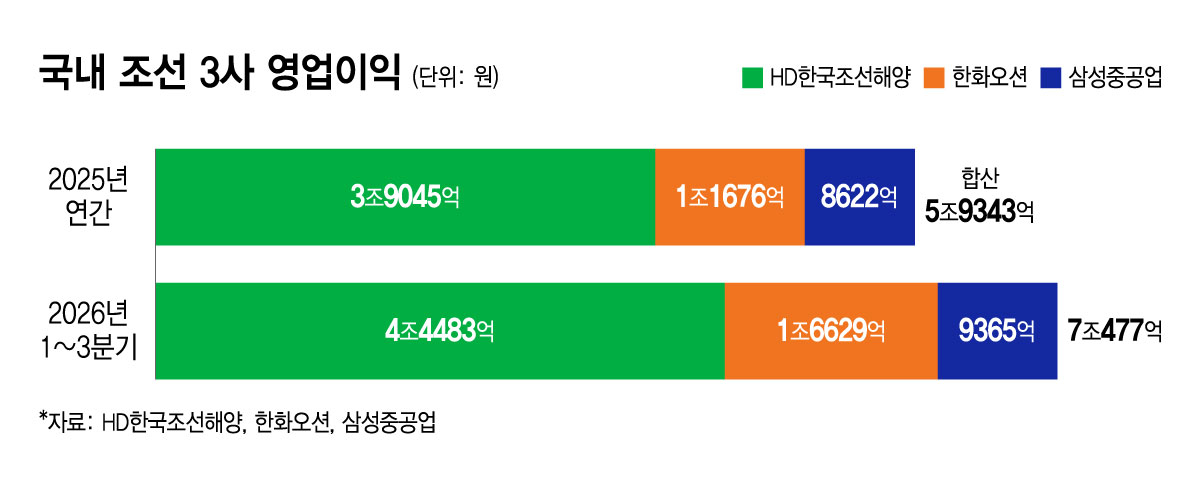
Korea’s top three shipbuilders (HD Hyundai Heavy Industries, Hanwha Ocean, and Samsung Heavy Industries) surpassed their combined annual operating profit from last year in just the first three quarters of this year. With the combined operating profit of the three companies breaking through 7 trillion won, expectations are gaining momentum that they will smoothly usher in the “10 trillion won operating profit era” for the first time in history this year.
According to industry sources on the 29th, the combined operating profit of Korea’s top three shipbuilders for the first three quarters of this year was tallied at 7 trillion 47.7 billion won.
By company, HD Hyundai Heavy Industries recorded 4 trillion 448.3 billion won, Hanwha Ocean 1 trillion 662.9 billion won, and Samsung Heavy Industries 936.5 billion won. As they have already surpassed the combined annual operating profit of the three companies last year (5 trillion 934.3 billion won) in just three quarters, it is predicted that they will set a new record for the highest annual operating profit this year.
As high-value-added vessels such as liquefied natural gas (LNG) carriers and ultra-large container ships ordered in the past are being fully reflected in sales, the trend of improving profitability among the three shipbuilders continues.
Due to the nature of the shipbuilding industry, where there is a time lag from order placement to construction and delivery, volumes ordered during boom periods are being reflected in performance results with a delay.
In particular, this year has seen notable achievements not only in merchant ships but also in offshore plants. Following its win for the 3rd trillion 635.6 billion won Mozambique floating liquefied natural gas production facility (FLNG) project “Coral North” by Italian energy company Eni (ENI), Samsung Heavy Industries signed an FLNG contract worth $2.9 billion (approximately 4 trillion 386.2 billion won) with U.S.-based Delfin Midstream.
Hanwha Ocean also reflected 1 trillion 500 billion won in sales from the P-79 floating production, storage and offloading (FPSO) facility for Brazil’s Petrobras in its second-quarter performance results.
New orders are also steadily accumulating. Cumulative order intake through the third quarter reached $19.1 billion for HD Hyundai Heavy Industries, $7.72 billion for Hanwha Ocean, and $12.4 billion for Samsung Heavy Industries.
The shipbuilding industry expects strong order momentum to continue in the fourth quarter as well. This is because there is a high possibility that LNG carrier orders will increase centered on major U.S. LNG projects, and demand for replacing aging vessels remains steady.
Efforts to capture the U.S. market are also accelerating, centered on the Korea-U.S. shipbuilding cooperation project “MASGA.” After Hanwha Ocean acquired Philly Shipyard in 2024 to secure a local production base, HD Hyundai recently decided to establish a joint venture with U.S. construction and engineering company Keewat. The goal is to build a smart shipyard utilizing existing Ministry of Trade, Industry and Energy land, breaking ground next year and commencing full operations in 2029.
Intensifying competition with Chinese shipbuilders remains a variable. This is because Chinese companies are rapidly increasing their order volumes by leveraging price competitiveness. According to Clarksons Research, a U.K.-based shipping market analysis firm, China’s share of global vessel orders from January to September this year reached 76%, while Korea’s was only 15%.
The shipbuilding industry believes that Korean shipbuilders still hold a competitive advantage in high-value-added vessels such as LNG carriers. This is because LNG carriers require stable supply chains, and versatility for deployment in various projects, including U.S. LNG, is also important. An industry official said, “Considering the entire operational lifespan of the vessels, Korean shipyards still maintain competitiveness.”

 in INDUSTRY
