

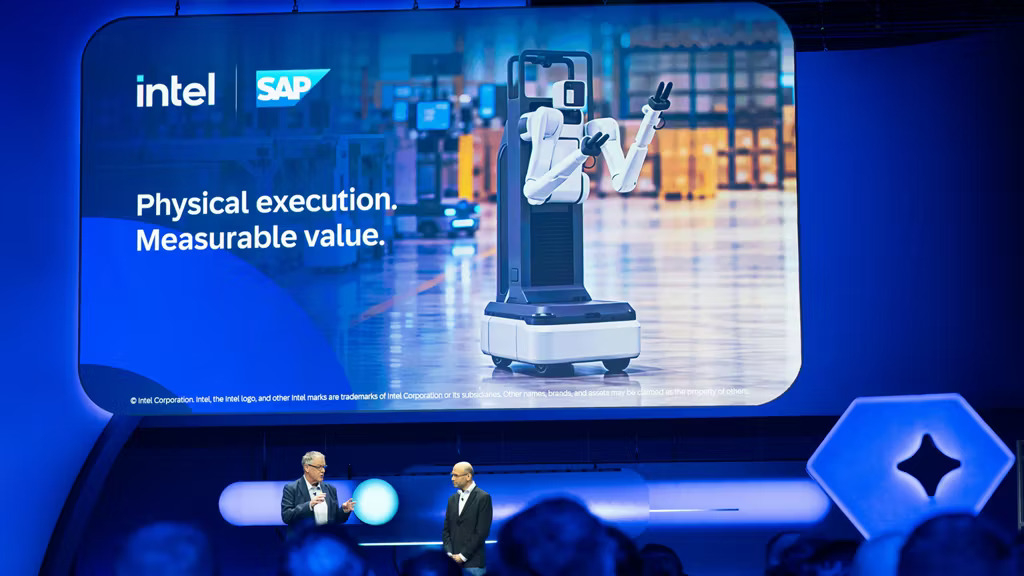
Intel unveiled physical artificial intelligence (AI) technology that connects corporate business systems with autonomous robots, in partnership with German enterprise software company SAP.
Under this system, when a task is instructed from a corporate system, the robot executes it and automatically reports the results. The focus is on integrating overall corporate operations with physical sites, going beyond the automation of individual robots.
On Thursday, Intel announced that it had implemented a bidirectional feedback system connecting corporate IT (information technology) systems with OT (operational technology), which controls actual equipment and processes, in collaboration with SAP.
The two companies demonstrated an automated material handling system combining SAP's warehouse management solution 'SAP EWM' with Intel's edge AI and robotics technologies through a Proof of Concept (PoC).
When a material transport task is requested from SAP EWM, an autonomous robot equipped with Intel's AI hardware and software receives the request and performs the work on-site. Subsequently, the robot reports the progress and completion status of the task to SAP EWM. This structure ensures that business instructions from corporate systems lead to actual on-site operations, with results being reflected back into the system.
Intel explained that it confirmed operational efficiency improvements in this PoC, such as shortening material transport distances and reducing repetitive manual work. However, specific figures regarding task time reduction rates or cost savings were not disclosed.
While existing robot automation focused on the operation of individual equipment, this collaboration differs by directly connecting corporate business processes with robot operations. SAP manages business flows and work rules, while Intel is responsible for robots' environmental perception, autonomous driving, and real-time control.
To achieve this, Intel provides edge AI technology that utilizes CPU (Central Processing Unit), GPU (Graphics Processing Unit), and NPU (Neural Processing Unit) together. It also leverages its own software, including OpenVINO Physical AI, Physical AI Studio, and Robotics AI Suite.
In particular, it adopted an open structure that does not depend on specific robot manufacturers. Companies can choose the robot manufacturer, operating system, and AI model, and can build the system in cloud or their own server environments. This is designed to expand the application of the same automation system to various business sites.
John Healey, head of the Industry and Robotics division at Intel's Client and Physical AI Group, said, "Companies want to directly connect AI to actual on-site operations. By combining SAP's enterprise business context and orchestration capabilities with Intel's edge AI and robotics technologies, we will support turning business decisions into actual on-site work."

 in TECH
