

Samsung Electronics is embarking on comprehensive business innovation across semiconductor research and development (R&D), manufacturing processes, and factory energy management by leveraging artificial intelligence (AI). The company's plan goes beyond applying AI to individual tasks; it aims to connect data analysis, decision-making, and execution processes to enhance the speed of semiconductor development and production efficiency.
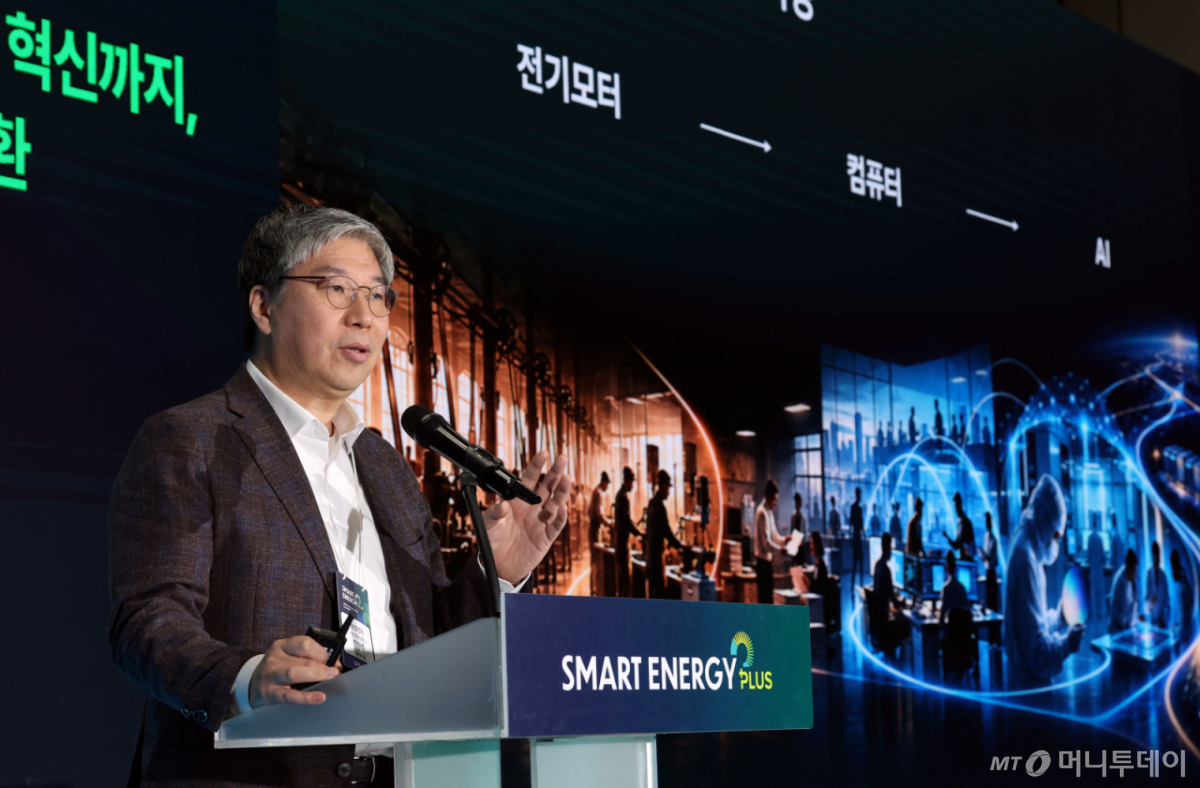
Han Jae-jun, executive directyor at Samsung Electronics' AX/PI Center, said at the 'Smart Energy Plus (SEP) 2026' conference held on the 29th in Hall B of COEX in Seoul, "The weak link in the semiconductor industry is not humans, but the work structure centered around humans." He added, "Intelligentization creates better judgments, and automation connects those judgments to business outcomes."
Speaking on the theme of "The Future of Semiconductors Made by AI," Han emphasized that advancements in AI technology do not directly translate into improved productivity. He said, "It is not simply about introducing innovative technologies; actual work methods must be redesigned," noting that innovating the entire business process is more important than improving the efficiency of individual tasks.
In practice, when Samsung Electronics applied its self-developed AI tool 'Cowork' to semiconductor defect analysis, a task that previously took 180 minutes was shortened to 8.5 minutes.
However, when viewed as a whole from customer defect reporting to final feedback delivery, the improvement effect was limited to 2.6%. Han stressed, "It is not enough for some tasks to become faster; it is important to speed up from an overall perspective."
The core of the AI transformation Samsung Electronics is pursuing also lies in connecting the entire business process rather than just improving the efficiency of individual tasks. In the semiconductor R&D stage, AI is used to propose hypotheses and analyze experimental results.
In the process development and manufacturing stages, AI performs everything from anomaly detection to root cause analysis, deriving improvement plans, and taking follow-up actions. This approach aims to reduce repetitive data analysis by engineers and waiting times associated with handovers between departments.
In this process, the role of AI expands beyond simple analytical support to actual judgment and execution. Samsung Electronics is enabling AI that has learned from past defect resolution cases during the process development phase to detect new defects early and propose improvement plans.
On the manufacturing floor, the company is integrating multiple AI agents into a single workflow, covering everything from defect root cause analysis to action execution and effectiveness verification.
The company also disclosed a case where AI judgments were reflected in actual equipment operation. Samsung Electronics has developed an optimized cooling water operation technology combining digital twins and AI, which automatically adjusts operating conditions in response to changes in external temperature and humidity.
This is aimed at improving power usage efficiency and reducing manual intervention by operators, given that the annual electricity consumption of Samsung Electronics' DS Division's domestic and overseas business sites reaches approximately 30 terawatt-hours (TWh).
However, the company maintains engineer verification and approval procedures when reflecting AI judgments in actual work. Han explained, "Because AI can make mistakes, we have built and are operating a system that allows engineers to inspect and approve actions at critical moments."
Finally, Han stated, "We will build an AI-native company where the way AI works becomes the very essence of our operations, going beyond simply being an organization that utilizes AI well."

 in INDUSTRY
