

Samsung Electronics and SK hynix, whose combined operating profit for the third quarter of this year surpassed 190 trillion won amid an artificial intelligence (AI) semiconductor boom, gathered to unveil technology innovation strategies centered on power and efficiency.
Samsung Electronics plans to improve semiconductor development and manufacturing processes as well as equipment operations using AI, while SK hynix aims to reduce the power required for data processing through next-generation memory semiconductor (hereinafter referred to as memory) technology.
Samsung Electronics and SK hynix presented these technological directions at the 'Smart Energy Plus 2026' conference at COEX in Seoul. This came despite Samsung Electronics earning approximately 107 trillion won and SK hynix earning approximately 83 trillion won in the previous third quarter, as surging power demand and increasing process complexity have emerged as new challenges.
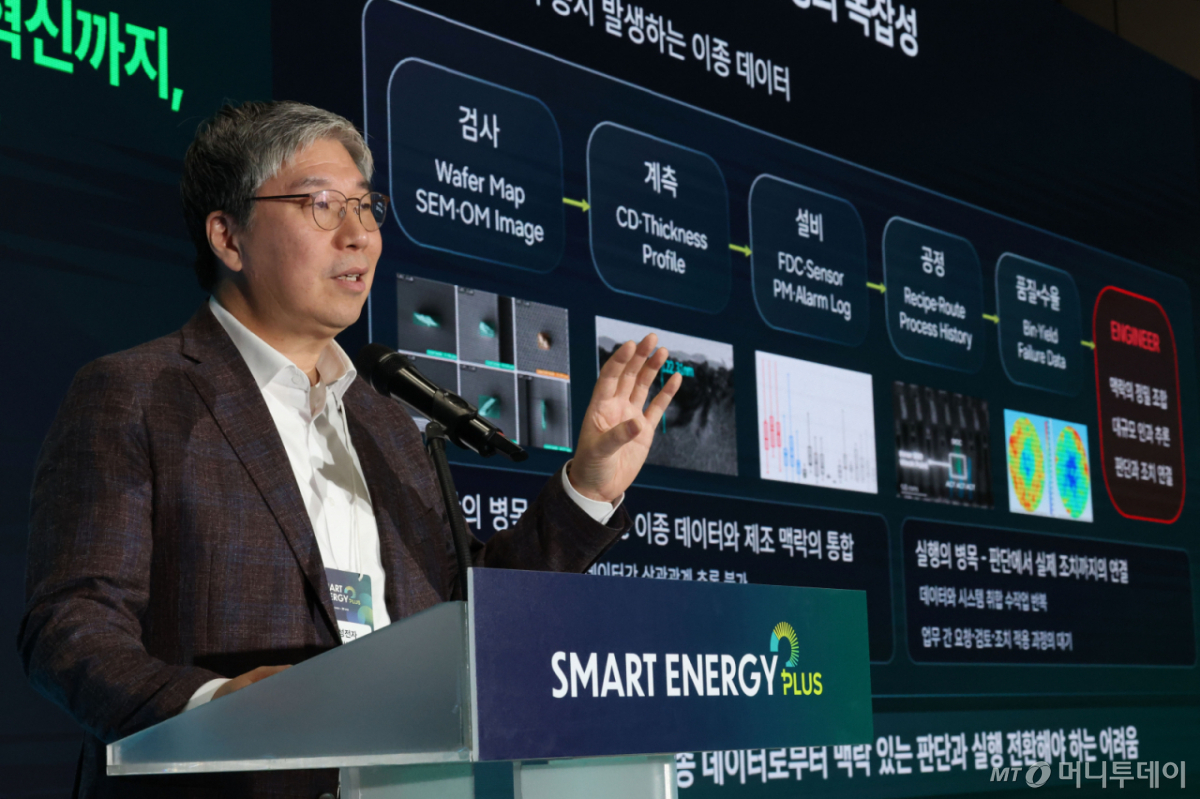
On this day, Han Jae-jun, vice president at Samsung Electronics' AX and PI Center, delivered a presentation on "The Future of Semiconductors Shaped by AI," pointing out that it is difficult to sufficiently boost productivity by applying AI only to individual tasks.
Semiconductor development and manufacturing involve sequential work requiring analysis, judgment, and follow-up actions; therefore, even if the processing speed of one stage increases, delays at the next stage prevent a significant reduction in overall task time.
A representative example is the result of applying Samsung Electronics' self-developed AI tool 'Cowork' to semiconductor defect analysis. While the analysis work, which previously took 180 minutes, was shortened to 8.5 minutes, the improvement effect on the entire process from customer defect reporting to final feedback delivery was limited to just 2.6%.
Han emphasized, "It is not enough for some tasks to become faster; what matters is that the overall perspective becomes faster."
Samsung Electronics is restructuring its work systems so that AI analysis results lead to actual improvement measures. When an AI trained on past defect resolution cases detects an anomaly, multiple AI agents analyze the cause and derive improvement plans, linking them to follow-up actions and effect verification.
The company explained that in the research and development stage as well, AI will be used to propose hypotheses and analyze experimental results, thereby reducing waiting times caused by repetitive tasks and handovers between departments.
The method of reflecting AI judgments in actual operations is also applied to energy management. Samsung Electronics has developed technology that automatically adjusts cooling water operating conditions based on external temperature and humidity by combining digital twins with AI.
This aims to improve power usage efficiency by optimizing equipment operating conditions, given that the annual power consumption of domestic and overseas facilities under the DS (Device Solutions) division, which handles the semiconductor business, reaches approximately 30 terawatt-hours (TWh).
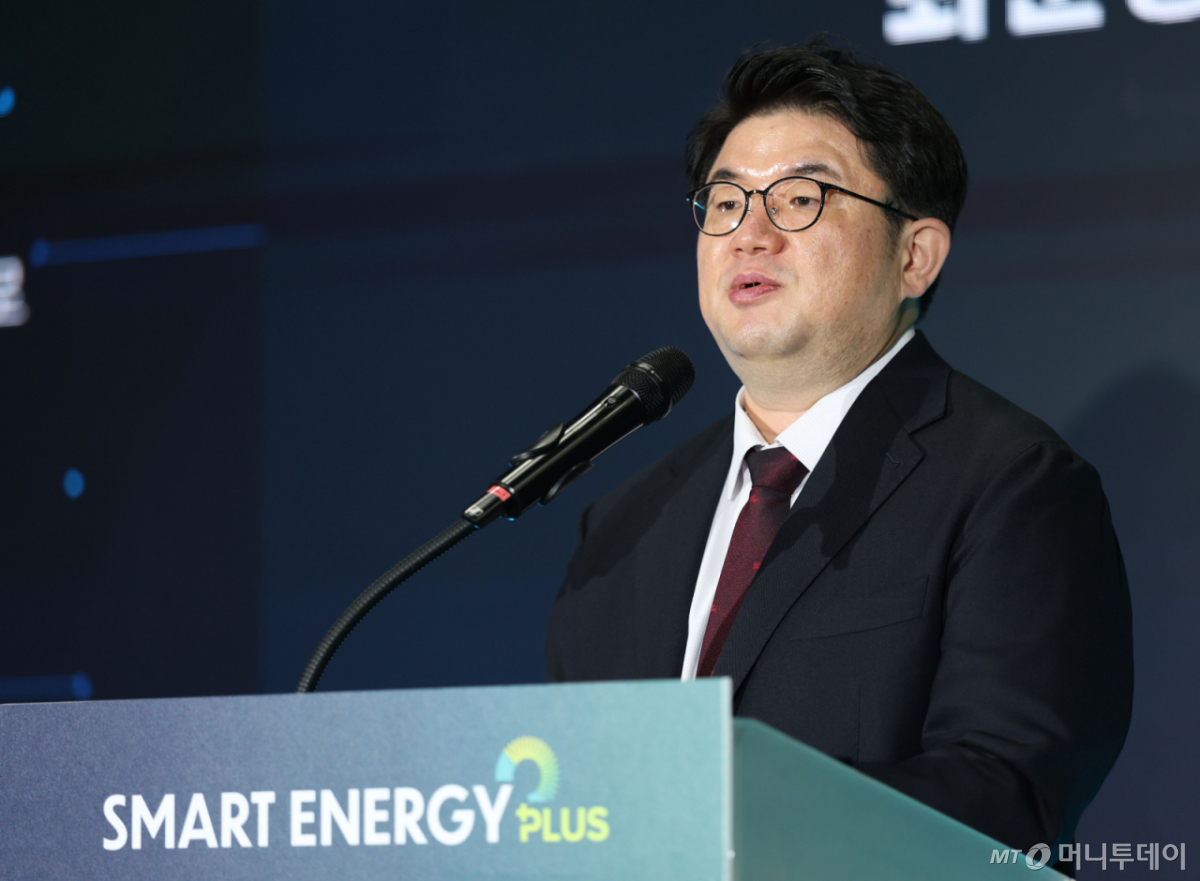
SK hynix has focused on reducing the power required for data movement in AI systems. Choi Jun-yong, vice president of HBM (High Bandwidth Memory) Business Planning at SK hynix, delivered a presentation titled "Memory Defining the Future of AI: From Memory Wall to Energy Wall," diagnosing that growth constraints in the AI industry are shifting from computing performance to memory, and then to power.
Unlike the PC and mobile eras, AI has no limits on service usage or data throughput, causing power demand to explode. Choi analyzed, "Since distance is energy itself, reducing the transmission process of reading and moving data, rather than the computation itself, is the direction memory should take."
SK hynix plans to simultaneously enhance performance and power efficiency in HBM4E, its seventh-generation HBM. The goal is to achieve a maximum capacity of 48 gigabytes (GB) and a bandwidth of over 4 terabytes (TB) per second while reducing power consumption by approximately 20% compared to HBM4 (6th generation). This approach aims to boost AI system performance by increasing data throughput while lowering power consumption.
Even if the power efficiency of memory itself is improved, the process of repeatedly exchanging data between computing devices and memory remains.
This is why SK hynix is concurrently developing technologies to reduce both the distance and volume of data movement. To this end, it is developing '3D stacked DRAM,' which stacks GPUs and memory vertically to shorten data movement distances, and 'Processing-in-Memory (PIM),' which performs computation directly within the memory.
Choi expressed confidence, stating, "By sending only processed data to the processing unit, we can significantly reduce data movement and computational load."

 in INDUSTRY

