

As the spread of artificial intelligence (AI) drives up electricity demand, the industrial sector is focusing its efforts on improving energy efficiency.
Hyundai Motor is working to reduce the power consumed by AI computations in robots to secure operating time, while LG Electronics is lowering cooling power for data centers to increase capacity available for AI services.
POSCO Group is concentrating on optimizing overall energy consumption across steel mills by analyzing production volumes and process operating conditions together.
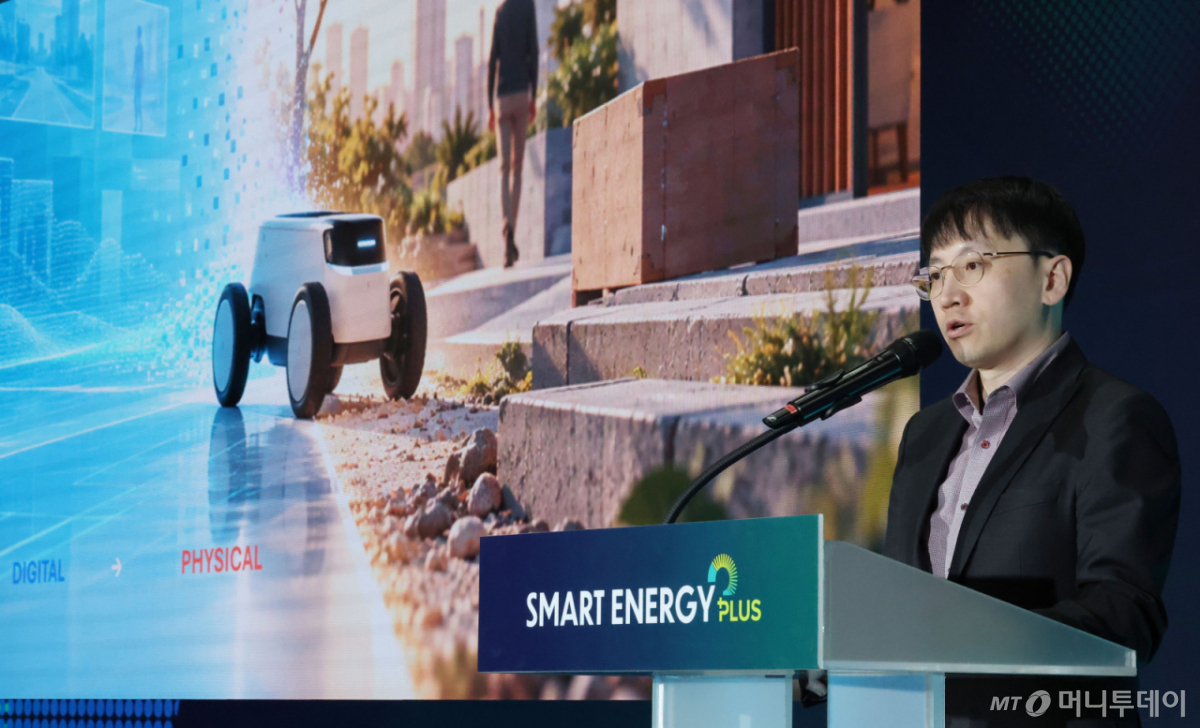
At ‘Smart Energy Plus (SEP) 2026,’ held on the 29th in Hall B of COEX in Samsung-dong, Seoul, corporate strategies were presented for enhancing the value of AI utilization with limited energy. Balancing energy consumption with performance and productivity across different sites—robots, data centers, and steel mills—was a common challenge.
Hyundai Motor focused on battery efficiency, which determines robot operating hours and product viability. Kim Young-hoon, director of the Robotics Business Division at Hyundai Motor’s Robotics Lab, emphasized, “It is important not to unconditionally use the latest or best model, but to apply a model suitable for the environment in which it is used.” This is because a single battery must handle movement, communication, sensor operation, and AI computation; if too much power is used for computation, actual working time may decrease.
There are also limits to increasing battery capacity. As weight increases, more force is required for movement, and the specifications and costs of drive systems can rise. This is why Hyundai Motor has lightened the surrounding environment recognition and autonomous driving algorithms of its autonomous mobile robot platform, ‘Mobed.’ Director Kim explained, “The future expected of physical AI robots is to create more physical value with limited energy.”
If robots must allocate energy between computation and movement, data centers face the challenge of reducing power used for cooling. Lee Gwang-won, Head of the Applied Business Division at LG Electronics, stated, “It has become important how to utilize fixed power for AI services rather than spending it on cooling.” This reflects that as AI semiconductors become more high-performance and server heat generation increases, cooling efficiency has become a factor determining AI processing efficiency per unit of power.
In response to the shift from air cooling to liquid cooling, LG Electronics is promoting an integrated ‘chip-to-chiller’ solution. This approach connects components ranging from cold plates that directly cool semiconductors to coolant distribution units (CDUs) and chillers that produce coolant. It goes beyond individual equipment to integrate the entire cooling system and links with energy storage systems (ESS) and operations to support data center energy management.
Heat generated during the cooling process is also being viewed as a target for recycling. The official introduced that they are developing technology to reuse heat by reabsorbing it for cooling, alongside plans to utilize waste heat in smart farms or district heating systems. In line with this expanding cooling demand, LG Electronics plans to increase its production capacity next year by approximately 10 times compared to this year and will establish a new manufacturing plant in Virginia, United States, next year.
The POSCO Group is focusing on extending energy efficiency from individual equipment to the entire production process. Its key development project, ‘Energy GPT,’ aims to optimize overall energy use across steel mills by comprehensively analyzing production volumes and operating conditions for each process. The focus is on finding operating conditions that maintain necessary production while reducing energy consumption.
Yoon Il-yong, Head of the AI Robotics Convergence Research Institute at POSCO Holdings’ Future Technology Research Institute, pointed out the conflict between production and energy savings, stating, “The best decision to minimize energy is not to produce.” This means that optimal decisions must be made by considering the impact on production, not just reducing consumption for specific equipment. To achieve this, data from each process must be connected, and the experience of skilled workers must be accumulated as knowledge that AI can utilize. The POSCO Group is simultaneously working on systematizing worker know-how and automating existing manufacturing equipment with AI.

 in INDUSTRY
