

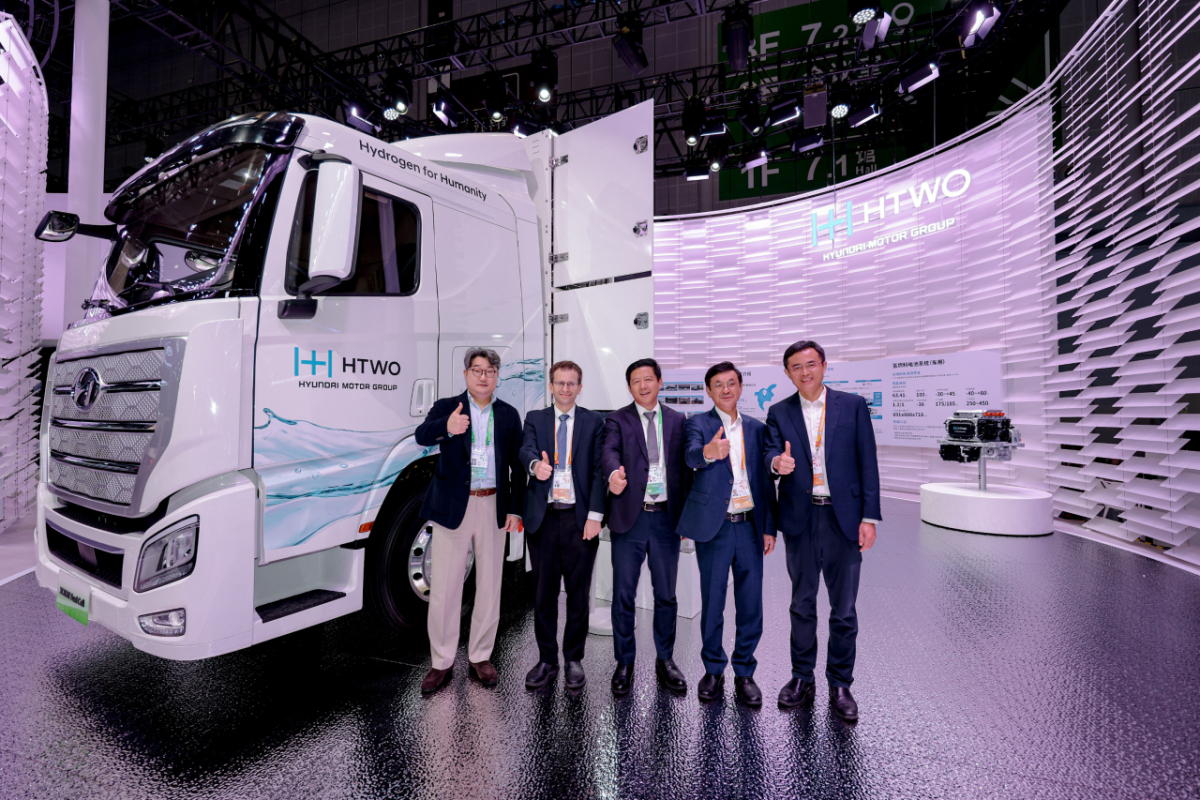
The Hyundai Motor Group is accelerating its push into the Chinese "hydrogen mobility" market through cooperation with a French gas company. Synergies are expected between infrastructure companies that produce and supply hydrogen and hydrogen fuel cell companies that use hydrogen to generate electricity to power vehicles.
HTWO Guangzhou, the Hyundai Motor Group's production hub for hydrogen fuel cell systems in China, signed a "Memorandum of Understanding on Cooperation in the Hydrogen Mobility Sector" with Air Liquide China at the China International Import Expo (CIIE 2026) held in Shanghai, China, on Friday. Air Liquide China is the Chinese subsidiary of the French gas company Air Liquide.
HTWO Guangzhou conducts research and development (R&D), production, and sales of hydrogen fuel cell systems. Based on its hydrogen fuel cell technology expertise and understanding of the Chinese market, it develops technologies and products tailored to the demands of the local hydrogen commercial vehicle market, expanding its business scope into hydrogen logistics and commercial vehicles.
Air Liquide is a global gas company based in France that provides technologies, products, and services utilizing gases. Air Liquide China is advancing hydrogen infrastructure projects in China, including hydrogen production, storage, and transportation, as well as the manufacturing, installation, and operation of hydrogen refueling stations.
Leveraging their complementary strengths, the two companies will collaborate with various partners within the hydrogen industry ecosystem to develop an integrated hydrogen value chain demonstration model linking "vehicle transport, charging infrastructure, and hydrogen supply."
Specifically, they will verify efficient operational models by linking hydrogen supply and the operation of hydrogen commercial vehicles in actual transportation environments, such as logistics hubs and trunk line transport. They also plan to create a hydrogen mobility business model suitable for the Chinese market by enhancing economic viability, including reducing total cost of ownership (TCO).
The two companies will continue to discuss specific application scenarios and cooperation plans going forward. They also aim to support the transition to eco-friendly mobility in China's transportation sector through the expansion of hydrogen commercial vehicles and the reduction of greenhouse gas emissions in the logistics field, contributing to the achievement of China's "dual carbon" goals of reaching peak carbon emissions by 2030 and achieving carbon neutrality by 2060.
Choi Doo-ha, General Manager of HTWO Guangzhou, said, "HTWO Guangzhou is working to expand the application of hydrogen fuel cells in the Chinese commercial vehicle market," adding, "Through this cooperation, we will seek a hydrogen value chain business model linking 'vehicle transport, charging infrastructure, and hydrogen supply' and contribute to China's hydrogen mobility industry."
Chen Xing, Deputy General Manager of Air Liquide China, said, "We expect to expand cooperation in various fields, such as hydrogen logistics and vehicle demonstration, by combining the strengths of each company, seeking hydrogen mobility solutions with economic viability and sustainability, and contributing to the eco-friendly transition of transportation in China."

 in INDUSTRY
