

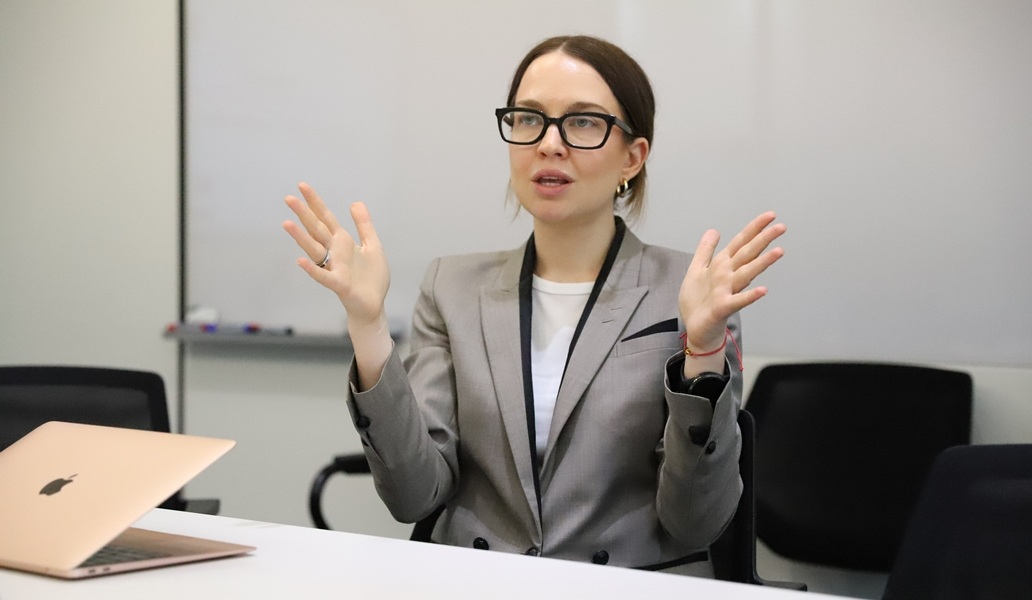
The UK pharmaceutical and biotechnology specialist media outlet "Pharma Boardroom" visited Korea for the first time in about seven years. It met with numerous domestic companies and conducted approximately 40 interviews. Pharma Boardroom has established industrial cooperation relationships with global big pharma companies such as Pfizer and Roche, and distributes reports on Bloomberg Terminal. The last time it issued a report on Korean companies was in 2019. Why did Pharma Boardroom return to the Korean bio sector now?
Julia Lukaitite, Asia head of Pharma Boardroom (hereinafter referred to as Lukaitite), cited the strengthening of K-bio's global standing, research and development (R&D) achievements, and changes in policy and market accessibility as reasons for returning to Korea. In particular, she assessed that the diversity of new drug pipelines, the advancement of science and technology levels, and large-scale production capabilities for biopharmaceuticals have grown very rapidly. She explained that she judged it is now time to re-examine Korean bio companies in the global market. The company plans to publish reports on Korean companies starting from the first quarter of next year.
"Korea has excellent new drug competitiveness... a hub for global innovation"
Lukaitite, who returned to Korea after seven years, praised K-bio in an interview with Money Today on the 8th, stating that it possesses world-class new drug pipelines.
Lukaitite said, "In 2019, Korean bio companies were largely focused on stem cells and regenerative medicine, but now they possess a wide range of innovative pipelines, including antibody-drug conjugates (ADCs), bispecific antibodies, targeted therapies, and AI-based new drugs." She added, "Korea's share in the global new drug pipeline has also expanded rapidly."
She continued, "Currently, Korea accounts for approximately 14% of new drug candidates under development worldwide, placing it among the top globally and leading the Asia-Pacific region." She assessed that a significant portion of Korea's new drug pipelines have the potential to be developed as first-in-class or best-in-class drugs.
Lukaitite also gave high marks for Korea's clinical trial competitiveness and commercialization achievements.
Lukaitite stated, "Seoul remains the second city in the world with the most clinical trials being conducted, demonstrating strong competitiveness." She added, "However, competition with clinical trial hubs like Beijing is becoming increasingly fierce, so I want to directly verify what innovations Korea's pharmaceutical and biotechnology industries and regulatory agencies are pursuing to maintain and expand their competitive advantage."
She also noted, "I am paying attention to the fact that Korea is transitioning from being centered on early-stage R&D to a stage where it creates substantial commercial results in the global market," adding, "It has firmly established itself as one of the hubs for global new drug innovation."
Lukaitite specifically mentioned the achievements of SK Biopharmatics and ABL Bio. She viewed SK Biopharmatics as leading the transformation of K-bio by growing its epilepsy new drug "Xcopri" into a blockbuster (a pharmaceutical with annual sales exceeding 1 trillion won) in the United States. She also attributed significance to the multi-billion dollar global technology transfers secured by domestic biotech companies, including ABL Bio.
Lukaitite further emphasized that she has personally felt how dramatically the global market's perception of the actual Korean bio industry has changed.
Lukaitite said, "In the past, the global pharmaceutical industry perceived Korea as a market centered on generics or biosimilars (biopharmaceutical copies)." She added, "But now it is recognized as a practical source of cutting-edge innovation, and companies are actively discovering new drug candidates and technologies in Korea to secure new modalities (treatment approaches)." She further added, "I assess that Korean science and technology is based on rigorous research and has very high creativity."
Lukaitite reported that perceptions of K-bio have also improved in Europe. She said, "I would rate the level of European interest in K-bio as 4 out of 5 points," adding, "Major European pharmaceutical companies such as Roche, Novartis, and AstraZeneca are closely cooperating with Korean biotech firms, and a stage where multi-billion dollar contracts and strategic partnerships are actively being formed has been reached."
"Late-stage clinical validation is the top priority... M&A and IR strategies also need consideration"
Lukaitite identified the need for validation in late-stage clinical trials as the top priority for K-bio to further elevate its global standing over the next 10 years. She also advised that companies should actively consider expanding mergers and acquisitions (M&A) among Korean companies and strengthening communication with global capital markets.
Lukaitite stated, "We must focus on validating the science and technology platforms of K-bio, which possess high potential, through results in global late-stage clinical trials." She added, "Going beyond technology transfers of early-stage platform technologies, Korean companies must directly develop their own new drug candidates up to global Phase 2-3 trials and secure complete commercial value in the global market before they can be firmly recognized in the global market."
She also said, "The weakest link in Korea's bio ecosystem is that M&A between companies is relatively lacking," adding, "If numerous small and medium-sized biotech companies with potential merge or join forces, they could expand their scale and narrow the gap with the global market."
Lukaitite pointed out funding gaps for growth-stage companies as one of the weaknesses of K-bio. In reality, many domestic biotech companies are struggling not only to invest in clinical trials but also to secure operating funds due to financing issues.
Lukaitite said, "The Korean government provides substantial support to early-stage bio ventures, but many biotech companies that have entered global clinical trials are suffering from issues with access to investment." She added, "Since securing overseas investment can be an alternative, there is a need to expand communication with global capital markets."
She also noted, "In particular, Korean biotech companies have a gap with the global standard in their ability to convey company value to the global market," pointing out that while more than 600 biotech companies are active in Korea, a significant number of them have not secured recognition in the global market. She emphasized, "While the capability to develop and implement science and technology is important, attention must also be paid to storytelling that persuasively conveys a company's technology and growth potential, as well as investor relations (IR) strategies."
Lukaitite expressed her ambition to broadly cover various fields such as CDMO (Contract Development and Manufacturing Organization), biosimilars, ADCs, AI, cell and gene therapy for central nervous system diseases, and organoids (artificial organs) in K-bio, ahead of publishing a report on Korean companies for the first time in eight years in the first quarter of next year.
In fact, Pharma Boardroom met with numerous domestic pharmaceutical and biotechnology companies in the second half of this year, including SK Biopharmatics, Yuhan Corporation, Biozen Cell, Medipost, and Alzgenomics.
Lukaitite said, "We plan to convey the research and commercialization achievements of K-bio to more than 800,000 Pharma Boardroom readers worldwide," adding, "If we publish a Korea report again seven years from next year, I expect that even more Korean companies will be listed among the global top 50 at that time."

 in THEBIO
