

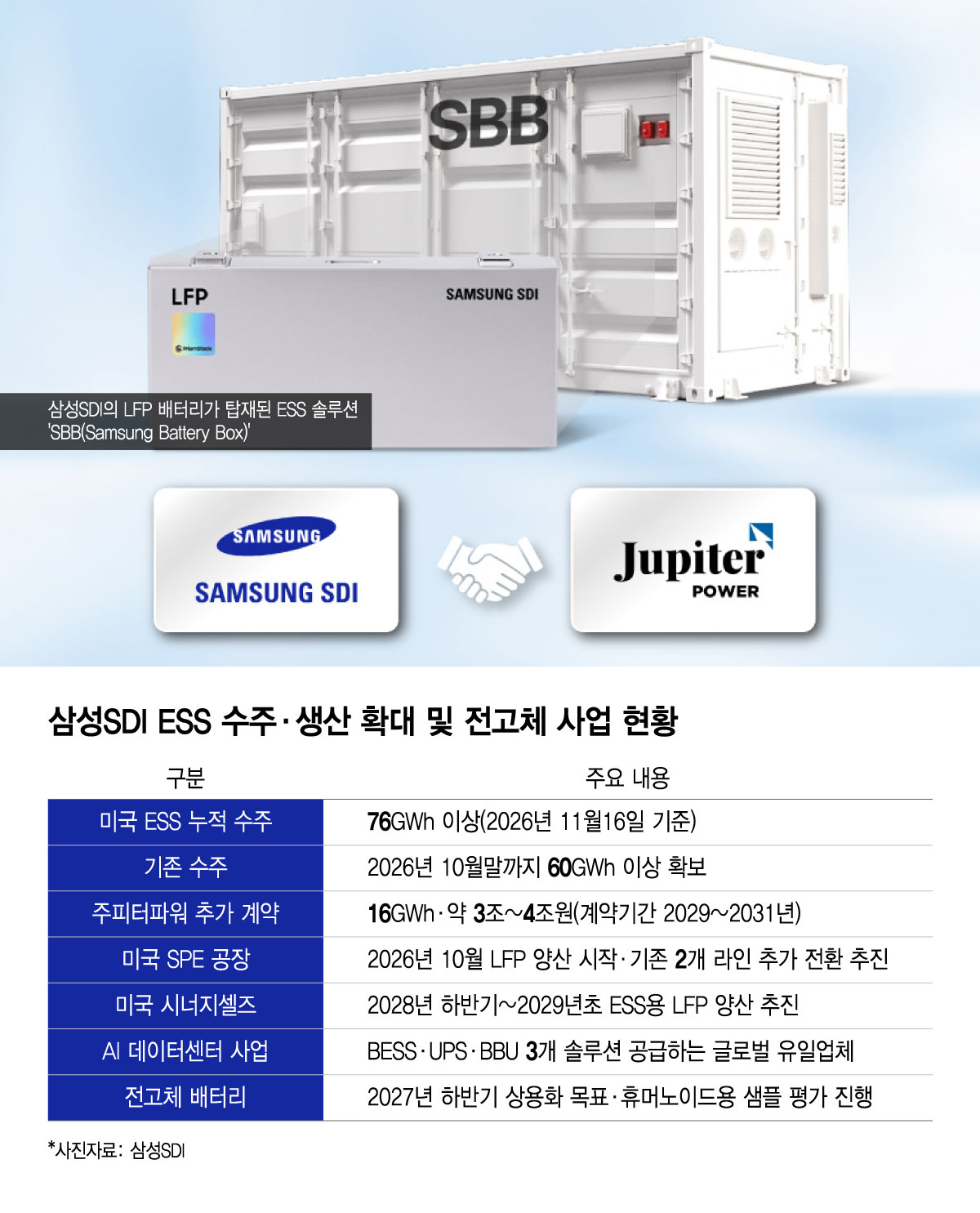
SamsungSDI has secured an additional supply volume of LFP (lithium iron phosphate) batteries for energy storage systems (ESS) worth 3 trillion to 4 trillion won from Jupiter Power in the United States, signaling a major expansion in its medium- and long-term order book. Following its earlier securing of production volumes through 2028, the company has also landed large-scale, long-term contracts starting in 2029, broadening its growth foundation in the U.S. ESS market.
As of the 16th, SamsungSDI's cumulative order volume for utility-scale ESS in the United States has grown to over 76 GWh (gigawatt-hours), including an additional 16 GWh contract with Jupiter Power. The existing order book of more than 60 GWh secured by the end of October this year alone is sufficient to keep its U.S. SPE (Star Plus Energy) and Ulsan production lines running at full capacity through 2028. The new contract covers supply over three years starting in 2029, marking another achievement for SamsungSDI in securing long-term supply volumes.
To meet growing ESS demand, SamsungSDI is accelerating the expansion of its local production capacity in the United States. In early October, it began mass production of prismatic LFP batteries for ESS at its SPE plant in Indiana, and started shipping battery cells from mid-October. The produced cells will undergo module and battery box processes before being delivered to customers as finished SBB (Samsung Battery Box) products starting in December.
SamsungSDI is expanding its supply capacity by converting existing electric vehicle (EV) battery production lines into ESS LFP battery facilities. It is additionally converting two of the four production lines at its U.S. SPE Plant 1. The company also plans to utilize the Synergy Cells plant in the United States, which it acquired by purchasing the full equity stake in its joint venture with GM (General Motors) in August, as an ESS production hub. Synergy Cells is currently undergoing design optimization work to convert its existing EV facilities into high-capacity LFP battery production lines for ESS. Mass production is scheduled to begin from late 2028 to early 2029, followed by phased expansion of production lines.
This expansion of the ESS business is also closely tied to efforts to capture the battery market for AI (artificial intelligence) data centers. SamsungSDI is accelerating its market push by leveraging its status as the only company in the world capable of supplying all three types of battery solutions required for data centers: BESS (battery energy storage systems), UPS (uninterruptible power supplies), and BBU (battery backup units). As a result, its performance has shown signs of recovery. SamsungSDI's cumulative operating profit for the first three quarters of this year reached 456 billion won, turning profitable compared to an operating loss of 1.4232 trillion won in the same period last year.
Building on improved performance, SamsungSDI is strategizing to accelerate its next-generation all-solid-state battery business. All-solid-state batteries are a next-generation technology that uses solid electrolytes instead of liquid ones to enhance safety. The company is developing the technology with a target of commercialization in the second half of next year. Since September, it has been supplying all-solid-state battery cell and pack samples for humanoid robots to multiple customers for performance evaluation. It is currently at the stage of refining product specifications for mass production next year by repeatedly improving performance and conducting verification based on customer requirements. The company is also working in parallel to establish a stable supply chain for core materials such as cathode materials and solid electrolytes.
A SamsungSDI official stated, "This order reflects recognition of our global technological competitiveness by securing large-scale volumes early on," adding, "We will continue to lead the market with products that combine the performance and safety required by customers."

 in INDUSTRY
