

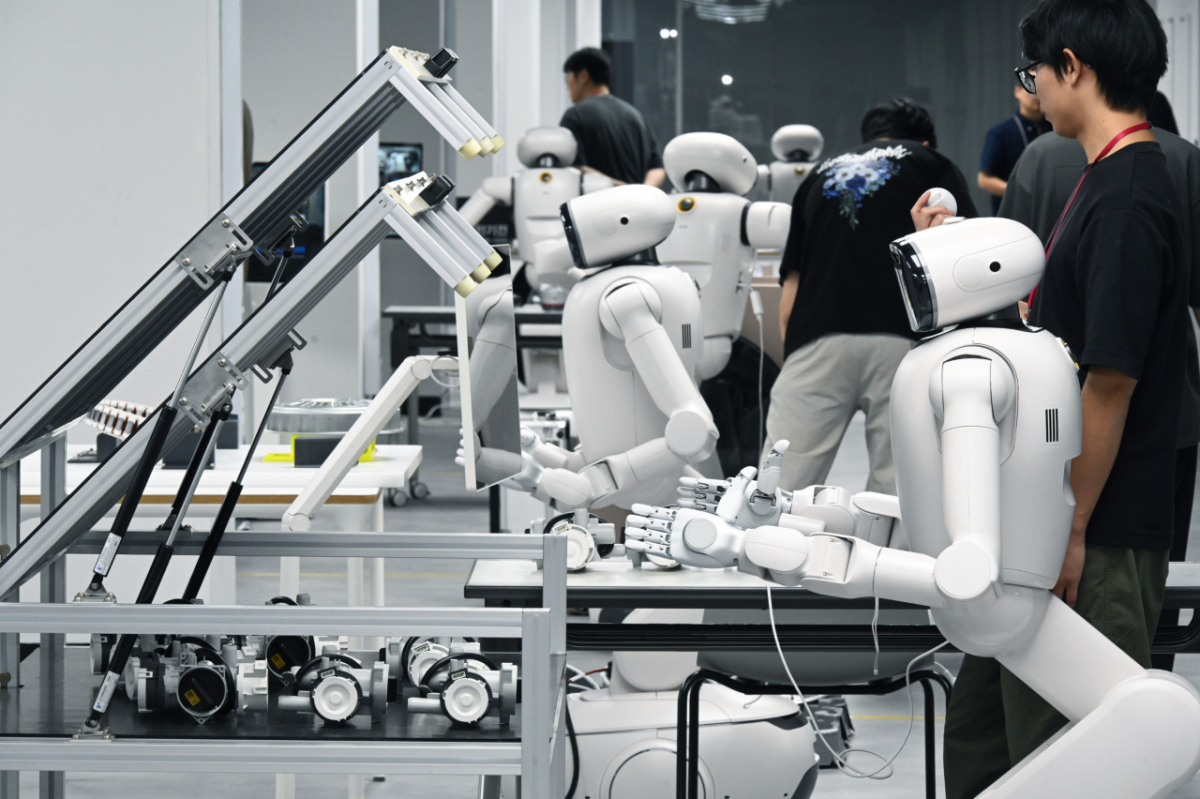
Samsung Electronics and LG Electronics are accelerating preparations for the commercialization of their humanoid (humanoid) robot businesses ahead of 'CES 2027,' the world's largest home appliance and information technology (IT) exhibition, to be held in Las Vegas, USA, next January.
Samsung Electronics is advancing technological refinement for on-site deployment, with Chairman Lee Jae-yong personally inspecting high-difficulty motion demonstrations. Meanwhile, LG Electronics is rushing to prepare for commercialization by solidifying its safety verification system and external supply base.
According to the electronics industry on the 16th, LG Electronics signed a Memorandum of Understanding (MOU) with the Korea Robotics Industry Promotion Agency on Nov. 13 to strengthen the quality competitiveness of humanoid robots.
Under this agreement, both parties will establish a system to evaluate robot safety and usability and promote domestic pilot certification. In this process, LG Electronics plans to participate in building the evaluation system for the Humanoid Robot Safety Certification Center and developing related international and national standards, while also conducting domestic safety pilot certification for its own humanoid robots, such as 'LG CLOiD.'
Humanoids working in the same space as humans require not only motion accuracy but also collision risk management and balance maintenance capabilities, making it essential to establish safety standards from the early stages of development. While laying this verification foundation, LG Electronics is also accelerating the development of bipedal humanoids using NVIDIA's robot development platform. This robot aims for a release in the first quarter of next year, with CES 2027 reportedly set to be its debut stage.
Additionally, it is known that LG Electronics plans to enhance technical completeness by combining its capabilities in developing core robot components such as actuators (driving devices) with LG Data Factory, which collects and manages large-scale learning data, with priority supply to research and educational institutions planned for the second half of next year.
Samsung Electronics is also pushing forward with plans to unveil a humanoid prototype at CES 2027. Its moves to improve product completeness have also quickened. Last month, Samsung Electronics Chairman Lee Jae-yong visited the RX (Robotics eXperience) Business Promotion Office in Umyeon-dong, Seocho-gu, Seoul, and personally inspected high-difficulty motion demonstrations, including precision manipulation using robot arms and hands, jumps, and backflips.
While such precision manipulation demonstrates full-body control and object handling capabilities, the core challenge lies not just in successful demonstrations but in stably repeating tasks in production environments. In particular, manufacturing sites require robots to respond to changes in work objects and surrounding environments, rather than merely repeating predetermined motions.
It is interpreted that Samsung Electronics' concurrent research on robot foundation models (models that execute human instructions) and world models (models that simulate and predict their own surroundings) aims to enhance these judgment and control capabilities.
To this end, Samsung Electronics has formulated a strategy to utilize its more than 100 in-house factories and production lines as hubs for technical verification and commercialization, revealing such plans at an AI forum in September. The goal is to leverage the vast on-site data accumulated in actual manufacturing processes for AI learning to enhance practical work capabilities.
Related industry officials assess that the decisive factor for both companies will ultimately be how well they can prove stable work performance in real industrial and research settings. An industry official stated, "
The center of gravity in the humanoid competition is shifting from simple motion demonstrations to practical commercialization stages, such as safety certification and on-site data acquisition," adding, "Whoever first secures reliability and applications that work in real-world settings around next year's CES unveiling will determine market leadership."

 in INDUSTRY
