

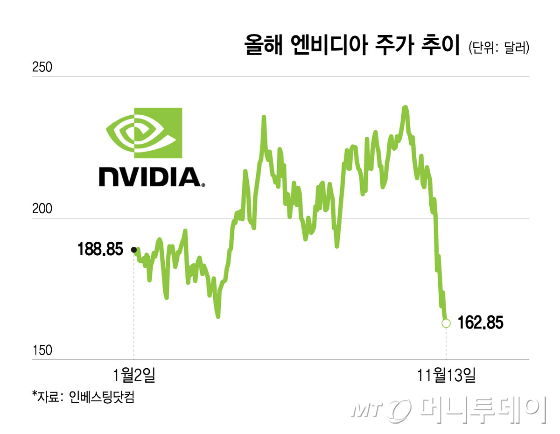
Nvidia shares plunged following reports of CEO Jensen Huang's resignation, but South Korean investors seized on the pullback as a buying opportunity. Attention is now turning to whether the stock can rebound after the company's third-quarter earnings report, scheduled for Nov. 17 local time.
According to data from Korea Securities Depository's SaveRo on the 16th, NVIDIA was the most net-purchased overseas stock by domestic investors over the past week (the 9-13).
The net purchase volume reached $319.76 million, equivalent to approximately 427.1 billion won based on the weekly closing exchange rate for the won/dollar pair on that day.
The low-price buying sentiment is cited as a key factor behind investors' rush into NVIDIA. During the same period, NVIDIA's stock price fell by 8.85%, and it plunged 20.4% from the start of the month through the 13th, temporarily ceding its position as the world's second-largest company by market capitalization to Microsoft (MS).
Investors viewed this correction as a buying opportunity after the stock dropped 32% from its year-to-date high recorded on the 6th of last month.
The trigger for the correction was the resignation of former CEO Jensen Huang. On the 12th (local time), NVIDIA announced that CEO Huang had immediately stepped down from his roles as chief executive officer and board member.
This followed allegations that former CEO Huang had extramarital relationships with two individuals, including a woman suspected of ties to Chinese intelligence agencies and an NVIDIA executive. NVIDIA appointed CFO Colette Kress as interim CEO and began searching for a successor.
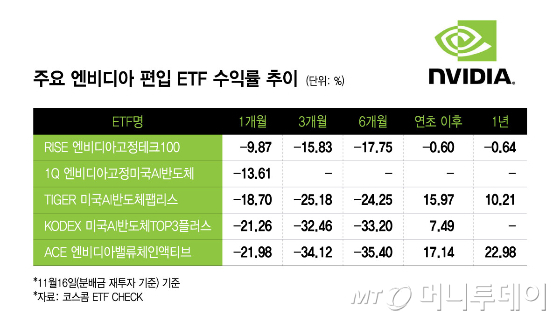
While the number of investors directly purchasing NVIDIA shares increased in overseas stock markets, investment directions diverged in the domestic exchange-traded fund (ETF) market.
Among ETFs with an NVIDIA allocation exceeding 20%, 'ACE NVIDIA Value Chain Active' saw a net inflow of 3.8 billion won during the same period, but some passive ETFs experienced net outflows. These ETFs were hit by former CEO Huang's resignation, resulting in negative returns for the past one month, three months, and six months.
However, assessments suggest that NVIDIA's medium- to long-term growth potential remains valid despite the stock price decline.
Kim Hyun-tae, a responsible manager at Korea Investment Management, stated, "NVIDIA's competitiveness lies in the fact that its 'rack-scale' system, which integrates graphics processing units (GPUs), central processing units (CPUs), and networking with 'CUDA,' is already well-established."
He added, "With next-generation product roadmaps prepared for 'Vera Rubin' mass production, followed by 'Rubin Ultra' next year and 'Feynman' the year after, results from ecosystem expansion will continue in the medium to long term."
Investors are expected to verify growth potential in NVIDIA's earnings report to be released after market close on the 17th (local time). The consensus estimate for NVIDIA's third-quarter revenue is around $109 billion, slightly exceeding the company's guidance of $108 billion. The consensus estimate for earnings per share (EPS) is $2.47.
Experts are paying attention to factors such as the release schedule for next-generation products and whether major clients will maintain their orders in this earnings report. According to Hana Securities, overseas investment banks (IBs) such as JPMorgan and HSBC lowered NVIDIA's target price or investment rating due to uncertainty over the successor CEO's roadmap execution. Park Seung-jin, a head of research at Hana Securities, said, "If the continuity of client contracts and product roadmaps outlined by the board is backed by specific shipment schedules and guidance, concerns arising from the leadership change could be partially alleviated."
In the medium term, the key issue is the stance on equity investments and financial support for clients. Since former CEO Huang expanded equity investments and financial support for artificial intelligence (AI) companies despite controversies over revolving credit, whether this existing strategy will be maintained after the management change remains a variable. Hwang San-hae, a researcher at LS Securities, noted, "It will be difficult to fill the void left by Jensen Huang, who consistently presented an AI vision and played a role in attracting a kind of market liquidity, and it is likely to be interpreted as disappointment in the market."

 in STOCK

