

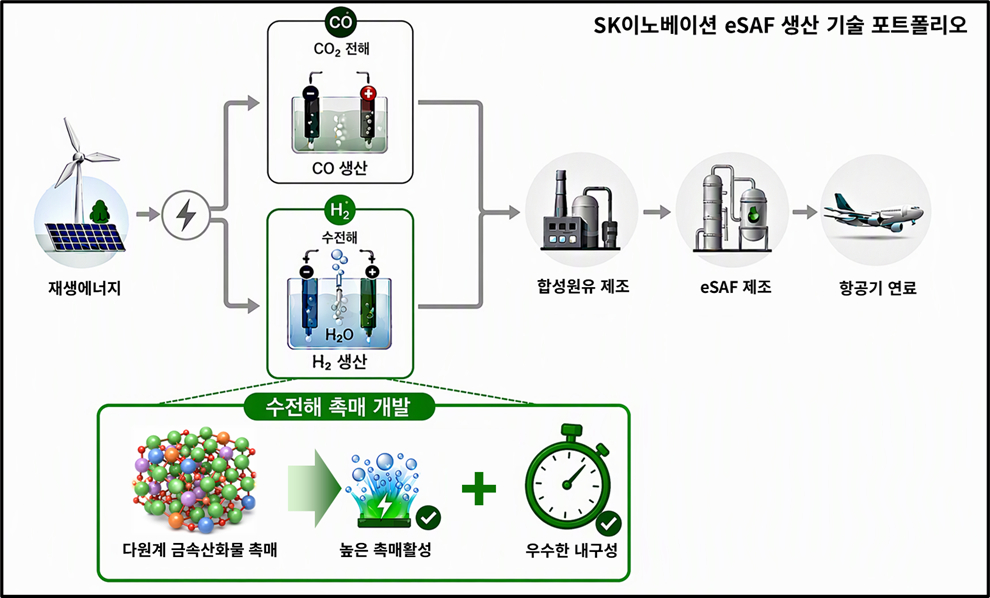
The Environmental Science and Technology Institute at SK Innovation announced on the 18th that it has developed water electrolysis catalyst technology capable of efficiently producing green hydrogen despite fluctuations in power supply from renewable energy sources. SK Innovation is also accelerating the commercialization of 'next-generation sustainable aviation fuel (e-SAF),' which is synthesized by combining this green hydrogen with carbon dioxide captured from industrial processes and other sources.
The high-efficiency water electrolysis catalyst technology developed by SK Innovation was recently published in the 'Journal of Materials Chemistry A,' a prestigious international academic journal issued by the Royal Society of Chemistry (RSC) in the UK. The journal is evaluated as being among the top 25% globally in the fields of materials and energy.
In the water electrolysis process, which produces hydrogen by decomposing water through electricity, catalysts play a central role. Catalysts are substances that promote the reaction breaking down water into hydrogen and oxygen, thereby reducing power consumption and increasing hydrogen production efficiency. However, renewable-energy-based water electrolysis systems, where generation output varies depending on weather and time of day, have had the drawback that irregular power supply can damage the catalyst structure or reduce hydrogen production efficiency and catalyst lifespan.
The research team addressed this issue by adding trace amounts of 'lithium (Li)' to a nickel-iron-tungsten (Ni-Fe-W)-based catalyst. The lithium maximizes oxygen reactivity within the catalyst, increasing the speed of hydrogen production while simultaneously preventing the collapse of the catalyst structure.
The green hydrogen produced in this manner is used as a key raw material for manufacturing next-generation sustainable aviation fuel (e-SAF). First, carbon dioxide captured from the atmosphere and other sources is converted into carbon monoxide (CO) through electrolysis. This CO is then combined with green hydrogen to produce synthesis gas. Subsequently, the synthesis gas undergoes chemical reactions to produce synthetic crude oil, which is refined and processed to create e-SAF usable as aircraft fuel.
This achievement represents a case where SK Innovation has expanded its thermochemical catalyst technology accumulated in refining and chemical processes into electrochemical-based technology for manufacturing useful substances. In particular, by holding patent technologies covering the entire e-SAF production process—from water electrolysis catalysts to carbon dioxide (CO2) electrolysis, synthetic crude oil manufacturing, and e-SAF refining and conversion—SK Innovation has further strengthened its technological competitiveness in the next-generation eco-friendly aviation fuel business.
According to the International Air Transport Association (IATA), global sustainable aviation fuel (SAF) production is expected to reach approximately 2.4 million tons in 2026, while an annual production of approximately 500 million tons of SAF will be required to achieve carbon neutrality in the aviation industry by 2050. In particular, e-SAF is reported to account for more than 40% of the global SAF production potential by 2050.
Kim Pil-seok, President of SK Innovation's Environmental Science and Technology Institute, stated, "This research is a case where catalyst technology capabilities accumulated during energy and chemical R&D have been expanded into electrochemical technology required for eco-friendly fuel manufacturing." He added, "Going forward, we will secure future eco-friendly energy technologies based on SK Innovation's core R&D capabilities in catalysts, processes, and synthesis, and contribute to building the e-SAF ecosystem."
SK Innovation is an intermediate holding company of SK Group focused on energy, chemicals, and batteries. It operates businesses in refining, chemicals, LNG (liquefied natural gas), renewable energy, and batteries and materials.

 in INDUSTRY
