

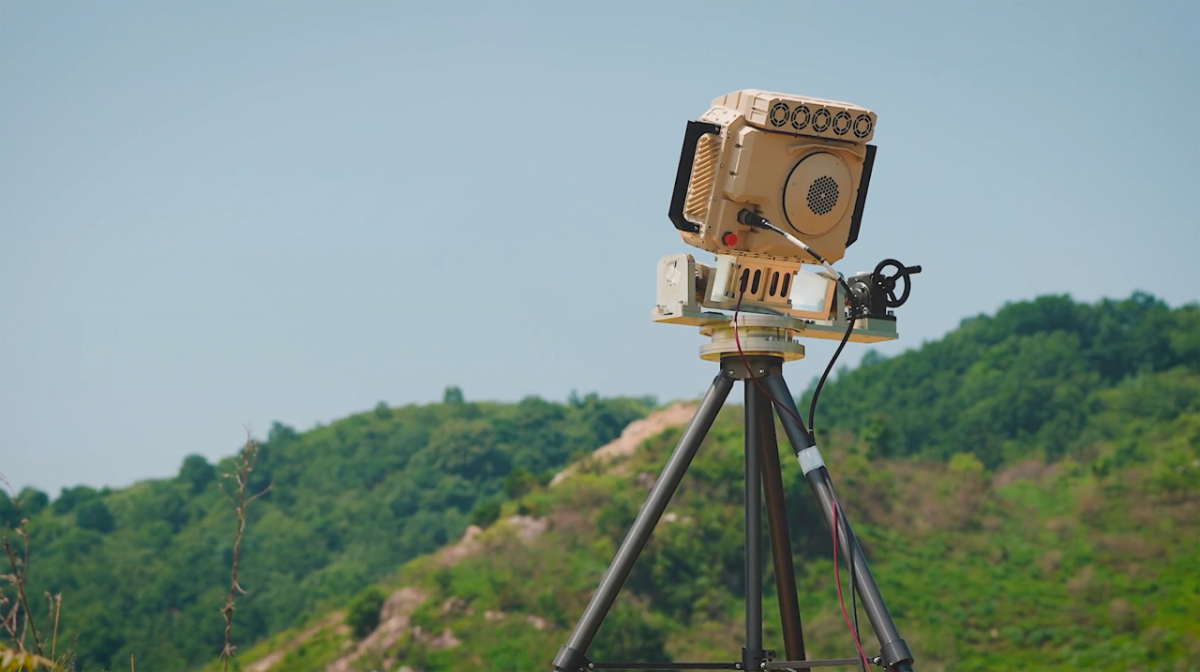
Hanwha Systems announced on the 18th that it has signed an export contract with U.S. defense company Reaverion Industries for a "short-range AESA (Active Electronically Scanned Array) radar."
This contract was carried out as a pilot export, in which a small quantity of products is supplied to verify local suitability before full-scale large-volume exports. The supply quantity and amount are not disclosed. Hanwha Systems plans to deliver the short-range AESA radar to Reaverion Industries sequentially by early 2027. The two companies are also discussing follow-on contracts for additional large-scale supply within the United States.
This marks the first time Hanwha Systems has exported a short-range AESA radar to the United States. It is the company's second U.S. export achievement, following the export of digital avionics equipment to Boeing last December. At that time, Hanwha Systems signed a supply contract for ELAD (Electronic Large Area Display) units installed on the F-15K fighters operated by the Republic of Korea Air Force and the F-15EX fighters of the U.S. Air Force, both produced by Boeing.
The radar being exported this time will be prioritized for application to major civilian facilities within the United States, including oil refineries, corporate data centers, logistics centers, and multi-purpose stadiums. Reaverion Industries is a defense technology company headquartered in New York, U.S., that develops AI-based air defense systems and sensors. The two companies plan to cooperate on demand analysis in the North American region and the expansion of global defense and civilian businesses in the future.
Hanwha Systems began developing ultra-lightweight and ultra-compact short-range radars in 2024 and recently completed the independent development of an export model. Featuring an integrated structure that combines the antenna, main body, and power source into one, it can be mounted not only on tanks, armored vehicles, and small vessels but also on civilian facilities and vehicles. The application of AI technology has also enhanced target identification capabilities. It is designed to detect and distinguish living organisms such as birds from flying objects even in environments with fog, dust, or electromagnetic interference.
Following the 10th-kilometer detection range product being exported this time, Hanwha Systems plans to additionally develop 5-kilometer and 1-kilometer products by early 2027. The company's strategy is to supply products that detect fast targets at long distances in the defense sector and products that intensively detect targets at close ranges in the civilian sector, thereby responding to customer-specific demands. As part of this effort, Hanwha Systems plans to introduce automated lines at its Gumi business site and elsewhere to build a mass production system. The company aims to reduce production costs and secure price competitiveness to tackle the domestic and international short-range radar markets.
To date, Hanwha Systems has been responsible for developing MFRs (Multi-Function Radars) for systems such as the Long-Range Artillery Missile Defense System (LAMD), the Medium-Range Surface-to-Air Missile System (Cheongung/M-SAM), the Medium-Range Surface-to-Air Missile System-II (Cheongung-II/M-SAM-II), the Long-Range Surface-to-Air Missile System (L-SAM), and the Long-Range Surface-to-Air Missile System-II (L-SAM-II). It has also demonstrated its capabilities by creating the "eyes" of South Korea's land, sea, and air security assets, including multi-function radars for the KDDX (Korean Next Generation Destroyer) and the latest frigates (FFX Batch-III), as well as AESA radars for KF-21 fighter jets.
Previously, in May 2024, Hanwha Systems entered the European market by signing a supply contract with Italian defense company Leonardo for AESA radar antennas for light fighter jets. The company is determined to accelerate efforts toward building a "multi-layer integrated air defense network" that integrates short-, medium-, and long-range capabilities to provide comprehensive defense, going beyond the supply of individual weapon systems.
An official from Hanwha Systems said, "Currently, not only in the United States but also in various overseas regions, there is a continuous stream of interest in our short-range AESA radar," adding, "We expect this achievement to serve as an opportunity for the product to establish itself as another powerful K-defense export item following MFRs."

 in INDUSTRY
