

The calculation work for the first loss compensation amount under the petroleum product maximum price system for the four major refiners (SK Innovation, GS Caltex, S-Oil, and HD Hyundai Oilbank) has been completed. As the Loss Compensation Settlement Committee submitted the calculation results to the government approximately eight months after the implementation of the maximum price system, only the final decision by the Ministry of Trade, Industry and Energy remains. Since the four major refiners expect the actual loss compensation amount to be lower than industry estimates, they are also expected to consider legal responses such as filing objections or administrative lawsuits.
According to the refining industry on the 22nd, the Loss Compensation Settlement Committee for the petroleum product maximum price system is known to have submitted the first loss compensation calculation results to the Ministry of Trade, Industry and Energy on the 20th. The target of this first settlement covers losses incurred over approximately 110 days, from March 13 last year when the maximum price system was implemented through June 30. Once the Settlement Committee reviews the recognized loss items and amounts for each refiner and transmits them to the government, the Ministry of Trade, Industry and Energy will determine the final loss compensation amount to be paid to the four major refiners and the payment schedule, taking into account factors such as reasonable profit.
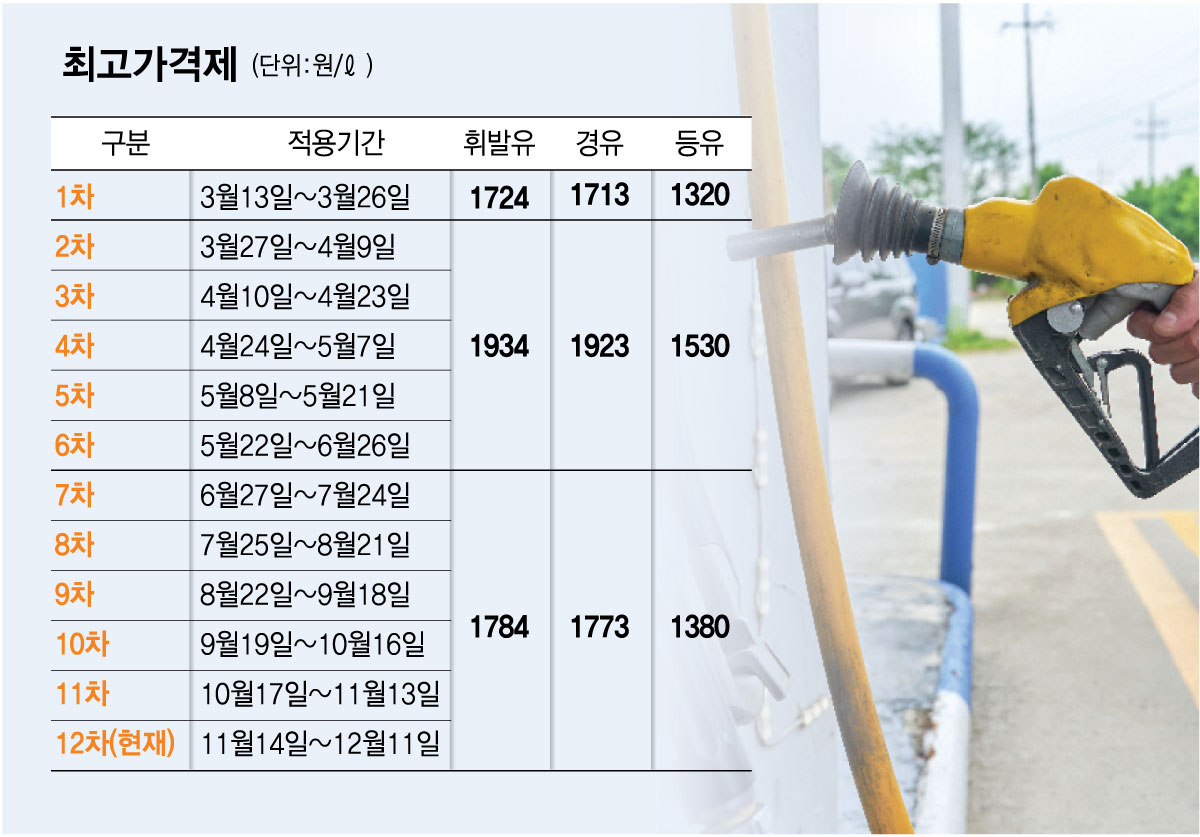
The maximum price system is a policy introduced by the government to suppress domestic petroleum product price increases in response to the sharp surge in international oil prices caused by the war between the United States and Iran. Refineries supply gasoline, diesel, kerosene, etc., below the maximum price set by the government, and in return, they receive compensation for losses incurred during this process on a post-hoc basis. By implementation phase, the maximum prices applied are as follows: △1st phase (March 13–26): 1,724 won per liter (L) for gasoline, 1,713 won for diesel, and 1,320 won for kerosene; △2nd to 6th phases (March 27–June 26): 1,934 won, 1,923 won, and 1,530 won respectively; and △7th to 12th phases (June 27–December 11): 1,784 won, 1,773 won, and 1,380 won respectively.
The first loss compensation amount for the four major refiners is expected to be lower than the 3.6 trillion won estimated by the Korea Petroleum Association. This is because the 3.6 trillion won presented by the association is a loss estimate calculated based on the difference between international petroleum product prices and domestic supply prices from March through June last year. This amount is close to the upper limit of the compensable scale.
On the other hand, the government calculates the loss compensation amount based on the actual costs incurred by refineries and reasonable profit. The compensation amount decreases because it does not cover the entire difference between international prices and domestic supply prices, but only reflects actual costs and profits recognized by the government. Since cost structures differ among refineries, there are differences in the cost items recognized as losses, and the criteria for calculating reasonable profit have not been disclosed, a gap is inevitable between the amounts claimed by refineries and the loss compensation amounts recognized by the government.
If the loss compensation amount finalized by the government falls short of the claimed amount, the four major refiners may consider legal responses such as filing objections or administrative lawsuits. This is because, with last year's revision to the Commercial Act expanding the scope of directors' duty of loyalty to include shareholders in addition to the company, responsibility issues could arise if management fails to take measures for just loss compensation. The possibility that foreign investors may consider Investor-State Dispute Settlement (ISDS) procedures under relevant investment agreements is also being discussed.
Above all, the fact that it is structurally difficult to easily narrow the gap between the government and refineries is increasing the likelihood of legal disputes. While the government must strictly calculate the scope of recognized losses and compensation amounts since taxpayer money is involved, refinery management must protect the interests of the company and its shareholders. Both sides face potential responsibility issues if they compromise their existing positions. An official in the refining industry said, "Even if refineries file objections in the future, we do not expect the government to reverse its stance," adding, "Structurally, someone has to give up their rights, and the issue is who bears the responsibility for giving up those rights."

 in INDUSTRY
