

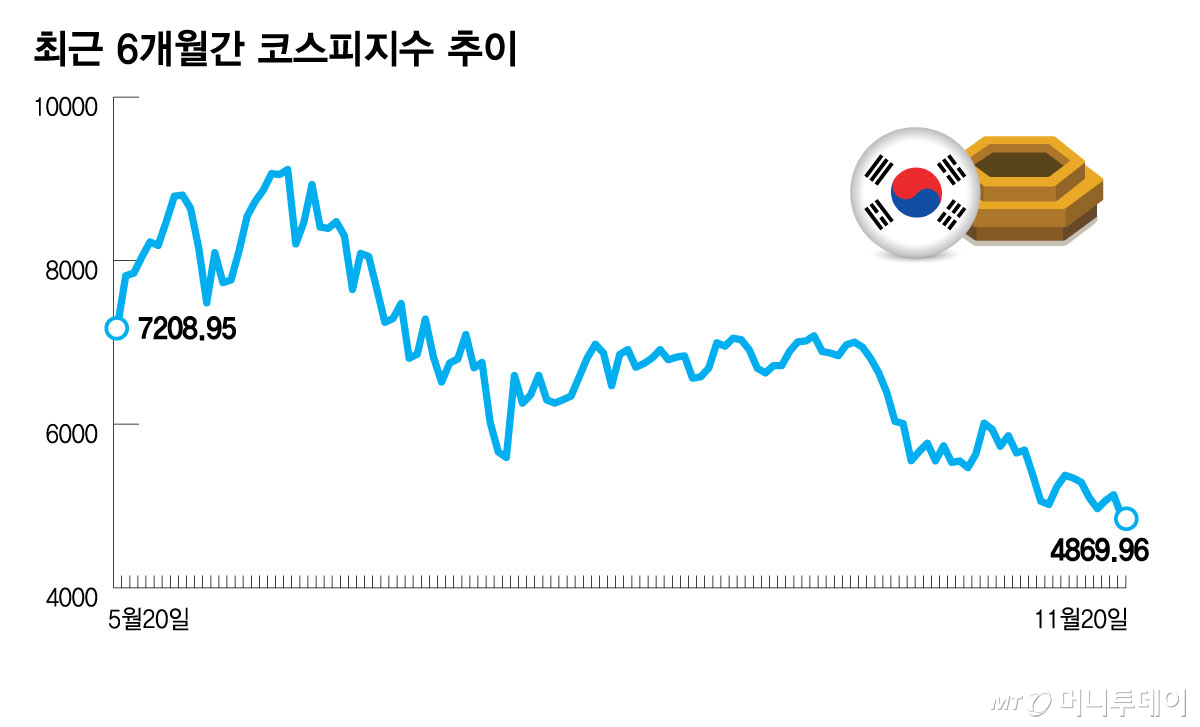
As simultaneous sharp declines in the Korean and U.S. stock markets have repeated recently, the correction phase is becoming prolonged. The securities industry analyzed that because extreme fear sentiment has been reflected in stock prices, with the domestic market’s decline exceeding levels seen during the COVID-19 pandemic, there is a possibility of a rebound due to the excessive drop. However, given the ongoing uncertainty surrounding the artificial intelligence (AI) industry and continued foreign selling, it was viewed as uncertain whether a short-term rebound would lead to a trend-based recovery. Corporate earnings outlooks, market interest rates, and foreign supply and demand are cited as key variables that will determine the future direction of the stock market.
Larger drop than during COVID-19… “Fear sentiment is extreme”
According to Korea Exchange on the 22nd, the KOSPI closed regular trading at 4,869.96 on the 20th, down 267.93 points (5.21%) from the previous trading day. Samsung Electronics and SK hynix fell by 7.01% and 5.92%, respectively, dragging down the index. The KOSDAQ also declined by 5.71%. The activation of a sell-side sidecar (futures market circuit breaker) in both the Korea Exchange and KOSDAQ markets on the same day marked the first occurrence in 10 trading days since the 6th.
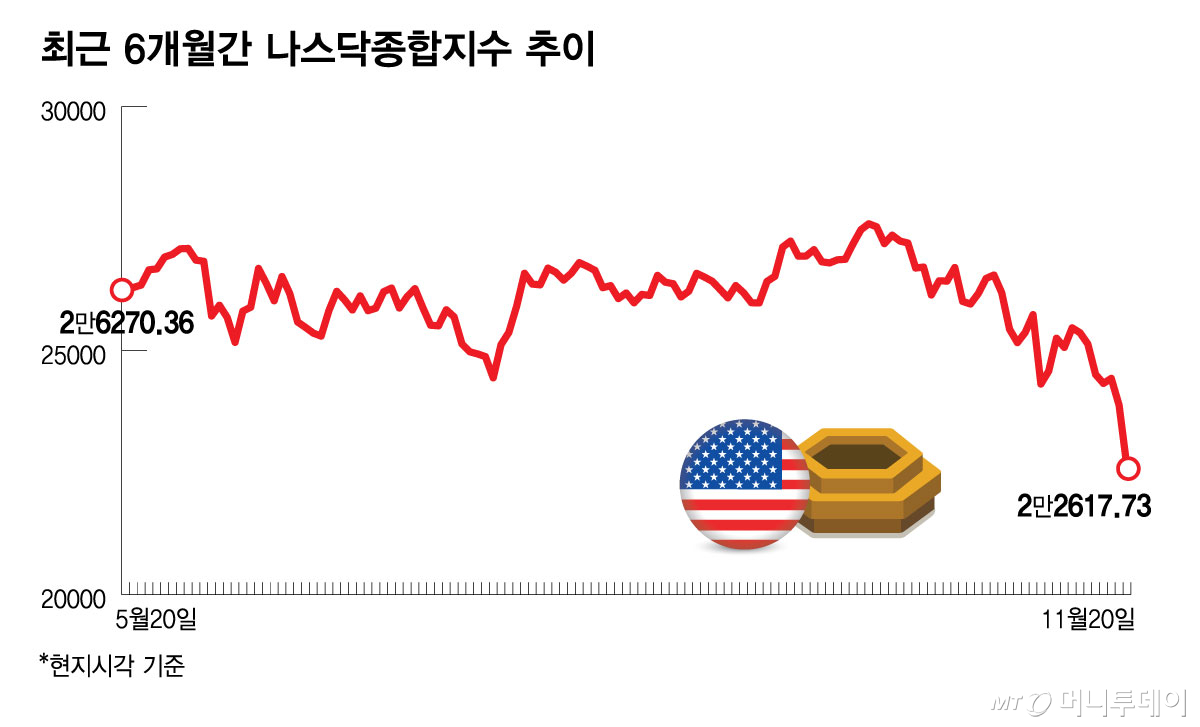
Following the close of domestic markets, the New York stock market also plunged. On the 20th (local time), the NASDAQ Composite Index fell by 5.28%, the Standard & Poor’s (S&P) 500 Index dropped by 3.70%, and the Dow Jones 30 Industrial Average declined by 1.93%. The Philadelphia Semiconductor Index plunged by 10.7%. It was analyzed that concerns over strengthened U.S. export controls on AI semiconductors to China, the investment profitability and credit risks of AI companies, and supply and demand burdens from Anthropic’s large-scale initial public offering (IPO) acted in combination.
The securities industry analyzed that extreme fear sentiment has been reflected in recent stock price declines in domestic and international markets. According to Hana Securities, the KOSPI’s decline rate from its peak this year is 46.6%, which is 2.7 percentage points higher than the decline rate (43.9%) during the 2020 COVID-19 pandemic. It differs by 7.9 percentage points from the decline rate (54.5%) during the 2008 global Financial Services Commission period.
Among the 200th constituent stocks of the KOSPI, 81% have seen their stock prices fall by more than 40% from this year’s peak. Stocks that have fallen by more than 50% account for 61% of the total. It was analyzed that stock price adjustments in sectors other than large-cap semiconductors have progressed to a level comparable to past Financial Services Commission periods.
The Volatility Index (VIX), known as the VIX (Fear Index) of the U.S. stock market, has risen to 36. This significantly exceeds the upper limit of the typical volatility range of 24 analyzed by Hana Securities. Demand for betting on stock price declines or defending against downside risks has also increased, causing trading volume in put options (right to sell) in the U.S. stock market to surpass that of call options (right to buy).
Lee Jae-man, a researcher at Hana Securities, stated, “The fear sentiment (selling) triggered by NVIDIA can be seen as an excessive decline state where it has entered an extreme situation.” The researcher noted that the market capitalization share of the semiconductor sector in the U.S. S&P 500 Index has dropped to 12.4%, a level last seen in June of last year. If the share of the semiconductor sector in the total net income of all S&P 500 companies in the first half of last year is applied to next year, the projected net income for the semiconductor sector next year must be lowered by approximately 70% from current levels. The researcher analyzed that the current market capitalization share of U.S. semiconductor stocks is similar to a level assuming such extreme earnings deterioration.
Kim Seung-no, a researcher at BNK Investment & Securities, also analyzed that the domestic stock market has entered a historically undervalued zone. The 12-month forward price-to-earnings ratio (PER) of the KOSPI has fallen to 3.5 times. The forward PER for the KOSPI 200, excluding semiconductors and holding companies, is around 10 times. However, he cited as a burden factor that while earnings forecasts for the entire KOSPI maintain an upward trend, earnings forecasts for the semiconductor sector have stagnated.
Where is the KOSPI bottom… Rebound conditions are improved supply and demand and lower interest rates
Seo Sang-yeong, a researcher at Mirae Asset Securities, stated, “Given that this decline reflects not only option supply and demand but also credit risks of AI companies, regulations on NVIDIA, and accounting-related uncertainties, aggressive rebound buying will be limited,” adding, “The Korean stock market on the 23rd is expected to open lower and attempt to narrow the decline, but a process of digesting sell orders with high volatility will continue rather than a full-fledged rebound.”
Analysis on the bottom in case of further KOSPI declines has also emerged. Researcher Kim judged that if the KOSPI reaches the 4,500–4,700 range, it would be a level where many negative factors could be reflected in stock prices. This is because the domestic stock market has experienced a decline comparable to the level during the Information Technology (IT) bubble burst, and investment attractiveness evaluated by the price-to-book ratio (PBR) has also increased.
Researcher Kim analyzed that if the KOSPI’s decline rate from its peak exceeds 50%, it is desirable to keep open the possibility of a rebound rather than adopting a pessimistic view. He viewed it as a time when rebounds can be expected for stocks whose prices have fallen close to 70–80% from their peaks.
Researcher Lee presented an analysis assuming a lower index level. If the KOSPI’s 12-month trailing PBR, currently at 1.07 times, falls to the level of August last year (0.94 times), before the full-scale rise in semiconductor stocks began, the KOSPI bottom is estimated at the 4,300 line. This is the result of evaluating the index level based on already confirmed net asset value in a situation where market confidence in corporate future earnings forecasts has weakened.
From a supply and demand perspective, whether foreign selling continues is a key variable for a domestic stock market rebound. According to Researcher Lee, the cumulative net selling amount by foreigners in the KOSPI over the seven months from May to this month is 168 trillion won, reaching 4.3% of the current Korea Exchange market capitalization. This is close to the 4.4% level during the global Financial Services Commission period.
Researcher Kim analyzed that domestic stock market buying power has weakened as funds flow out of equity funds and investor deposits decrease. In a situation where institutional investors’ buying power has decreased, he stated that for stock prices to rebound, the direction of foreign trading must change. While foreign selling may continue for some time due to weakening liquidity in the U.S. stock market, the increased valuation appeal of the domestic stock market and the approaching year-end dividend season were evaluated as positive factors.
A decline in market interest rates can also serve as a catalyst for a stock market rebound. Although the possibility of a U.S. base rate hike in December is acting as a burden on the market, stabilization of international oil prices due to increased crude oil supply is a factor lowering inflationary pressure. Researcher Kim analyzed that the likelihood of a sharp interest rate hike is low, as interest rates are expected to pass their peak in October–November according to the Taylor Rule, which calculates the appropriate base rate reflecting economic and price conditions.
Researcher Lee stated, “For the index to rebound, momentum is needed, but if earnings forecasts do not deteriorate significantly, a decline in market interest rates as the high-interest-rate environment changes will be the trigger for an index rebound.” Researcher Seo stated, “The direction of the index may vary depending on the intensity of foreign supply and demand, whether selling pressure from semiconductor companies subsides, and whether U.S. index futures stabilize on the 23rd.”

 in STOCK

