

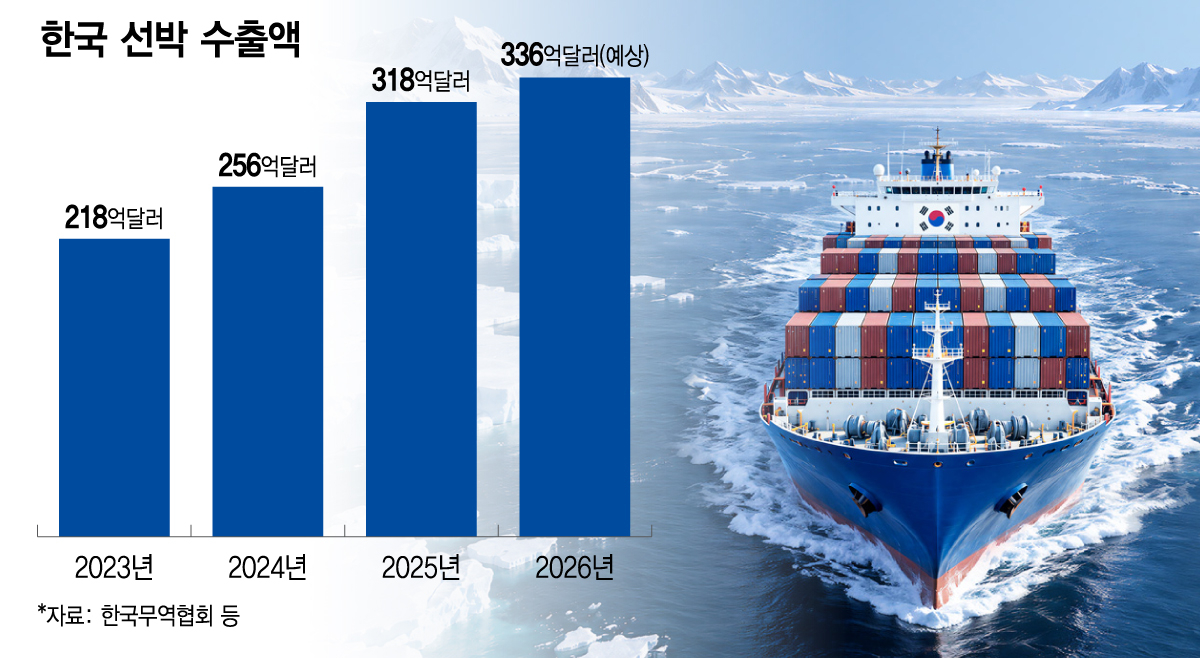
As South Korea achieved an annual export value of $1 trillion, domestic ship exports are also on a steady course. The country is continuing its export growth trend by leading with eco-friendly and high-value-added vessels such as liquefied natural gas (LNG) carriers.
According to industry sources on the 23rd, South Korea's ship export value this year is projected to reach approximately $33.6 billion. Last year's ship export value was approximately $31.8 billion, marking a record high in eight years. This follows three consecutive years of growth, from $21.8 billion in 2023 to $25.6 billion in 2024. It is also contributing to the improvement of the trade balance. Last year's ship import value was approximately $4.6 billion, resulting in a trade surplus of approximately $27.2 billion. This accounts for 35% of South Korea's total trade surplus (approximately $78 billion).
In fact, among the 79th LNG carriers ordered worldwide up to mid-this month, the country's three major shipbuilders (HD Hyundai Heavy Industries, Hanwha Ocean, and Samsung Heavy Industries) secured orders for 46 vessels. This accounts for approximately 58% of total orders. HD Hyundai Heavy Industries and Samsung Heavy Industries each secured 19 vessels, while Hanwha Ocean secured eight.
The country is also standing out in the gas carrier sector, which transports liquefied petroleum gas (LPG), ammonia, and other fuels. Up to last month, a total of 103 very large gas carriers (VLGCs) and very large ammonia carriers (VLACs) were ordered in the global market, of which the three major domestic shipbuilders secured 65 vessels (63.1%). In particular, HD Hyundai Heavy Industries secured orders for 53 vessels, accounting for 51.5%, more than half of the world's order volume.
Domestic shipbuilders are expanding their presence in the special vessel sector beyond merchant ships. HD Hyundai Heavy Industries and Hanwha Ocean have entered the U.S. Navy's maintenance, repair, and overhaul (MRO) business for warships, accumulating track records in maintaining military support vessels and others. Hanwha Ocean plans to strengthen its local business based on the U.S.-based Philly Shipyard, while HD Hyundai Heavy Industries plans to do so through a joint venture with KeyW, a U.S. engineering, procurement, and construction (EPC) firm.
To prepare for the period after the shipbuilding boom and respond to China's pursuit, the industry is accelerating efforts to open new markets. A representative field is power generation engines. This is because demand for power supply equipment is growing as artificial intelligence (AI) data center construction surges, centered on the United States. HD Hyundai Heavy Industries signed power generation equipment supply contracts worth 627.1 billion won with Aperiion Energy Group and 956 billion won with Coban Energy Group in the U.S., respectively, this year.
In the marine sector, development of floating data centers (FDCs) and floating power generation facilities (BMPPs) is in full swing. Samsung Heavy Industries is promoting a 50-megawatt-class floating data center project with a U.S. company, while Hanwha Ocean is collaborating with ABB, a global power and automation firm.
Small modular reactors (SMRs) are also an area that domestic shipbuilders are focusing on as a future growth driver. Following its $30 million investment in U.S. next-generation nuclear power company TerraPower in 2022, HD Hyundai is expanding its nuclear equipment business by securing orders for reactor vessel manufacturing. Samsung Heavy Industries is accelerating the development of floating nuclear power plants that mount SMRs on offshore floating bodies, partnering with the Korea Atomic Energy Research Institute, U.S. nuclear design firm Sargent & Lundy (S&L), and others. An industry official said, "While continuing the export growth trend centered on high-value-added vessels, we will secure additional export momentum in new businesses."

 in INDUSTRY
