

The memory semiconductor (hereinafter referred to as "memory") supercycle of Samsung Electronics and SK hynix has been put to the test. Market anxiety is growing as concerns over a slowdown in AI (artificial intelligence) investment have led to a decline in DRAM spot prices. However, memory supply and demand remain solid, and long-term supply agreements (LTAs) with big tech companies have established a floor. External uncertainties are shaking the market more than the fundamental strength of the companies themselves.
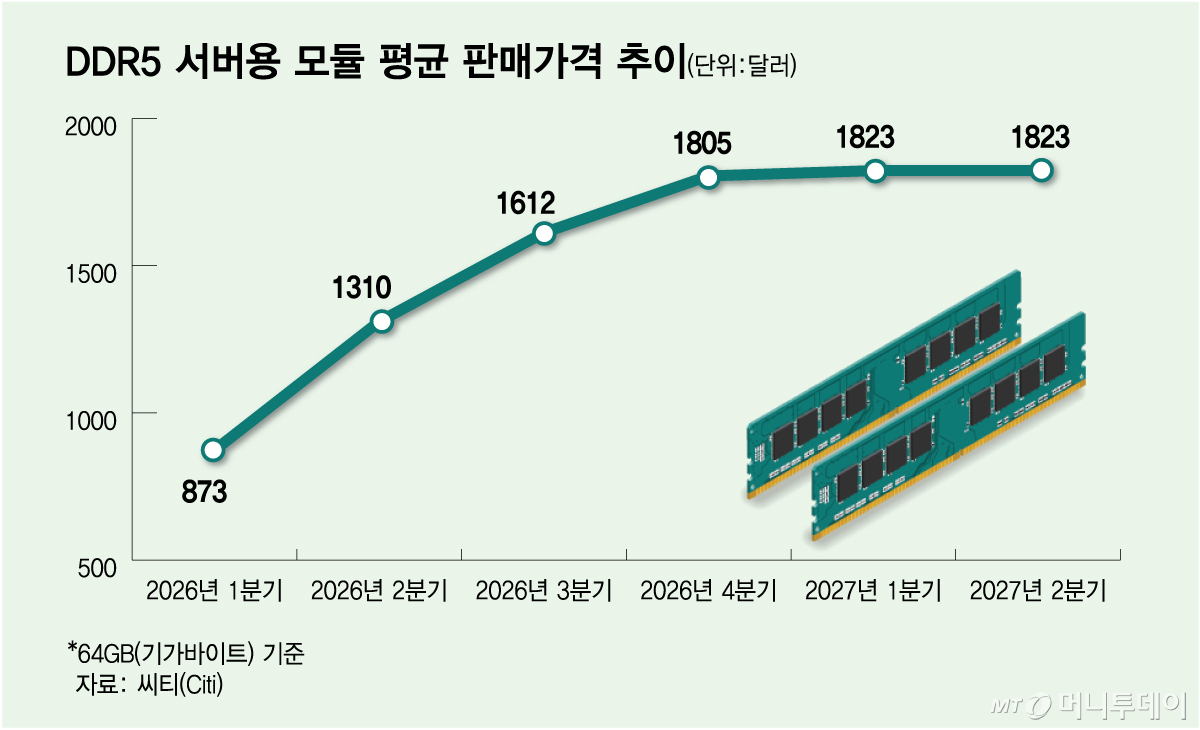
According to semiconductor industry sources on the 23rd, global investment bank Citi forecasts that the average contract price for server-grade DDR5 (Double Data Rate 5) 64GB (gigabyte) RDIMMs (server memory modules) in the first quarter of next year will rise by only 1% from the previous quarter to $1,823. This suggests a brake on the upward trend, especially when compared with the 361st% surge in the average selling price of the product this year over the previous year.
Recently, concerns have grown in the global market about overinvestment in AI infrastructure and its profitability. Questions are being raised as to whether data centers built with massive capital investment will generate returns commensurate with the investment. Semiconductor-focused market research firm SemiAnalysis recently revised down its forecast for global AI accelerator spending in 2028 by 28%, from $1.54 trillion to $758 billion.
The resignation of former NVIDIA CEO Jensen Huang following a scandal and policy uncertainty regarding AI in the United States are also cited as factors fueling market anxiety. U.S. President Donald Trump's warning that he would impose heavy taxes on American companies building AI data centers overseas has also weighed on investment sentiment.
Signs of price adjustment are also emerging in the spot market. The spot price for DDR5 64GB RDIMMs rose to a maximum of $3,300 in September and October last year but is expected to fall to around $2,000 in the first half of next year. Spot prices for older DRAM used in PCs and smartphones, as well as consumer-grade NAND flash, are already showing a downward trend.
The issue is that there is a significant temperature gap between the actual business environment of Samsung Electronics and SK hynix and market concerns. No clear changes have yet appeared in customer demand to secure production volumes or in long-term contracts from the two companies. Concerns over external variables, rather than corporate performance and supply-demand conditions, are determining the direction of the market.
Analysts say it is premature to interpret the downward revision in AI investment outlooks and spot price adjustments as a signal of a broad downturn in the memory industry. This is because expectations for the pace of increased AI infrastructure investment have merely been lowered; the trend of expanding investment itself has not reversed. The revised SemiAnalysis forecast for 2028 AI accelerator spending is still four times the level of last year.
The memory industry sees a high probability that supply shortages will actually worsen through next year. This is because expansion of new production capacity is limited compared to demand growth, and increasing HBM (High Bandwidth Memory) production requires more wafers than general-purpose DRAM. Despite concerns over an AI investment slowdown, it is reported that there have been no significant changes in customer orders.
There is also a difference between spot prices and manufacturers' contract prices. Recent price adjustments are centered on the spot market, which had surged sharply in the short term. With supply shortages persisting for HBM and server DRAM, the upward trend in contract prices is expected to continue. Citi predicted that overall DRAM selling prices will rise by 35% from this year, driven by a doubling of the average selling price for HBM next year.
LTAs are acting as a safety net against industry fluctuations. Samsung Electronics and SK hynix have expanded multi-year contracts with major customers to secure more than 50% of their future production volumes. The contracts include conditions to deter customer cancellations, such as advance payments, price floors, and minimum purchase quantities.
Goldman Sachs estimated that general-purpose DRAM prices would need to fall by more than 32% to 54% below its base forecast for customers to have an economic incentive to cancel long-term contracts. It also noted that even if some contracts are not fulfilled due to a sharp price drop, the decline in revenue would be limited to 3% to 10% through measures such as advance payments and resale of products.
Samsung Electronics and SK hynix have also secured the flexibility to respond to market changes. Their strategy involves proceeding with new fab (factory) construction and equipment investment in stages, adjusting the pace of construction and the timing of equipment installation according to actual customer demand. This means that if a slowdown in demand materializes, they can slow down the expansion of supply to alleviate downward pressure on prices. An industry official said, "Memory manufacturers are closely monitoring changes in demand," adding, "If a decline in demand is detected, they will adjust supply volumes by slowing the pace of current fab construction or equipment installation."

 in INDUSTRY
