

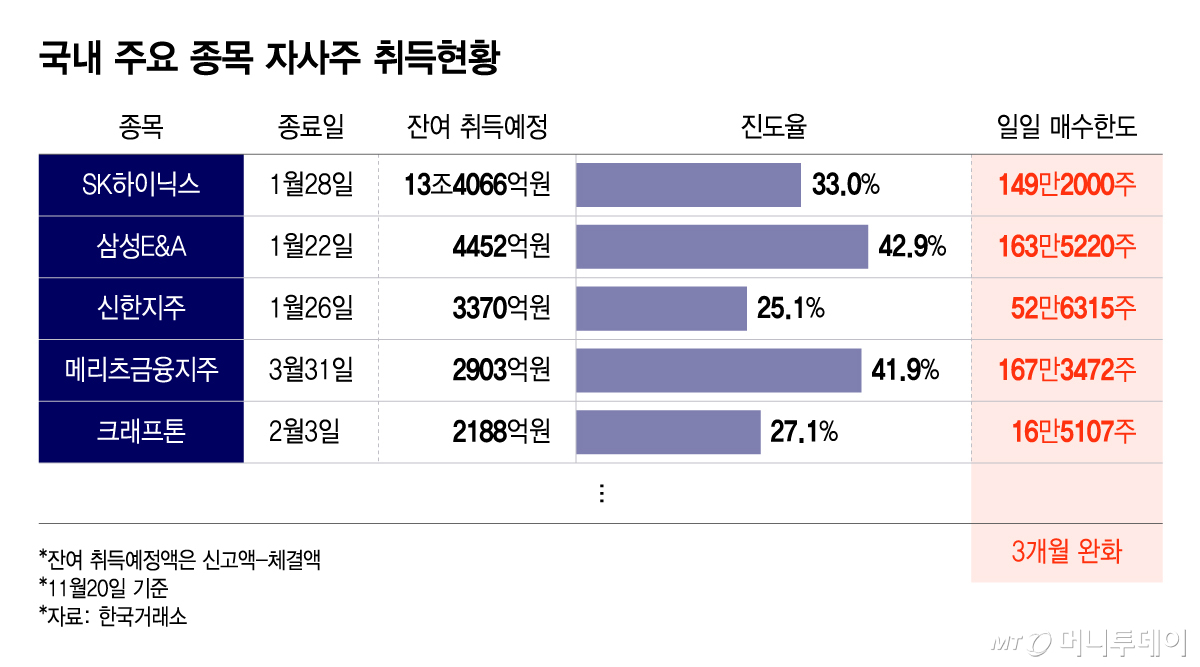
The impact of the Financial Services Commission's decision to ease the daily limit on share buybacks, which takes effect on Nov. 24, is expected to depend on how much SK hynix buys on the open market.
This is because of the company's influence on the stock market due to its market capitalization and the fact that most of the funds available for immediate share buybacks are concentrated in its stock.
According to a review of share buyback plan disclosures on the Korea Exchange's KIND disclosure system on Nov. 23, 181 listed companies had remaining buyback limits as of the previous trading day: 59 conducting direct purchases and 122 through trust contracts.
Their combined remaining amount totaled 15.5086 trillion won, comprising 14.7847 trillion won in direct purchases and 724 billion won under trust contracts.
By stock, SK hynix alone accounted for 86.4% of the entire market with a remaining amount of 13.4066 trillion won. After reporting a treasury stock acquisition of 20.077 trillion won on the 28th of last month, SK hynix purchased 33.0% of the reported amount on-exchange by the 20th of this month.
SK hynix was found to have purchased an average of 311,765 shares per day (range: 250,000–350,000 shares) over 17 trading days, which amounted to only 20.9% (range: 16.8%–23.4%) of the previous daily purchase limit (1,492,000 shares).
Whether it will maintain a split-purchase approach considering average acquisition price management, or turn to aggressive buying on the back of falling stock prices and the eased limits, is a key variable for the direction of the index.
The remaining 180 companies have only 2.102 trillion won left. By market, 69 KOSPI-listed companies have 1.978 trillion won, and 111 KOSDAQ-listed companies have 124.1 billion won, which is less than half of last week’s net foreign selling on the KOSPI (4.5159 trillion won). This clearly limits the ability to support the index with stocks other than SK hynix.
Companies such as Samsung E&A (remaining amount 445.2 billion won), Shinhan Financial Group (337 billion won), Meritz Financial Group (290.3 billion won), Hana Financial Group (177.1 billion won), BNK Financial Group (41.6 billion won), and JB Financial Group (40.7 billion won) have purchasing power exceeding their average daily trading value, allowing them to attempt short-term stock price support. However, given their relatively small market capitalizations, it is difficult to expect a strong stock market boost effect.
Among listed companies whose disclosed treasury stock acquisition end dates are after the 24th, 143 have completed executions for more than 99.0% of their reported amounts.
Hanwha Aerospace (reported amount 149.6 billion won), KB Financial Group (700 billion won), and Celltrion (100 billion won) have exhausted their purchasing power, while Samsung Electronics (15 trillion won) ended its purchase period on the 21st.
Some are also paying attention to the possibility that listed companies may attempt new share buybacks following this limit easing.
This is because there is precedent where KOSPI and KOSDAQ-listed companies disclosing share buybacks in the three months immediately after the limit easing in March 2020 increased by approximately 1.9 times compared to the previous three months.
However, counterarguments also emerge that it is difficult to expect immediate supply-demand improvement, considering the time required for board resolutions and disclosure procedures.
Due to the challenging conditions for share buybacks, market attention is focused on the Securities Market Stabilization Fund (10.76 trillion won), whose activation possibility has increased following remarks by Lee Hyoung-il, Deputy Prime Minister and Minister of Economy and Finance, on this day, after the emergency market situation review meeting (F4 meeting) held the previous day.
In the year following the execution of the Securities Market Stabilization Fund in 2003 and 2008, the KOSPI rose by 41.3% and 42.0%, respectively. There is also precedent where the KOSPI formed short-term lows solely on the announcement of preparation for the fund without actual capital injection in 2020 and 2022.
Jeong Da-un, a research analyst at LS Securities, said, “It may be difficult to reverse the trend with the Securities Market Stabilization Fund alone, but it is worth expecting its role as a safety net to suppress irrational panic selling in a market with thin order books.”
High-intensity market measures emerging one after another in Asian stock markets are fueling arguments for early execution of the domestic Securities Market Stabilization Fund.
Following the injection of the National Financial Stability Fund into the market in early this month, Taiwan implemented measures on the 23rd, including restrictions on short selling (prohibition of orders below the previous day’s closing price) and raising margin requirements. China has also been managing supply and demand by lowering interest rates on share buyback funds and suspending initial public offerings since early this month.
Jo Byung-hyun, a research analyst at Daol Investment Securities, said, “The Taiwan stock market experienced a sharp rebound for four trading days immediately after stabilization measures in early this month, yet still suffered its largest crash since 1991 last week.”
He added, “While policy cannot change direction all at once, it can be meaningful in that it slows the pace of decline and buys time.”

 in STOCK
