

Hyundai Glovis is accelerating its efforts to pioneer the E2E (End-to-End) logistics market, taking responsibility from maritime transport all the way to final delivery at dealerships. In response to the surge in car exports from China, the company is securing a large number of ultra-large car carriers while expanding integrated logistics services that link overseas ports with inland transportation.
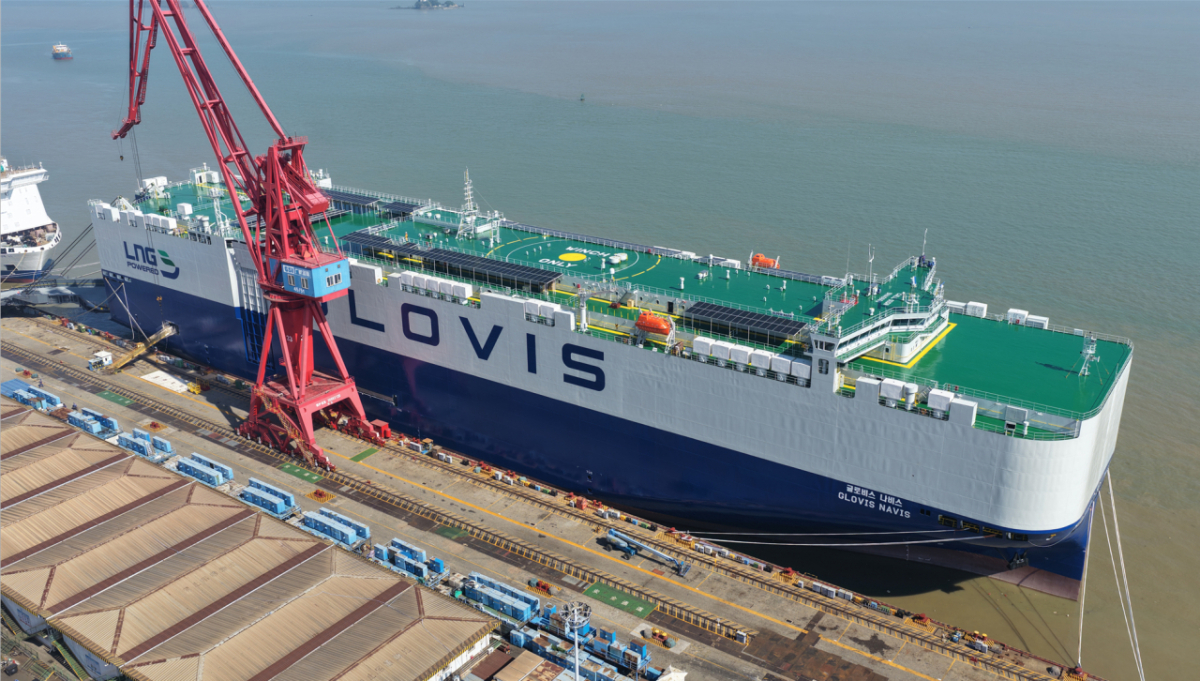
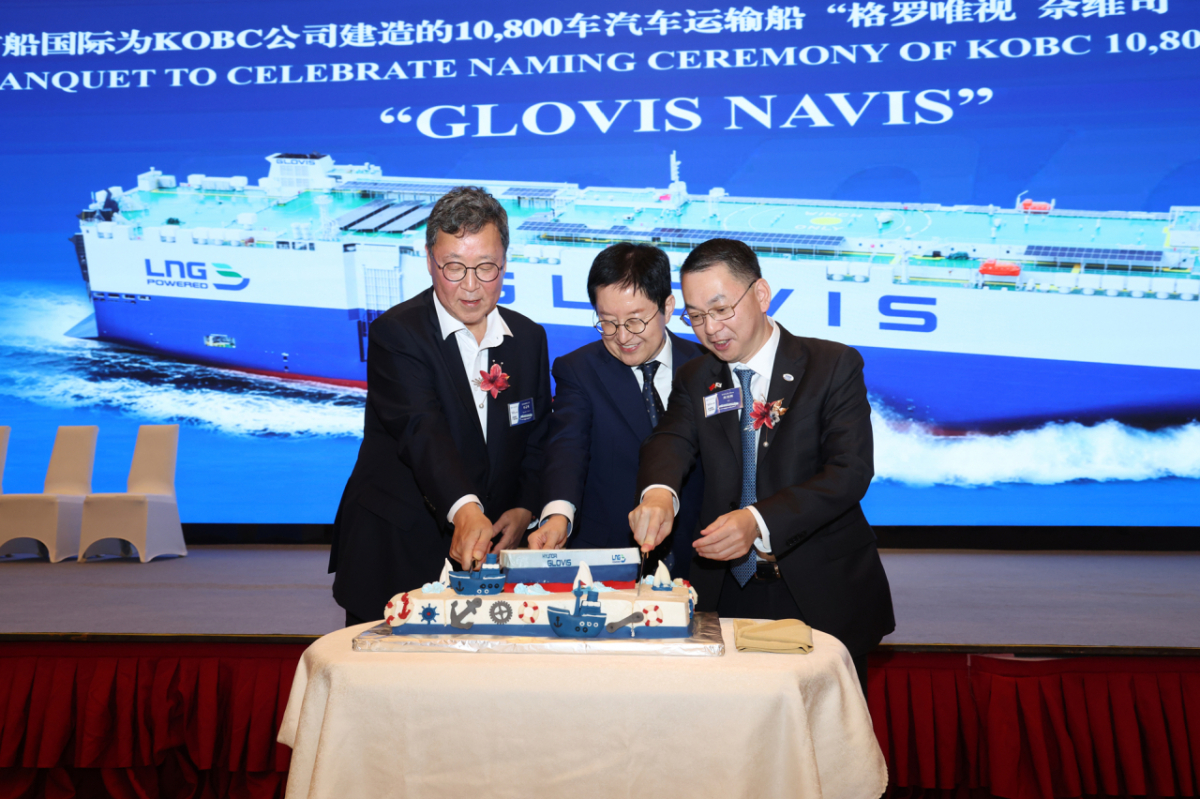
On the 26th, Hyundai Glovis held the naming ceremony for the world’s largest pure car and truck carrier (PCTC), the ‘GLOVIS NAVIS,’ at the Guangzhou Shipyard International (GSI) shipyard in Guangzhou, Guangdong Province, China. The event was attended by Lee Gyu-bok, President of Hyundai Glovis, Kim Hyung-jun, Head of the Marine Strategy Division at the Korea Ocean Business Corporation (KOBC), and others.
The NAVIS measures 230 meters in length and 40 meters in width, with a capacity to carry up to 10,800 small cars per voyage. It is the seventh 10,000-car-class car carrier introduced by Hyundai Glovis this year. The vessel is equipped with liquefied natural gas (LNG) dual-fuel propulsion engines and can utilize shore power supply facilities (AMP), enabling it to comply with tightening international maritime environmental regulations.
Daily charter rate of $100,000… Even if ordered now, delivery in 2030
The surge in car exports from China is behind Hyundai Glovis’s rapid fleet expansion. The company estimates that China’s finished vehicle export volume could increase from approximately 7.1 million units last year to 12 million units this year. It forecasts that the figure could reach up to 15 million units next year.
Combined with route diversions due to Middle East conflicts and demand for replacing aging vessels, the shortage of car carriers is trending toward long-term persistence. The daily charter rate for car carriers, which had stabilized downward last year, has surged again this year to around $100,000.
Kim Jung-seok, Head of the Shipping Business Division at Hyundai Glovis (Senior Executive Vice President), stated at a press conference held on the 25th at the Guangzhou Marriott Nansha Hotel, “Even if you place an order now, the earliest delivery would be in the second half of 2030 or in 2031,” predicting that structural capacity shortages will continue from 2027 through the early 2030s.
The car carrier market is an oligopoly dominated by a small number of shipping lines with long-term transport contracts with finished vehicle manufacturers. Since securing stable cargo volumes is a prerequisite for large-scale vessel investment, it is difficult to increase supply in the short term. A Hyundai Glovis official explained that the company is pushing fleet expansion as this market characteristic coincides with the period for replacing vessels with eco-friendly ships.
Following the surge in charter rates after the pandemic, Hyundai Glovis proactively invested in 30 car carriers, including owned vessels and long-term charters. Of these, 20 are ultra-large vessels with a capacity of 10,800 cars, to be delivered sequentially: eight this year, 10 next year, and two in 2028.
President Lee said, “Because charter rates rose first, costs spiked immediately, and freight rates followed suit. To respond to this, we ordered 30 vessels through long-term charters and ownership.”
BYD is also shipping by sea… Hyundai Glovis solidifies its No. 1 position in China’s transport market
Hyundai Glovis seeks differentiation from Chinese shipping lines not only in fleet size but also in service quality. The company is expanding the integrated logistics capabilities accumulated through managing export logistics for Hyundai Motor and Kia to global customers.
Lee Gyu-bok, President of Hyundai Glovis, emphasized at a press conference held on the 25th in Guangzhou, China, that “other shipping lines only provide maritime transport services up to the port of arrival,” adding, “Hyundai Glovis aims to provide E2E services to customers for both finished vehicles and containers.”
The core of this service is providing a single integrated solution covering maritime transport, port unloading, inland transportation via rail and truck, and final delivery to dealerships. The company is also developing a system that allows customers to track vehicle locations and estimated arrival times up to the final destination based on the Vehicle Identification Number (VIN).
This year, the company has also begun pioneering inland transport linkage services centered on Northern Europe. It plans to secure infrastructure connecting all logistics processes, including port yard storage capacity, unloading capabilities, rail networks, and data systems. President Lee stated, “We are developing a system to solidify customer lock-in as a competitive advantage, not simply through fare differences.”

 in INDUSTRY

