

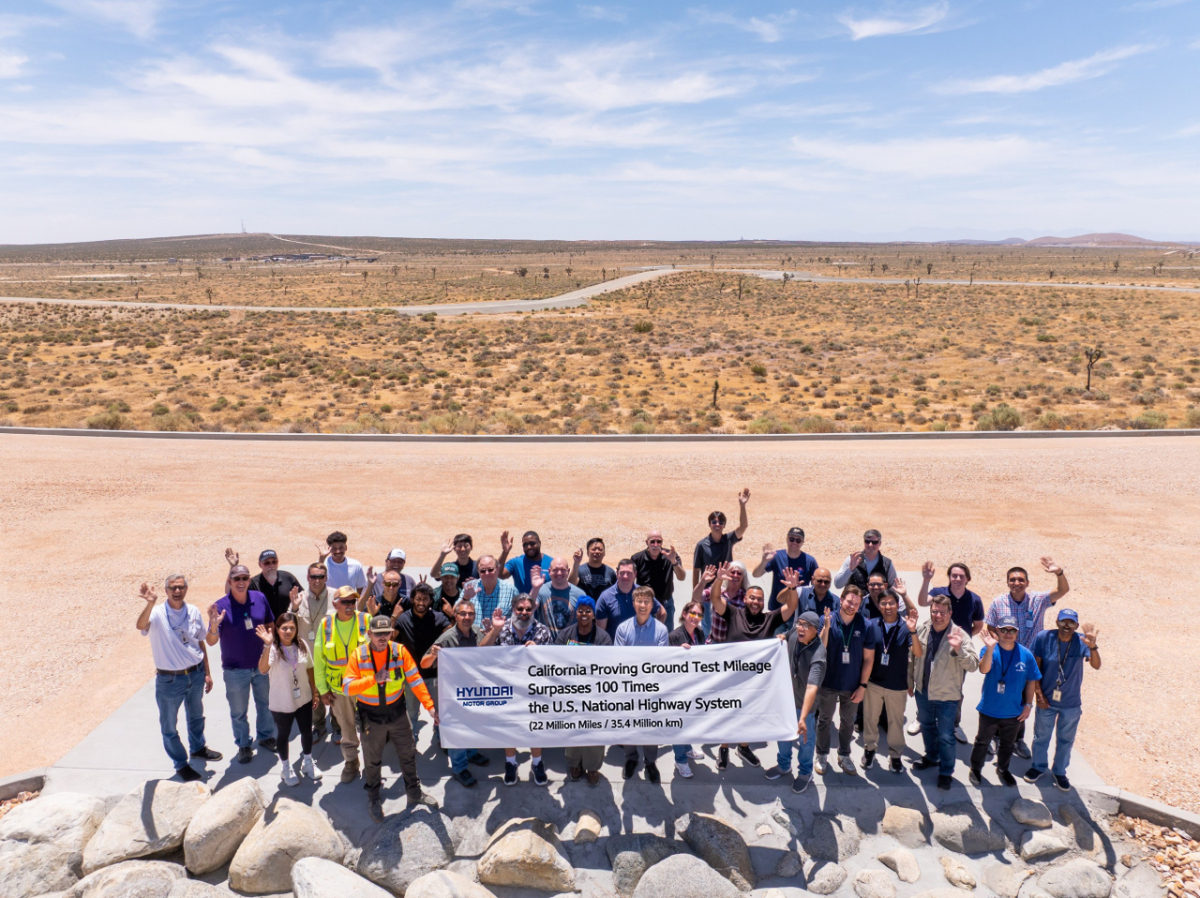
Hyundai Motor Group announced on the 29th that the cumulative test distance at its California test track, a key research and development (R&D) hub in the United States, has surpassed 22 million miles (35.4 million kilometers). This is the result of verifying vehicle performance and durability by driving a distance approximately 100 times the total length of the U.S. National Highway System over more than 20 years since its establishment in 2005. This distance is equivalent to circling the Earth approximately 883 times or making a round trip between the Earth and the Moon about 46 times. Assuming continuous driving at 100 kilometers per hour for 24 hours a day without rest, it would take approximately 40 years.
Located on a site of approximately 17.7 million square meters within the Mojave Desert, this test track is equipped with 14 test courses, including high-speed ovals, off-road tracks, and material environmental durability facilities. Under conditions of summer temperatures exceeding 45 degrees Celsius and solar radiation of over 1,000 watts per square meter, it verifies the thermal management performance of batteries and motors in electric vehicles and hybrid electric vehicles (HEVs). Additionally, using a 10.3-kilometer high-speed oval and an acceleration durability track, it applies harsh conditions equivalent to 10 times those of general roads to conduct body and braking durability tests.
In line with the transition to electrification and autonomous driving, the scope of verification has also expanded. On test tracks replicating 18 types of local North American road surfaces, the quietness and ride comfort of electric vehicles are tuned. On off-road test tracks, which have increased to seven, wheel slip control in electrified models and repeated driving performance in high-performance vehicles are checked. Simultaneously, it is verifying the recognition accuracy of autonomous driving sensors and Advanced Driver Assistance Systems (ADAS), the safety under high load for hydrogen fuel cell vehicles, and component durability using solar tracking panels.
This verification capability has translated into local market results and external evaluations. Since entering the U.S. market in 1986, Hyundai Motor Group entered the era of 30 million cumulative sales this year and achieved 2 million cumulative sales of eco-friendly vehicles locally in August last month. Furthermore, it has won a total of 25 awards, including 15 top prizes, at the world's three major automotive awards: "World Car of the Year," "North American Car of the Year," and "European Car of the Year." It is also achieving results in global automotive media evaluations, such as winning Top Gear Awards for six consecutive years.
A Hyundai Motor Group official stated, "By advancing our driving test infrastructure to continuously verify vehicles under conditions harsher than actual roads, in addition to precise design, analysis, and simulation, we plan to ensure customer safety and trust in the era of electrification, autonomous driving, and high-performance vehicles."

 in INDUSTRY
