

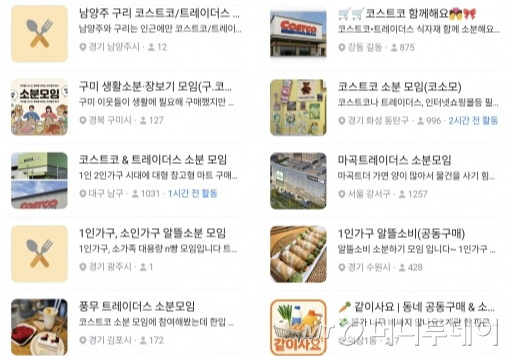
#. A 34-year-old office worker joined a "small-portion gathering" after seeing a post on the secondhand trading community Danggeun earlier this year that read, "Looking for someone to shop together at Trader's." The gatherings involve 5 or 6 people coming together at E-Mart Trader's to purchase large-volume items such as meat, frozen foods, and bread, then dividing them according to individual needs. Participants join the gatherings once a month because they can obtain only the amount they need of large-volume products that are difficult to buy all at once on their own.
With high inflation and an increase in single-person households, small-portion gatherings where consumers jointly purchase and divide large-volume items at warehouse-style discount stores have established themselves as a new consumption culture. More consumers are seeking to reduce the burden of grocery shopping by leveraging the price competitiveness of warehouse-style discount stores, which offer better prices for larger quantities.
According to industry sources on the 3rd, posts recruiting participants with titles such as "Large-volume supermarket ingredient small-portion gatherings" and "Trader's·Costco small-portion sharing" can be easily found on online communities like Naver Cafes and Danggeun.
Small-portion gatherings are particularly active among one- and two-person households. Warehouse-style discount stores sell large volumes at low prices, but the quantities are often too much for a single person to use, leading many to hesitate before purchasing. Small-portion gatherings offer the advantage of reducing per-person purchase costs while minimizing food waste and inventory burdens.
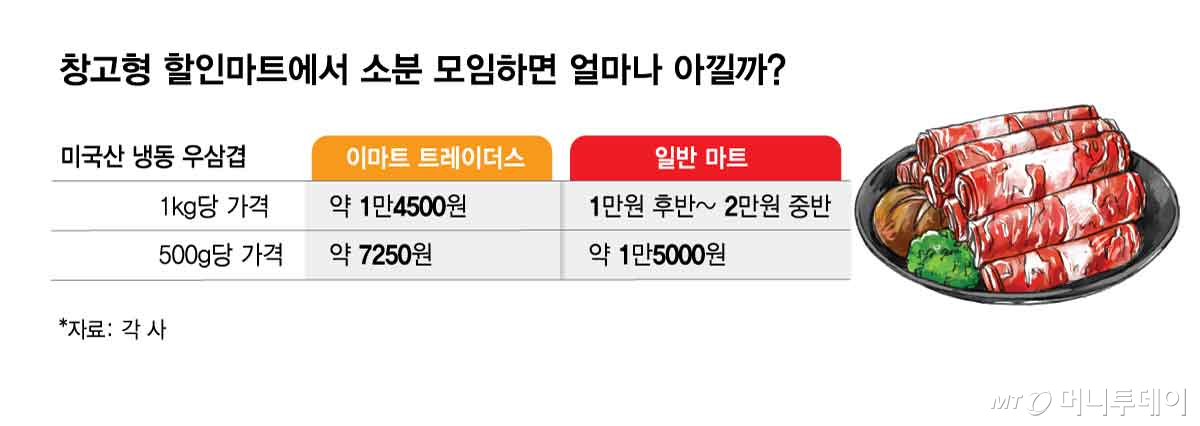
Price competitiveness is cited as the biggest factor driving the spread of small-portion consumption. For example, frozen American beef brisket sold at E-Mart Trader's costs 47,980 won for 3.3 kg, putting the price per kilogram at around 14,500 won. In contrast, frozen American beef brisket at general large-scale department stores ranges from just over 10,000 won to mid-20,000 won per kilogram. Small-packaged products of around 500 grams often cost around 15,000 won. For one- or two-person households needing only about 500 grams, small-portion gatherings allow them to purchase at nearly half the price of small-packaged products at general supermarkets.
As more consumers visit warehouse-style discount stores, leading companies like E-Mart Trader's are continuing their growth trend. E-Mart Trader's sales for the first half of this year reached 2.05 trillion won, a 10 percent increase compared to the same period last year.
Interest in small-portion gatherings is also on the rise. According to a survey by market research firm Embrain on warehouse-style discount store usage and small-portion gathering consumers, 53.8 percent of respondents said they were aware of such gatherings, while 39.6 percent expressed interest in using them in the future. When asked why they would like to participate (multiple responses allowed), "able to purchase only the needed amount" ranked highest at 52.8 percent, followed by "reduced price burden" at 50 percent, "able to consume large-volume products rationally" at 44.2 percent, and "able to reduce waste" at 40.4 percent.
The survey also found that consumers hope warehouse-style discount stores will introduce small-portion functions. Regarding what they would like to see at warehouse-style discount stores, 46.3 percent cited "dedicated spaces for small-portioning and small-packaging within the store," while 36.5 percent pointed to "services where staff portion products on the spot."
A retail industry official stated, "In the past, warehouse-style discount stores were strongly perceived as channels mainly for large families or self-employed business owners, but recently there is a growing trend of one- and two-person households using them without burden through joint purchases and small-portioning. As high inflation continues, the way consumers use warehouse-style discount stores will evolve from 'bulk purchasing' to 'buying together and sharing consumption.'"

 in LIVING

