

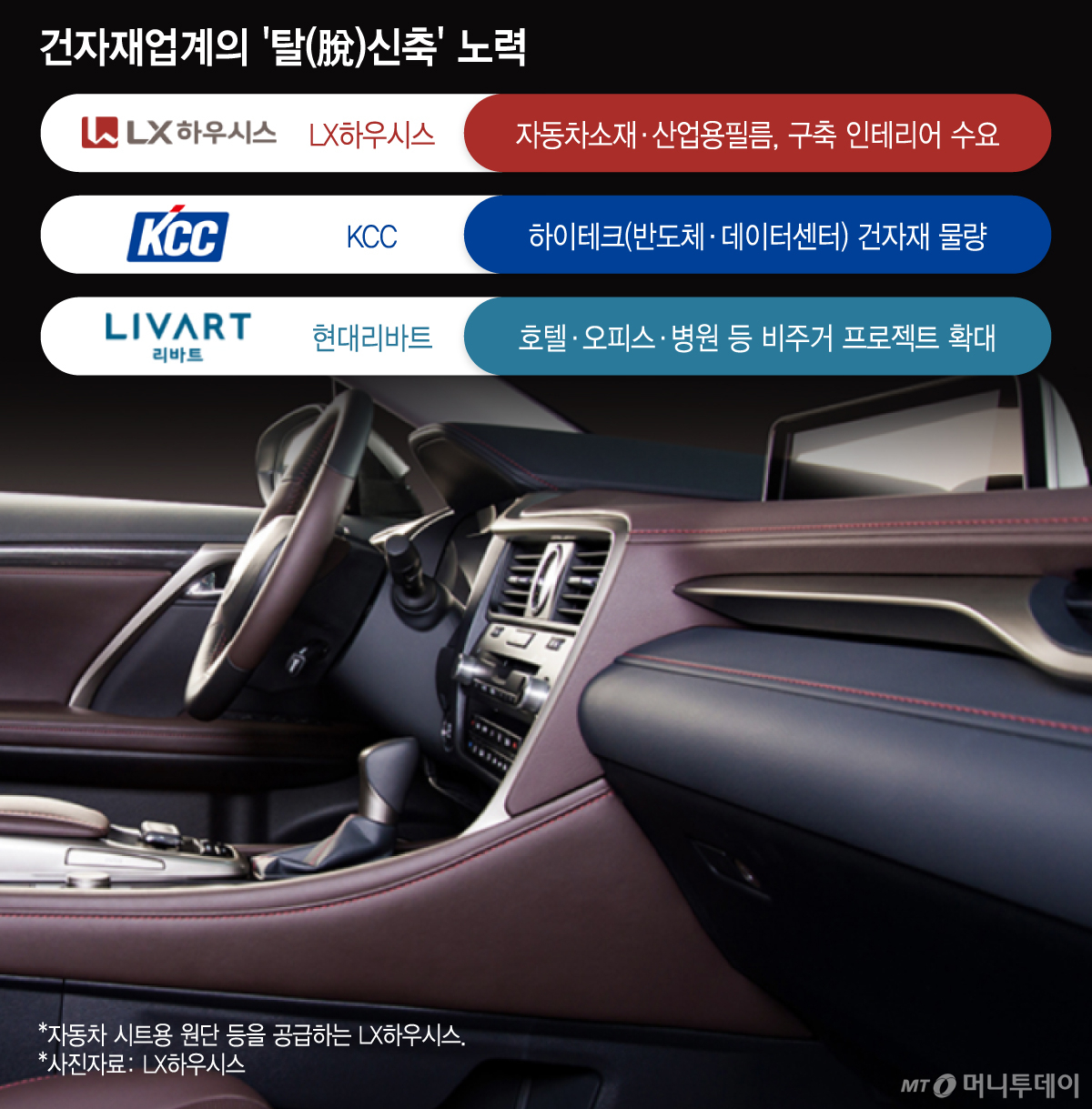
As new housing supply has sharply declined, the construction materials industry is busy improving its structure to reduce dependence on the new construction market. Companies that have expanded their business portfolios with automotive materials, high-tech construction materials, and silicon are successfully defending their performance despite the downturn in the construction sector, establishing a new growth strategy to endure the prolonged recession.
According to industry sources on the 5th, LX Hausys' operating profit for the second quarter of this year was recorded at 54.9 billion won, a 329% increase compared to the same period last year. This was driven by increased B2C (business-to-consumer) demand for built-in interiors and renovations, along with consecutive quarterly growth in sales of automotive materials and industrial films.
LX Hausys' automotive materials and industrial film business has steadily grown its presence. The share of related revenue expanded from 27.1% in 2023 to 32.9% last year. In contrast, the share of construction materials dropped from 72.8% to 67.1% during the same period. Automotive materials are used for interior and exterior fabrics and parts of finished vehicles, while industrial films are applied in home appliances, electronics, and industrial materials, making them relatively less affected by the construction market.
This trend is increasingly evident as expectations for new housing supply have waned. According to the Ministry of Land, Infrastructure and Transport, the number of newly completed homes nationwide in the first half of this year was 103,735 units, a 49.5% decrease compared to the same period last year. Permits also fell by 15.8% to 116,611 units. The environment has become such that it is difficult to expect growth in the construction materials industry by simply waiting for a recovery in housing supply.
A similar trend was confirmed in KCC's performance for the second quarter of this year. KCC's consolidated revenue for the second quarter reached 180.6 billion won, up 7.2% from the same period last year. Operating profit (128.9 billion won) decreased by 13.1%, but still exceeded the securities industry consensus estimate (111.2 billion won) by about 16%, surpassing market expectations.
KCC attributed its performance improvement to increased high-tech material volumes boosting results in the construction materials segment and expanded sales of high-value-added silicon products. High-tech construction materials are functional building materials used in advanced manufacturing facilities such as semiconductor clusters and data centers, featuring larger project scales and higher value-added compared to general construction materials. KCC explained that its diversified business portfolio helped defend against a decline in profitability.
In contrast, Hyundai Rebat was fully impacted by the cliff in new housing supply. Although it operates in the construction materials sector, its business structure has a high proportion of furniture, leading to a 9% year-on-year decrease in second-quarter sales to 373.1 billion won. A Hyundai Rebat official stated, "As the construction market slowdown continues, the supply volume of built-in furniture has decreased."
Hyundai Rebat plans to diversify by expanding non-residential projects such as hotels, offices, and hospitals, and entering the FF&E (Furniture, Fixtures, and Equipment) business that supplies furniture, lighting, art pieces, and living accessories. Ship interior design is also a new project Hyundai Rebat expects to grow. However, given the high proportion of built-in furniture currently, it may take more time to establish a diversified portfolio.
A construction materials industry official said, "In the second half of this year, housing market weakness and volatility in raw material prices and freight rates due to instability in the Middle East are expected to continue." He added, "Companies that increase their share of high-value-added products and strengthen competitiveness in non-construction businesses will see even clearer differentiation."

 in LIVING
