

As the won/dollar exchange rate has fallen by about 140 won over two months to settle below the 1,420 won range, attention turns to whether this will relieve cost pressures on food companies and other manufacturers. However, industry insiders agree that it is difficult to immediately feel the impact of recent exchange rate changes in actual business operations due to long-term contracts lasting six months or more and still-high raw material prices.
According to industry sources on the 6th, food companies and mid-sized and small manufacturing firms view the recent stabilization of the exchange rate as a positive signal for reducing cost burdens. The won/dollar exchange rate closed at 1,424.5 won, down 8.0 won from the previous day, and traded in the 1,410 won range during today's session. Compared to the peak of 1,561.5 won reached on June 8 — the highest since March 2009, marking a 17-year and three-month high — this represents a drop of more than 140 won.
The problem is that even if the exchange rate stabilizes, cost burdens do not immediately decrease. This is because raw materials secured through existing long-term contracts are currently being used in production, while international raw material prices remain at high levels.
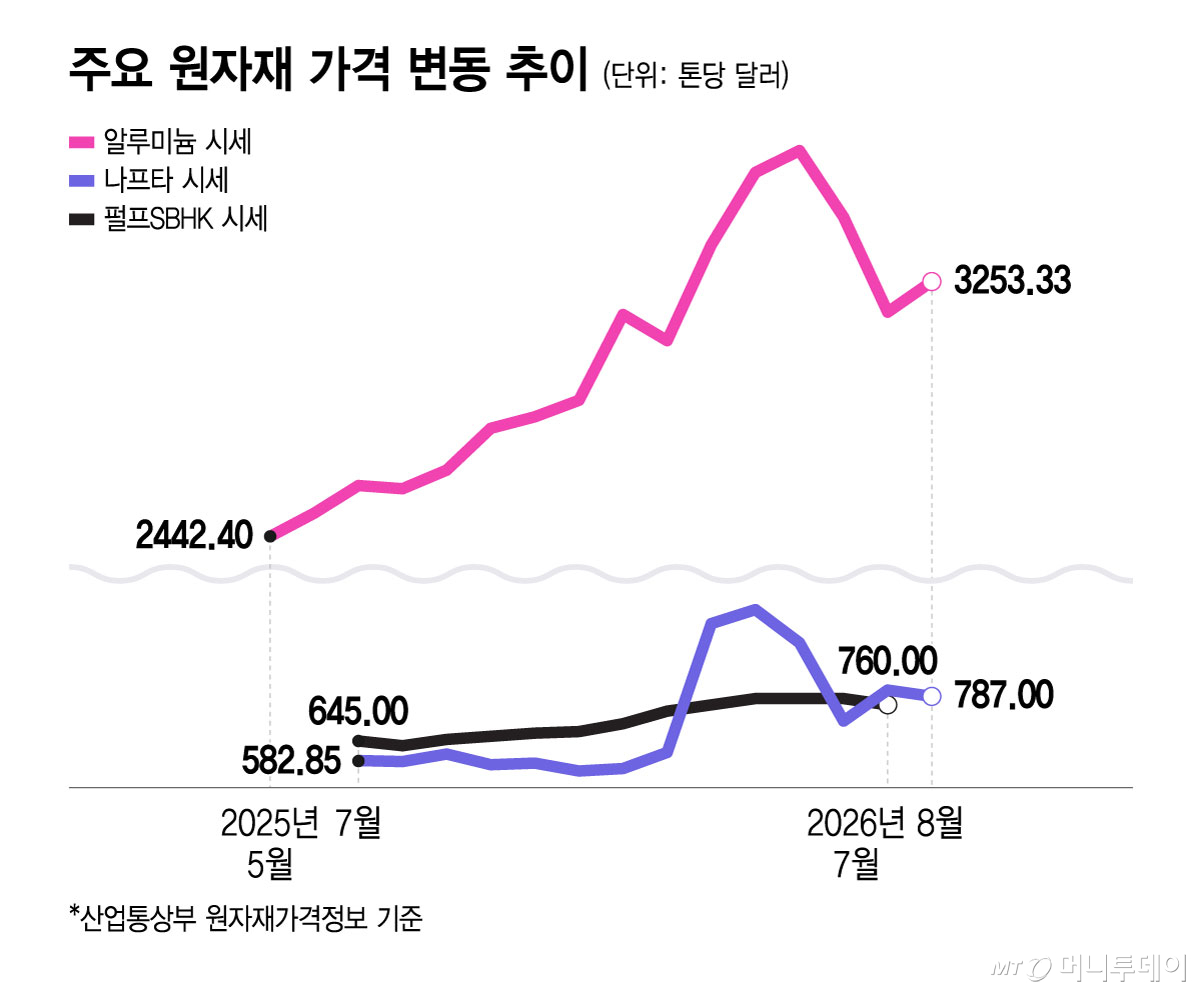
According to the Ministry of Trade, Industry and Energy's Raw Material Price Information, the price of PET (polyethylene terephthalate) used for packaging beverages and processed foods, as well as naphtha — the raw material for plastic packaging — averaged $797 this month (as of the 5th), which is 33.7% higher than the July average of last year ($582.85). Aluminum, a raw material for cans, also rose by more than 32%, from around $2,440 per ton in May last year to an average of $3,253 per ton this month.

Accumulated cost burdens are being reflected in product prices. CJ CheilJedang raised prices for 27 items across eight categories, including Hae-ttan (instant rice), mandu (dumplings), and grilled fish, by an average of 8%. Nongshim increased the ex-factory prices for 43 brands — including 18 cup noodle varieties, 23 snacks, and two beverages — by an average of 5.8% starting from the 1st of this month. Pulmuone will also raise consumer prices for 30 items across seven product categories, including snacks, kimchi, and dumplings, by an average of 6.7% starting on the 13th.
An executive at a beverage manufacturing company stated, "Even the 1,400 won range cannot be considered a low exchange rate; given the nature of food products, it is more important that supply chains for securing raw materials remain stable than fluctuations in exchange gains or losses." Another executive from a different beverage company added, "Major raw materials are already under supply contracts arranged on a six-month basis," noting that "exchange rate fluctuations occurring on a weekly basis have almost no impact on costs."

The situation is similar for mid-sized and small manufacturing firms. Explanations indicate that effects will appear with delays due to differences in contract structures and business conditions across industries. The paper industry faces pressure from rising pulp prices. The international price of softwood bleached chemical pulp (SBHK) rose by more than 20% to $760 per ton in July, compared to around $645 per ton in July last year. An executive at Asia Pulp & Paper stated, "Reduced exchange rate volatility will improve predictability and help with future contracts."
The construction materials and paint industries operate on a structure where PVC and raw materials are settled in dollars, so a drop in the exchange rate reduces import cost burdens. However, given the prolonged slump in the construction market, industry responses indicate that business conditions remain a more significant variable than exchange rates. The furniture industry also expects effects to appear only from new purchases after the end of the year, as existing contracted volumes and inventory remain.
Industry sources say that if this level of trend continues, gradual cost improvement effects could begin appearing from the fourth quarter at the earliest. An executive at the SME (small and medium-sized enterprise) Central Association stated, "Exchange rate stability is a positive factor in alleviating cost burdens for SMEs, but considering contracts and inventory, there will be a time lag before it is felt on the ground," adding, "What companies want is not short-term volatility but a stable exchange rate flow."

 in LIVING


