

The cement industry, hit hard by the slump in construction activity, is betting its survival on rationalization facility investments to improve its financial structure. With cement demand weak and factory utilization rates stuck at around 50%, companies are lowering costs through alternative fuels, waste heat power generation, and factory automation while boosting production efficiency, waiting only for a recovery in market conditions.
According to industry sources on the 18th, Hanil Cement is investing a total of 651.4 billion won in equipment from 2021 through 2028, including alternative fuel (recycled fuel) burners, kiln modifications, next-generation coolers, and waste heat power generation. About 500.5 billion won has been spent so far, with an additional 150.9 billion won planned for investment as scheduled. Hanil Cement's alternative fuel substitution rate has reached 48.8%, and its waste heat power generation substitution rate has risen to 22.1%. This allows the company to secure alternative fuels to replace thermal coal and generate electricity from waste heat, reducing manufacturing costs such as fuel and electricity expenses and carbon emission-related charges.
Sambo Cement also generated about 65 GWh of electricity through waste heat recovery power generation at its Samcheok plant last year, substituting for 11% of its total electricity usage. It replaced one clinker cooler last year and plans to replace two more by early October this year. High-efficiency coolers improve heat recovery rates, reduce fuel consumption, and help cut production process costs.
Seongsin Yanghoe invested 172.1 billion won from 2020 through last year in energy efficiency improvements, including kiln facilities and alternative fuel injection systems. By improving kiln efficiency, it reduced thermal coal and electricity usage, raising its recycled fuel substitution rate to 38.5% last year.
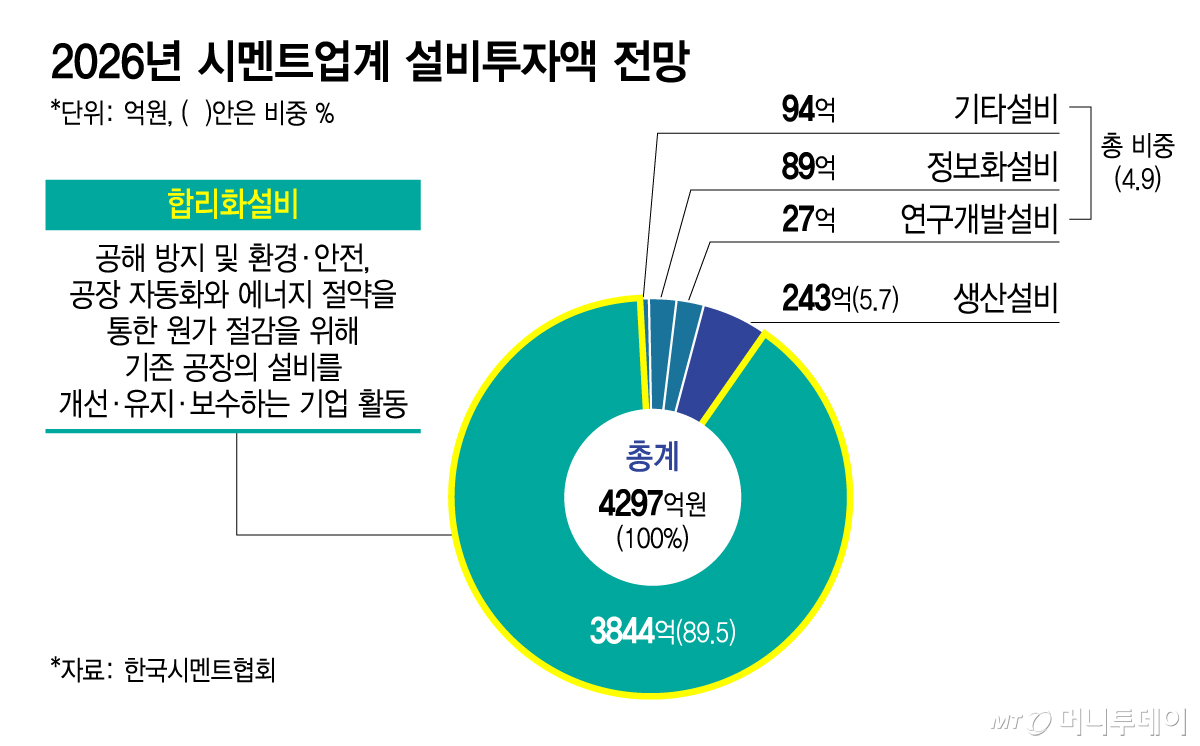
According to the Korea Cement Association, of this year's planned equipment investment of 429.7 billion won by the cement industry, 384.4 billion won (89.5%) is expected to be allocated to "rationalization facilities" related to maintenance and repair, environmental and safety measures, and energy conservation. While total investment is down about 10% from last year, the share devoted to rationalization facilities has grown larger.
The reason the cement industry is focusing so intensely on cost reduction is that weak demand has persisted for an extended period. In the first half of this year, consolidated operating profits for Asia Cement and Sambo Cement fell by 30.8% and 28.9%, respectively, compared to the same period last year, reaching 35 billion won and 21.7 billion won. Hanil Cement's cement division operating profit also dropped by more than half, from 28.2 billion won to 13.8 billion won.
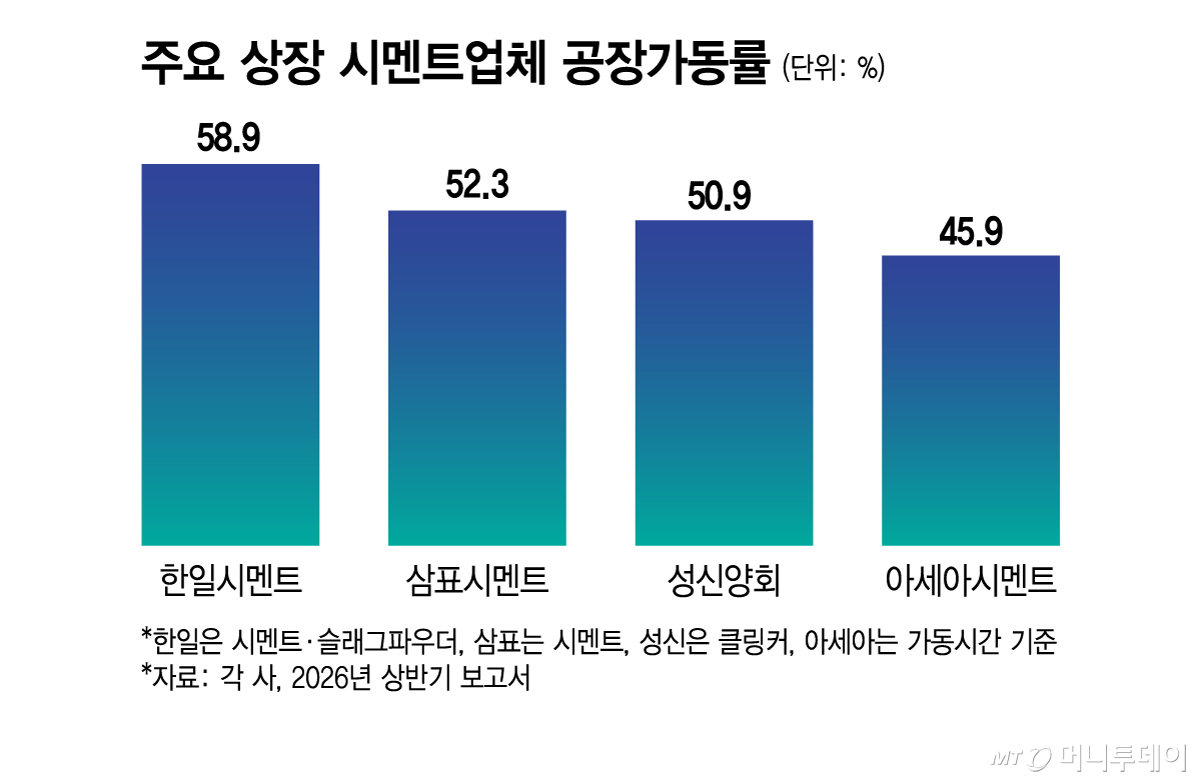
Factory utilization rates have remained below 50% for several recent years. In the first half of this year, Hanil Cement operated at 58.9%, Sambo Cement at 52.3%, Asia Cement's Jecheon plant at 45.9%, and Seongsin Yanghoe at 50.9%. All major listed cement companies recorded utilization rates below 60%.
A sharp recovery in demand is not expected immediately. Hanil Cement forecasts that domestic cement shipments this year will reach around 38.5 million to 39 million tons, similar to last year's record low of about 38.1 million tons. While there is a possibility for shipment improvements in the second half, analysts say it is too early to call it a full-scale demand recovery because housing supply recovery has been delayed.
The industry expects meaningful shipment rebounds only by the second half of next year, when large-scale housing supply and major projects such as industrial facilities in the Honam region begin construction. Having spared no expense on rationalization facilities despite prolonged profitability struggles, companies anticipate that once shipments rebound, profits will also grow alongside cost efficiency gains.
A cement industry official said, "Ultimately, if shipments do not rebound, the industry cannot revive," and added, "Given our investments in cost efficiency to address environmental regulations such as carbon reduction, we are continuously exploring ways to further enhance cost competitiveness."

 in LIVING

